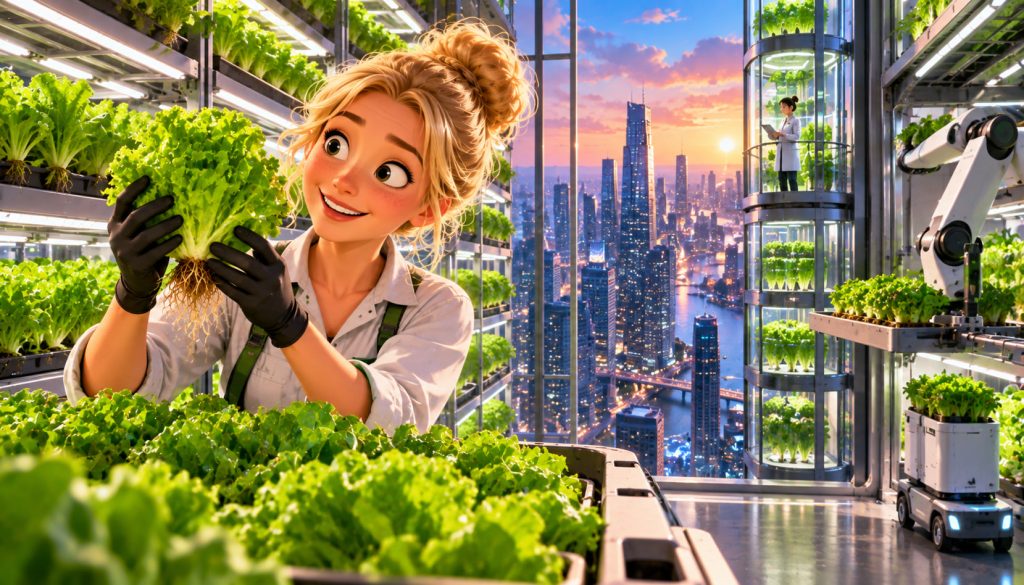
Cities consume enormous amounts of food, yet most of that food is grown far away.
Vegetables may travel hundreds or even thousands of kilometers before reaching supermarkets and restaurants. During that journey, freshness declines, transport uses energy, and part of the produce may be lost.
Vertical farming offers a very different model.
Instead of spreading crops across large fields, vertical farms grow plants in stacked layers inside buildings, warehouses, or specially designed towers.
For fast-growing crops such as lettuce, herbs, and leafy greens, this can turn urban buildings into highly controlled food-production systems.
What Is a Vertical Farm?
A vertical farm grows crops in multiple layers rather than on one horizontal field.
Plants may be stacked on shelves several meters high or arranged throughout an entire multi-story building.
Most modern vertical farms use controlled indoor environments.
They manage:
- Light
- Temperature
- Humidity
- Water
- Nutrients
- Airflow
- Carbon dioxide
- Plant spacing
This makes the growing environment much more predictable than outdoor agriculture.
A lettuce plant inside a vertical farm does not depend directly on rain, seasons, or changing daylight.
Why Lettuce Is Perfect for Vertical Farming
Not every crop works equally well indoors.
Lettuce is especially suitable because it grows relatively quickly, remains compact, and has a high market value compared with its size and weight.
It also does not require pollination.
Leafy greens such as spinach, arugula, basil, kale, and some Asian vegetables share many of these advantages.
A vertical farm can grow many layers of lettuce in the same floor area.
This means a small urban site can produce far more leafy vegetables per square meter than a conventional field.
However, that does not mean every type of agriculture can move into skyscrapers.
Wheat, corn, potatoes, and other calorie-rich crops usually require too much space and energy to make indoor production economical.
Soil Is Often Unnecessary
Most vertical farms do not use ordinary soil.
Instead, they rely on hydroponics, aeroponics, or related systems.
Hydroponics grows plants with their roots in water containing dissolved nutrients.
The roots may sit directly in flowing nutrient solution or in an inert support material.
Aeroponics takes a different approach.
Roots hang in the air and receive a fine mist containing water and nutrients.
These techniques give farmers very precise control over what plants receive.
The plant still needs the same essential minerals as a field-grown crop, but those nutrients are delivered directly to the roots.
Water Use Can Be Extremely Low
One of the strongest arguments for vertical farming is water efficiency.
Traditional agriculture can lose substantial amounts of water through evaporation, runoff, and drainage.
Indoor hydroponic systems can recirculate water.
Water that plants do not absorb can be collected, treated, and reused.
Even moisture released by plants into the air can sometimes be captured through dehumidification and returned to the system.
As a result, some vertical farms can use far less water per kilogram of lettuce than conventional field agriculture.
This is especially attractive in regions facing water scarcity.
LED Lighting Replaced the Sun
Indoor plants still require light for photosynthesis.
Because sunlight cannot efficiently reach many stacked growing layers, vertical farms usually rely heavily on LEDs.
Modern horticultural LEDs can produce wavelengths useful for plant growth while converting electricity into light much more efficiently than older lamps.
Different wavelengths influence different aspects of plant development.
Blue light can help regulate compact vegetative growth.
Red light is highly effective for photosynthesis.
Many modern farms use broader-spectrum lighting to balance growth, appearance, and plant quality.
Without efficient LEDs, large-scale vertical farming would be much less practical.
Why Not Just Use Windows?
A greenhouse can use sunlight directly.
A skyscraper farm has a harder problem.
Sunlight mainly reaches the outer surfaces of a building.
Crops stacked deep inside the structure would receive little natural light.
Designing every growing surface around windows can also create overheating and uneven illumination.
For these reasons, many commercial vertical farms resemble highly engineered indoor factories rather than glass skyscrapers filled entirely with natural sunlight.
Some future buildings may combine daylight with artificial lighting, but artificial light remains central to most high-density indoor farming systems.
A Computer Can Control the Entire Farm
Vertical farms are strongly connected to automation.
Sensors can continuously measure temperature, humidity, nutrient concentration, acidity, water flow, and light intensity.
Software can adjust pumps, fans, lights, and climate-control systems.
Cameras may monitor plant size and leaf color.
Artificial intelligence and computer vision can help detect disease, predict harvest times, and identify plants growing more slowly than expected.
This creates a form of precision agriculture in which thousands of plants can be monitored almost continuously.
Crops Can Grow All Year
Outdoor farms are tied to seasons.
Indoor vertical farms can operate throughout the year.
A lettuce crop can be planted and harvested in winter, summer, or during severe weather outside.
This allows predictable production schedules.
Supermarkets and restaurants can receive regular supplies without depending as heavily on seasonal harvests.
Multiple growing cycles per year are possible because temperature and light remain controlled.
The farm can effectively create the same ideal growing season every day of the year.
Farming Close to Consumers
One of the biggest potential advantages is location.
A vertical farm can operate inside or near a large city.
Lettuce harvested in the morning may reach a nearby store the same day.
Shorter transport distances can reduce refrigerated shipping and help preserve freshness.
Leafy vegetables are particularly suitable because they are delicate and contain a lot of water.
Transporting them long distances can be inefficient.
Urban production may also reduce some food losses caused by long supply chains.
Pesticide Use Can Be Reduced
Indoor farms are separated from many outdoor pests.
There are fewer insects entering from surrounding fields.
Weeds are essentially absent.
This can significantly reduce the need for conventional pesticides and herbicides.
But indoor farms are not automatically immune to biological problems.
Fungi, bacteria, insects, and plant diseases can still enter.
Because plants are grown close together, a disease can spread rapidly if hygiene and monitoring fail.
For this reason, vertical farms often operate with strict sanitation procedures.
The Biggest Problem Is Electricity
Vertical farming has a major weakness: energy use.
Sunlight is free.
LED lighting is not.
Electricity is needed not only for lights but also for pumps, cooling, heating, ventilation, dehumidification, sensors, and automation.
For some crops, electricity represents one of the largest operating costs.
If the electricity comes from fossil fuels, the environmental footprint can also become significant.
A water-efficient vertical farm is not automatically an energy-efficient farm.
This is one reason vertical farming makes most sense for high-value, fast-growing vegetables rather than staple grains.
Heat Must Be Removed
Every lamp and electronic device ultimately produces heat.
Thousands of LEDs operating inside an enclosed building can create a substantial cooling requirement.
Plants also release water vapor through transpiration.
If humidity becomes too high, fungal diseases can develop.
The farm therefore needs ventilation, air conditioning, and dehumidification.
Interestingly, some farms recover water from the humid air.
This demonstrates how tightly integrated the system can become.
Water, heat, light, and airflow all influence each other.
Can a Skyscraper Feed an Entire City?
Probably not by itself.
The popular image of a giant tower producing all the food for millions of people is attractive, but modern diets require enormous quantities of calories, proteins, oils, grains, fruits, and vegetables.
Vertical farms are much better at producing certain categories of fresh food.
They are particularly suited to leafy greens, herbs, seedlings, and some specialty crops.
A city would still need conventional agriculture for wheat, rice, corn, livestock feed, vegetable oils, and many other foods.
Vertical agriculture should therefore be seen as an addition to traditional farming rather than a complete replacement.
Expert Perspective
Agricultural researchers generally see controlled-environment agriculture as a valuable tool when it is matched to suitable crops and locations.
The strongest advantages include high yields per unit of land, reduced water consumption, year-round production, and short supply chains.
The biggest challenges remain electricity use, construction cost, equipment cost, and economic competitiveness.
Researchers also emphasize that sustainability depends heavily on the energy source.
A highly efficient farm powered by low-carbon electricity can have a very different environmental profile from the same farm powered by carbon-intensive electricity.
What Happens If the Power Goes Out?
Traditional field crops can survive temporarily without machinery.
Indoor vertical farms are more dependent on infrastructure.
A serious power failure can stop lighting, pumps, ventilation, and climate control.
Hydroponic roots may become stressed quickly if water circulation stops.
High temperatures or humidity can also develop.
Commercial farms therefore need backup systems, alarms, emergency power, and careful monitoring.
This dependence on technology is one of the trade-offs of extreme environmental control.
Could Skyscraper Farms Become Common?
The future may not look exactly like science-fiction towers covered entirely in vegetables.
Many successful vertical farms may instead operate inside warehouses, converted industrial buildings, supermarkets, or purpose-built facilities near cities.
But multi-story urban agriculture remains technically possible.
As LEDs become more efficient, automation improves, and renewable electricity expands, indoor farming could become more competitive.
The key question is not whether we can grow lettuce inside skyscrapers. We already can. The question is where doing so makes environmental and economic sense.
Interesting Facts
- Lettuce is one of the most common crops grown in commercial vertical farms.
- Many vertical farms use no agricultural soil at all.
- Hydroponic systems can recycle much of their water.
- Indoor farms can harvest crops throughout the year regardless of outdoor seasons.
- LED lighting allows crops to be stacked in layers where natural sunlight cannot reach.
- Different wavelengths of light can influence plant shape, growth, and photosynthesis.
- Vertical farms can produce very high yields per square meter of floor space.
- Weed control is minimal because ordinary soil is often absent.
- Urban farms can reduce the distance between harvest and consumer.
- Humidity produced by plants can be captured and converted back into usable water.
- Electricity is often one of the largest operating costs of indoor farming.
- Leafy greens are generally much more suitable for vertical farming than staple crops such as wheat.
- Some vertical farms use robots or automated systems to move plants between growing stages.
Glossary
- Vertical Farming — Growing crops in multiple stacked layers, usually inside controlled environments.
- Controlled-Environment Agriculture — Farming in which temperature, light, humidity, water, and other conditions are actively managed.
- Hydroponics — Growing plants without soil using water containing dissolved nutrients.
- Aeroponics — Growing plants with exposed roots that receive a nutrient-rich mist.
- Nutrient Solution — Water containing dissolved minerals required for plant growth.
- LED — Light-emitting diode, an efficient electronic light source widely used in indoor farming.
- Photosynthesis — The process by which plants use light energy to produce chemical energy from carbon dioxide and water.
- Transpiration — The release of water vapor from plant leaves.
- Dehumidification — The removal of water vapor from air.
- Recirculation — Reusing water or nutrient solution instead of continuously discarding it.
- Inert Growing Medium — A material that supports plant roots without acting like ordinary nutrient-rich soil.
- Crop Cycle — The period from planting to harvest.
- Yield — The amount of crop produced from a given area or growing system.
- Precision Agriculture — The use of sensors, software, data, and automation to manage crop growth accurately.
- Computer Vision — Technology that allows computers to analyze images, for example to monitor plant growth or detect disease.