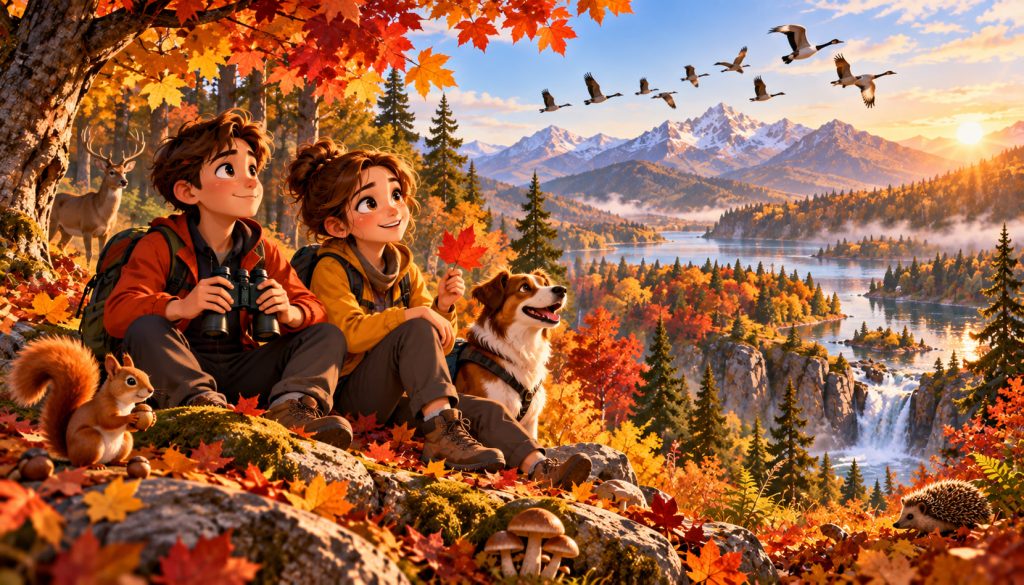
Autumn is one of the most dramatic seasons in nature. Forests change color, days become shorter, temperatures fall, animals alter their behavior, and plants begin preparing for months of reduced growth.
These changes are not random.
Autumn is a carefully coordinated biological transition driven mainly by daylight, temperature, and seasonal changes in food availability.
Trees withdraw nutrients from their leaves, migratory birds begin extraordinary journeys, mammals change feeding patterns, and countless organisms prepare for winter in ways that are often invisible to us.
Why Do Leaves Change Color in Autumn?
The green color of leaves comes mainly from chlorophyll, a pigment essential for photosynthesis.
During spring and summer, trees constantly produce and maintain chlorophyll because they receive enough sunlight to support active growth.
As autumn approaches, days become shorter and temperatures begin to fall.
Deciduous trees respond by reducing chlorophyll production.
As the green pigment disappears, other pigments that were already present in the leaves become visible.
These include carotenoids, which create yellow and orange colors.
Some trees also produce anthocyanins, pigments responsible for brilliant red, purple, and crimson shades.
Autumn colors are therefore not simply leaves “dying.” They are part of an organized process of nutrient recovery and preparation for winter.
Why Trees Drop Their Leaves
Leaves are extremely useful during the growing season, but they can become a disadvantage during winter.
Broad leaves lose water through evaporation and can be damaged by frost, snow, and ice.
Before dropping a leaf, a deciduous tree reabsorbs valuable nutrients from it.
These nutrients can be stored in branches, trunks, and roots and reused when growth resumes.
A special layer of cells gradually forms where the leaf connects to the branch.
Eventually, the connection weakens and the leaf falls.
This process helps the tree conserve water and energy during unfavorable conditions.
Why Evergreen Trees Keep Their Needles
Not every tree loses its foliage.
Many conifers, including pines, spruces, and firs, retain their needles throughout winter.
Needles are better adapted to cold and dry conditions than broad leaves.
Their narrow shape reduces water loss, while their waxy surfaces provide additional protection.
Some evergreen needles can survive for several years before being replaced.
This allows evergreen trees to begin photosynthesis whenever temperatures and light conditions are suitable, even outside the main growing season.
Autumn Is a Season of Preparation for Animals
Animals respond to autumn in very different ways.
Some migrate.
Some store food.
Some build fat reserves.
Others enter forms of dormancy.
For wildlife, autumn is often less about the beauty of the season and more about preparing for a period when food and warmth may become scarce.
The timing of these behaviors can be critical for survival.
Why Birds Migrate
Many birds depend on insects, aquatic organisms, fruits, or other foods that become less available during winter.
Migration allows them to move toward regions with better feeding conditions.
Changes in daylight are one of the strongest signals that trigger migratory behavior.
Hormonal changes can increase restlessness and stimulate birds to eat more before departure.
Some species travel only a few hundred kilometers.
Others cross continents and oceans.
Migrating birds use multiple navigation systems, including the Sun, stars, landscape features, and possibly Earth’s magnetic field.
Mammals Prepare in Different Ways
Mammals have developed many strategies for dealing with winter.
Squirrels collect and hide nuts.
Deer may grow thicker coats.
Some mammals increase their body fat.
Bears consume large amounts of food before entering prolonged winter dormancy.
True hibernators reduce their metabolic rate dramatically.
Their body temperature, heart rate, and breathing can fall to very low levels.
Other animals enter shorter or less extreme periods of inactivity known as torpor.
The goal is the same: reduce energy consumption when food is difficult to find.
Why Animals Store Food
Autumn often brings an abundance of seeds, nuts, berries, and fruits.
Many animals take advantage of this seasonal supply.
Squirrels hide food in many separate locations.
Birds such as jays may also store acorns and other seeds.
Interestingly, forgotten food stores can help plants spread.
A buried acorn that is never recovered may eventually germinate into a new oak tree.
This creates an important ecological relationship between animals and forests.
Fungi Become Highly Visible
Autumn is one of the best seasons for observing mushrooms in many temperate regions.
Cooler temperatures and increased moisture create favorable conditions for fungal fruiting bodies.
The mushroom visible above ground is only part of the organism.
Most of a fungus exists as a network of microscopic threads called mycelium within soil, wood, or other organic material.
Fungi play a vital ecological role.
They decompose dead plants, leaves, and wood, returning nutrients to the soil.
Without decomposers, forests would accumulate enormous amounts of undecomposed organic matter.
Fallen Leaves Are Not Waste
A forest floor covered in leaves may look like debris, but it is an essential part of the ecosystem.
Leaves gradually decompose.
Fungi, bacteria, worms, insects, and other organisms break them down.
Nutrients are released back into the soil and become available to plants.
Leaf litter also protects the ground from erosion, retains moisture, and provides shelter for small animals.
Removing every fallen leaf from natural areas would disrupt an important nutrient cycle.
Insects Also Respond to Autumn
Many insects disappear from view as temperatures fall, but that does not mean they are gone.
Different species survive winter in different life stages.
Some overwinter as eggs.
Others survive as larvae, pupae, or adults hidden beneath bark, underground, or inside leaf litter.
Monarch butterflies are famous for long-distance migration, while many other insects rely on dormancy.
Their autumn behavior is closely tied to temperature and day length.
Rivers, Lakes, and Wetlands Also Change
Seasonal change is not limited to forests.
Cooling air temperatures affect lakes and rivers.
In temperate lakes, surface water cools and becomes denser.
This can eventually cause seasonal mixing, redistributing oxygen and nutrients through the water column.
Wetlands may also change dramatically as vegetation dies back and migratory birds arrive or depart.
Autumn therefore affects entire ecosystems, not just individual species.
Expert Perspective: Autumn Is Controlled by Biological Timing
Ecologists often describe seasonal behavior through the concept of phenology.
Phenology studies the timing of natural events such as flowering, leaf fall, migration, breeding, and hibernation.
Day length provides a highly predictable seasonal signal, while temperature and rainfall can modify the exact timing.
Scientists pay close attention to these patterns because climate change can shift seasonal events.
For example, warmer autumns may delay leaf fall, migration, or dormancy in some species.
When interacting species respond differently to changing seasons, ecological relationships can also change.
Why Autumn Weather Matters
A warm, sunny autumn can produce different ecological conditions from a cold, wet one.
Temperature influences insect activity, plant metabolism, migration timing, and decomposition.
Rainfall affects fungi, soil moisture, rivers, and food availability.
Autumn storms can remove leaves quickly, while calm weather may allow colorful foliage to remain on trees longer.
This is why autumn can look very different from one year to another even in the same location.
Autumn Is Both an Ending and a Beginning
Many visible processes slow down in autumn, but ecosystems remain active.
Trees store nutrients.
Seeds are dispersed.
Fungi recycle organic matter.
Animals relocate or prepare for scarcity.
Soil organisms continue decomposition.
Autumn is not simply nature shutting down. It is a season of redistribution, preparation, and survival.
What appears to be decline is often a highly organized transition that allows ecosystems to survive winter and restart when conditions improve.
Interesting Facts
- Yellow pigments in many autumn leaves were present during summer but were hidden by chlorophyll.
- Some trees actively produce red anthocyanin pigments during autumn.
- Squirrels may create hundreds of separate food caches in a single season.
- Forgotten buried nuts can contribute to forest regeneration.
- Many fungi are mostly invisible because their main bodies grow underground or inside wood.
- Fallen leaves help insulate soil and protect small organisms during cold weather.
- Birds can use celestial cues and Earth’s magnetic field during migration.
- Some insects survive winter as eggs rather than adults.
- Evergreen needles can remain functional for several years.
- Autumn timing varies according to latitude, elevation, temperature, and local climate.
Glossary
- Autumn — The season between summer and winter, characterized by shorter days and generally falling temperatures.
- Chlorophyll — The green pigment that allows plants to absorb light for photosynthesis.
- Carotenoids — Yellow and orange pigments found in many leaves.
- Anthocyanins — Red, purple, or blue plant pigments produced in some autumn leaves.
- Deciduous Tree — A tree that sheds its leaves seasonally.
- Evergreen — A plant that retains leaves or needles throughout the year.
- Photosynthesis — The process by which plants use light energy to produce sugars from carbon dioxide and water.
- Migration — Seasonal movement of animals from one region to another.
- Hibernation — A prolonged state of greatly reduced metabolism used by some animals to survive unfavorable conditions.
- Torpor — A temporary state of reduced body temperature and metabolic activity.
- Mycelium — The network of fungal threads that forms the main body of a fungus.
- Decomposition — The biological breakdown of dead organic material.
- Leaf Litter — Fallen leaves and other plant material covering the ground.
- Phenology — The study of the timing of recurring seasonal events in nature.