
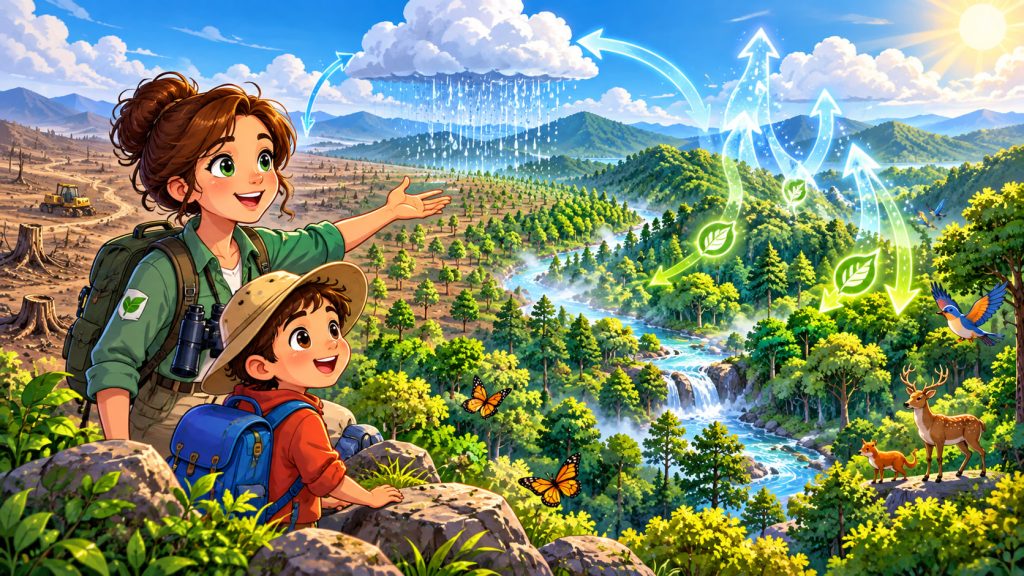
Forests do far more than cover the landscape with trees. They store carbon, move water through the atmosphere, influence clouds, cool the land, protect soils, and shape regional weather patterns.
Because of these effects, forest restoration is often discussed as a major climate solution.
But how powerful is it really?
The answer is encouraging but nuanced. Restoring forests can make a measurable and meaningful contribution to climate stabilization, especially when combined with rapid reductions in greenhouse gas emissions.
The greatest benefits appear when degraded forests are allowed to recover naturally, existing forests are protected, and new forests are established in places where they are ecologically appropriate.
Forests Remove Carbon Dioxide From the Atmosphere
Trees absorb carbon dioxide during photosynthesis.
Using sunlight, they convert carbon dioxide and water into carbohydrates that support growth.
Carbon becomes stored in trunks, branches, roots, leaves, and surrounding soils.
As forests mature, they can accumulate enormous quantities of carbon.
This makes forest restoration a form of biological carbon removal.
When a degraded landscape returns to healthy forest, carbon begins moving from the atmosphere into vegetation and soil.
The amount removed depends on tree species, climate, soil, rainfall, forest age, and previous land use.
Tropical forests often grow rapidly, while forests in cooler regions may accumulate carbon more slowly.
Restoring Forests Is Different From Simply Planting Trees
Tree planting and forest restoration are not the same thing.
A plantation containing a single fast-growing species may store carbon, but it does not necessarily reproduce the ecological functions of a natural forest.
Forest restoration aims to rebuild a functioning ecosystem.
That can involve protecting naturally regenerating trees, reconnecting fragmented habitats, restoring native species, controlling invasive plants, and improving soils.
In many places, natural forest regeneration can be cheaper and ecologically richer than intensive tree planting.
If seed sources remain nearby and human pressures are reduced, forests can sometimes recover surprisingly quickly.
How Much Carbon Could Restored Forests Store?
The global potential is significant.
Large areas of formerly forested land have been cleared or degraded through agriculture, logging, fire, mining, and urban expansion.
Restoring a portion of these landscapes could remove substantial amounts of carbon dioxide over decades.
However, forests cannot absorb unlimited emissions.
Trees require land, water, nutrients, and time to grow.
Carbon uptake also slows as many forests mature, although old forests can continue storing large quantities of carbon in biomass and soils.
Forest restoration can compensate for part of human greenhouse gas emissions, but it cannot replace the transition away from fossil fuels.
If emissions continue at very high levels, there is simply not enough suitable land to solve the entire problem through trees.
Forests Can Cool the Climate in More Than One Way
Carbon storage is only one climatic effect of forests.
Trees also influence temperature through evapotranspiration.
Roots draw water from the soil, and leaves release some of that water vapor into the atmosphere.
This process uses energy and can cool the surrounding surface.
A large forest therefore functions somewhat like an enormous biological cooling system.
In warm regions, this effect can be particularly important.
Forests may lower local daytime temperatures and reduce extreme heat compared with nearby deforested land.
Restoring forests can influence both the global carbon balance and the local climate experienced by people and ecosystems.
Forests Help Move Water Through the Atmosphere
Forests participate actively in the water cycle.
Water evaporated and transpired from vegetation enters the atmosphere, where it can contribute to clouds and rainfall.
Large forested regions can recycle water repeatedly as air masses move across continents.
This means deforestation can influence rainfall far beyond the area where trees were removed.
Restoring forests may help strengthen regional moisture recycling and stabilize hydrological cycles.
The effects vary greatly between regions because rainfall depends on atmospheric circulation, oceans, mountains, temperature, and many other factors.
Still, vegetation is an important part of that system.
Tropical Forest Restoration Has Powerful Climate Benefits
Tropical forests are especially important because they combine rapid plant growth with strong evaporative cooling.
Warm temperatures and abundant rainfall allow many tropical trees to grow throughout much of the year.
Restoring degraded tropical forests can therefore result in relatively rapid carbon accumulation.
Tropical forests also store enormous amounts of carbon in living vegetation.
Preventing their destruction is particularly important because cutting and burning mature forests can release decades or centuries of stored carbon.
Protecting an existing mature forest is usually more immediately valuable for the climate than cutting it down and trying to recreate it later.
Restoration works best alongside forest conservation rather than as a replacement for it.
Forests in Colder Regions Behave Differently
The climate effects of forests are not identical everywhere.
Snow-covered ground reflects large amounts of sunlight back toward space.
Dark evergreen forests absorb more sunlight.
As a result, expanding forests into some snowy high-latitude landscapes can reduce surface reflectivity, a property known as albedo.
This additional absorption of solar energy can partly offset the cooling produced by carbon storage.
For this reason, climate benefits depend strongly on location.
Restoring forests where they naturally belong is generally more effective than planting trees indiscriminately across every available landscape.
Expert Perspective: Forests Are Part of a Broader Climate Strategy
Climate scientist and ecosystem researcher Thomas Crowther has helped bring global attention to the enormous capacity of forests to store carbon.
Research in this field has emphasized that restoring degraded ecosystems could contribute substantially to climate mitigation.
At the same time, leading forest and climate researchers consistently stress an important principle: forest restoration works best as a complement to emissions reductions, not as a substitute for them.
This distinction matters because carbon stored in forests can potentially return to the atmosphere through fire, drought, logging, pests, or land-use change.
Fossil carbon, in contrast, can remain underground indefinitely if it is never extracted and burned.
Wildfires Can Threaten Stored Carbon
A restored forest is not a permanent carbon vault unless it remains healthy.
Wildfires, severe droughts, insects, storms, and disease can kill trees and release stored carbon.
Climate change itself can increase some of these risks.
This makes resilience important.
Forests containing diverse native species, different age groups, and varied structures are often better positioned to withstand environmental stress than simplified plantations.
Long-term management therefore matters just as much as the initial restoration effort.
Soil Carbon Is Easy to Overlook
A large fraction of forest carbon is stored below ground.
Tree roots add organic material to soils.
Fallen leaves, dead wood, fungi, microorganisms, and decomposing plant material also contribute carbon.
Healthy soils can store carbon for years, decades, or much longer.
Restoration can therefore rebuild both visible vegetation and underground carbon reserves.
Disturbing soils through intensive land clearing can release part of this stored carbon.
A successful forest restoration project protects the entire ecosystem, not just the trees that are visible above ground.
Reforestation Can Also Protect Biodiversity
Climate benefits are only part of the value of restoring forests.
Natural forests provide habitat for enormous numbers of plants, animals, fungi, and microorganisms.
They can protect watersheds, reduce erosion, improve water quality, and support pollinators.
Forest restoration can also reconnect isolated habitats, allowing wildlife populations to move across landscapes.
These additional benefits are strongest when restoration uses native ecosystems rather than creating uniform commercial plantations.
How Quickly Can Restored Forests Affect Climate?
Some effects begin almost immediately.
Young vegetation starts absorbing carbon as it grows.
Shade and evapotranspiration can alter local temperatures relatively quickly.
However, building large carbon stocks takes decades.
A newly restored forest cannot instantly replace a mature ecosystem that has been removed.
This is why timing matters.
The earlier restoration begins, the longer forests have to accumulate carbon and rebuild ecological functions.
Protecting forests that already exist remains one of the fastest ways to prevent additional emissions from land-use change.
The Best Strategy Is Protection Plus Restoration
The strongest climate strategy combines several approaches.
Existing natural forests should be protected wherever possible.
Degraded forests can be allowed to recover.
Deforested land can be restored when doing so does not threaten food production or valuable natural ecosystems such as grasslands and peatlands.
Agricultural landscapes can also incorporate trees through agroforestry.
The goal is not simply to maximize the number of trees.
It is to restore the right ecosystems in the right places.
A healthy forest is a long-term climate system, not just a collection of planted trunks.
Interesting Facts
- Trees store carbon in wood, roots, leaves, and surrounding soils.
- Tropical forests can accumulate carbon rapidly because warm conditions allow long growing seasons.
- Forests cool many landscapes through evapotranspiration.
- Water released by forests can contribute to cloud formation and regional rainfall.
- Mature forests can contain carbon accumulated over many decades or centuries.
- Forest soils may store enormous amounts of carbon that are invisible from above.
- Natural forest regeneration can sometimes restore ecosystems without large-scale planting programs.
- Forest restoration can simultaneously support climate mitigation, biodiversity, water quality, and erosion control.
- Dark forests can absorb more sunlight than snow-covered open land, making the climate effects of high-latitude reforestation more complicated.
- Protecting existing forests generally prevents carbon emissions more quickly than waiting for newly planted trees to grow.
Glossary
- Forest Restoration — The process of helping a degraded or damaged forest recover its ecological structure and functions.
- Reforestation — Re-establishing forest on land that previously supported forest.
- Afforestation — Establishing forest on land that has not recently been forested.
- Carbon Sequestration — The process of capturing and storing carbon dioxide from the atmosphere.
- Photosynthesis — The process by which plants use light energy to convert carbon dioxide and water into chemical energy.
- Evapotranspiration — The combined release of water into the atmosphere through evaporation and plant transpiration.
- Albedo — The fraction of incoming sunlight reflected by a surface.
- Natural Regeneration — Forest recovery that occurs primarily through natural seed dispersal and regrowth rather than extensive planting.
- Biomass — Organic material contained in living or recently living organisms.
- Soil Carbon — Carbon stored in organic matter and other carbon-containing materials within soil.
- Agroforestry — A land-use system that deliberately integrates trees with crops or livestock.
- Carbon Sink — A system that absorbs more carbon than it releases over a given period.
- Climate Mitigation — Actions that reduce greenhouse gas emissions or increase removal of greenhouse gases from the atmosphere.
- Ecosystem Resilience — The ability of an ecosystem to withstand disturbance and continue functioning.


Great blog you have here buut I was wanting tto know if you kknew of
any community forums thuat cover the same topics discussed here?
I’d rreally love too be a part of online community whedre
I can get comments from other knowledgeasble individuals that share tthe same interest.
If yyou have any recommendations, please lett me know.
Thanks! auroravpn