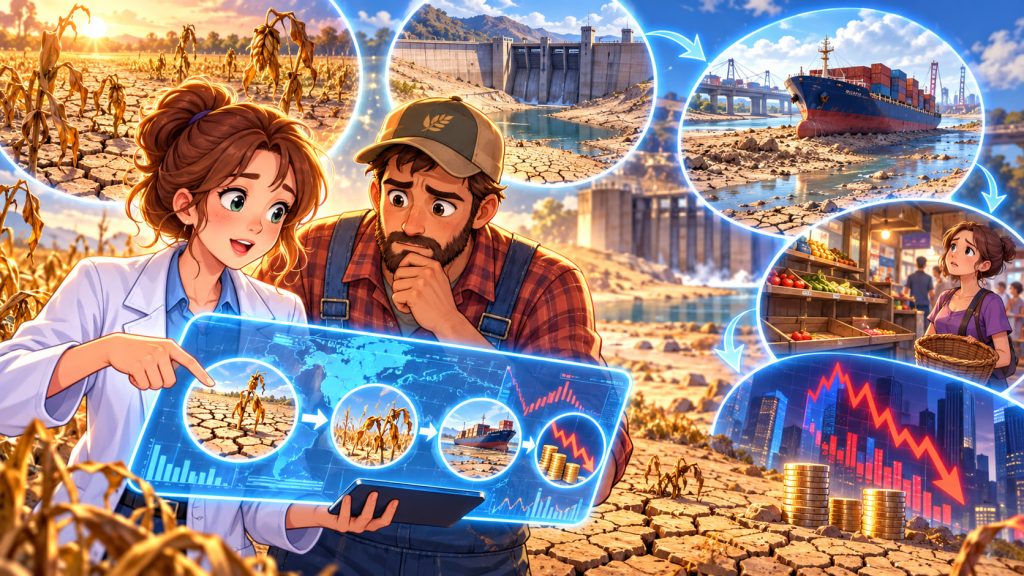
A drought may begin with something as simple as months without sufficient rainfall. Rivers shrink, reservoirs decline, and agricultural fields gradually lose their moisture. But the consequences can extend far beyond the environment.
When water becomes scarce, farmers lose crops, food prices increase, electricity production may decline, and industries struggle to maintain normal operations. What begins as a natural disaster can eventually threaten an entire national economy.
From agricultural regions in Africa to industrial economies in Europe and Asia, prolonged droughts have demonstrated how closely modern prosperity depends on reliable water supplies.
A severe drought is not simply a shortage of rain. It can trigger a chain reaction that affects food security, employment, international trade, energy production, and financial stability.
Why Water Scarcity Is an Economic Problem
Water is one of the most important resources supporting economic activity.
Agriculture requires water to grow crops and maintain livestock. Factories use it for manufacturing, cooling, cleaning, and processing raw materials.
Power stations depend on water for cooling, while hydroelectric facilities need sufficient river flows and reservoir levels to generate electricity.
When water supplies decline, these interconnected systems become increasingly vulnerable.
The economic consequences depend on several factors, including the duration of the drought, local infrastructure, water management, and the diversity of a country’s economy.
The greater an economy’s dependence on water-intensive activities, the greater its potential exposure to prolonged drought.
Agriculture: The First Major Economic Casualty
Agriculture is frequently among the first sectors to suffer during a severe drought.
Without sufficient rainfall or irrigation, crops grow more slowly, produce lower yields, or fail entirely.
Farmers may lose an entire growing season, leaving them unable to repay loans or purchase seeds and equipment for the following year.
Livestock producers face additional difficulties as pastures deteriorate and animal feed becomes more expensive.
The financial consequences extend beyond individual farms.
Food processing companies, agricultural equipment manufacturers, transportation businesses, and rural retailers may all experience declining revenues.
In regions where agriculture provides a substantial share of employment, a prolonged drought can threaten the livelihoods of entire communities.
How Droughts Drive Food Prices Higher
When agricultural production declines, food supplies can become more expensive.
Shortages of essential crops, including wheat, rice, corn, and soybeans, may affect both domestic markets and international trade.
Livestock products can also become more expensive when farmers face higher feed costs.
Countries that depend heavily on imported food are especially vulnerable when drought affects major agricultural exporters.
Rising food prices reduce household purchasing power, particularly among lower-income families.
Consumers may spend more of their income on essential groceries and less on other goods and services.
Businesses outside the agricultural sector can consequently experience weaker demand.
A drought affecting one major agricultural region can contribute to food price increases in countries thousands of kilometers away.
Energy Shortages and Rising Electricity Costs
Droughts can also disrupt electricity production.
Hydroelectric power stations require sufficient water to operate their turbines. When reservoir levels fall, electricity generation may decline substantially.
Thermal and nuclear power plants can also experience problems because many rely on water for cooling.
During extreme droughts, some facilities may need to reduce production to comply with environmental regulations or maintain safe operating temperatures.
Electricity shortages can force governments and utilities to purchase more expensive energy from alternative sources.
Higher electricity prices increase operating costs for factories, transportation systems, and households.
In countries that depend heavily on hydropower, severe drought can therefore become both an environmental and an energy crisis.
When Factories and Global Supply Chains Suffer
Modern industries depend on reliable water supplies and efficient transportation networks.
Water shortages can restrict production in sectors such as:
- Food and beverage manufacturing
- Semiconductor production
- Chemical processing
- Textile manufacturing
- Mining and metal production
- Paper manufacturing
Drought can also disrupt river transportation.
When water levels fall, cargo ships may need to carry smaller loads or use alternative routes.
The Rhine River in Europe and the Panama Canal have both experienced drought-related transportation disruptions.
Such restrictions can increase shipping costs, delay deliveries, and create problems for international trade.
Water scarcity in one region can disrupt supply chains serving industries across multiple continents.
From Economic Losses to Financial Instability
As drought-related losses accumulate, their effects can spread into the financial system.
Farmers and businesses experiencing declining revenues may struggle to repay loans.
Banks exposed to heavily affected sectors can experience rising credit risks.
Governments may need to increase spending on emergency assistance, agricultural subsidies, water infrastructure, and electricity imports.
At the same time, declining business activity can reduce tax revenues.
These pressures become particularly serious when a drought occurs alongside existing problems such as high public debt, inflation, or political instability.
A severe drought does not automatically cause a national economic crisis, but it can intensify existing financial vulnerabilities.
Expert Perspective: Climate Change and Economic Vulnerability
The Intergovernmental Panel on Climate Change (IPCC) has identified growing risks associated with drought and water scarcity in numerous regions.
Its assessments emphasize that climate change can intensify certain drought conditions, particularly in regions experiencing increasing temperatures and declining soil moisture.
Higher temperatures increase evaporation and can worsen agricultural water shortages even when rainfall changes are relatively modest.
The IPCC also highlights the importance of adaptation, including improved water management, drought-resistant agriculture, and resilient infrastructure.
The economic consequences of drought depend not only on climate conditions but also on how effectively societies prepare for water shortages.
Real-World Examples of Drought-Related Economic Disruption
Several major droughts illustrate how water scarcity can affect national and international economies.
During the 2015–2018 drought in Cape Town, South Africa, the city approached a situation in which municipal water supplies could have been severely restricted.
Emergency conservation measures, infrastructure management, and changing rainfall conditions ultimately helped the city avoid the anticipated crisis.
In Europe, the severe summer drought of 2022 damaged agricultural production, reduced river transportation capacity, and disrupted certain energy operations.
Meanwhile, the Panama Canal experienced major water shortages during 2023 and 2024, leading to restrictions on vessel transits and creating additional challenges for international shipping.
These events demonstrate that drought-related economic disruption can occur in both developing and highly industrialized regions.
Can Countries Prevent Droughts From Becoming Economic Crises?
Although governments cannot prevent every drought, they can reduce the economic damage.
Effective adaptation measures include improved irrigation, wastewater recycling, reservoir management, and more efficient industrial water use.
Diversifying electricity generation can reduce dependence on hydropower during periods of low rainfall.
Agricultural insurance and emergency financial assistance can help farmers survive severe crop losses.
Early-warning systems allow governments and businesses to prepare before water shortages become critical.
Long-term investment is particularly important because drought resilience often depends on infrastructure developed years before an emergency occurs.
A country’s ability to manage water efficiently can become a decisive factor in its long-term economic stability.
Interesting Facts
- Agriculture accounts for approximately 70% of global freshwater withdrawals, making it particularly vulnerable to water scarcity.
- Drought can increase food prices even in countries that receive adequate rainfall because agricultural markets are internationally connected.
- Hydroelectric power generation can decline substantially when reservoirs experience prolonged periods of low water levels.
- Low river levels may force cargo vessels to reduce their loads, increasing transportation costs.
- The Panama Canal depends on freshwater from surrounding lakes to operate its locks.
- Higher temperatures can intensify agricultural drought by increasing evaporation and reducing soil moisture.
- Droughts can continue affecting economic activity long after rainfall returns because depleted groundwater reserves and damaged agricultural production may take considerable time to recover.
Glossary
- Drought — An extended period of unusually dry conditions that causes water shortages.
- Water Scarcity — A situation in which available freshwater resources cannot meet demand.
- Food Security — Reliable access to sufficient, safe, and nutritious food.
- Economic Resilience — The ability of an economy to withstand and recover from disruptions.
- Climate Adaptation — Measures designed to reduce vulnerability to climate-related changes.