Imagine a group of chemicals so resistant to degradation that they can remain in rivers, soil, and living organisms long after the products containing them have been discarded.
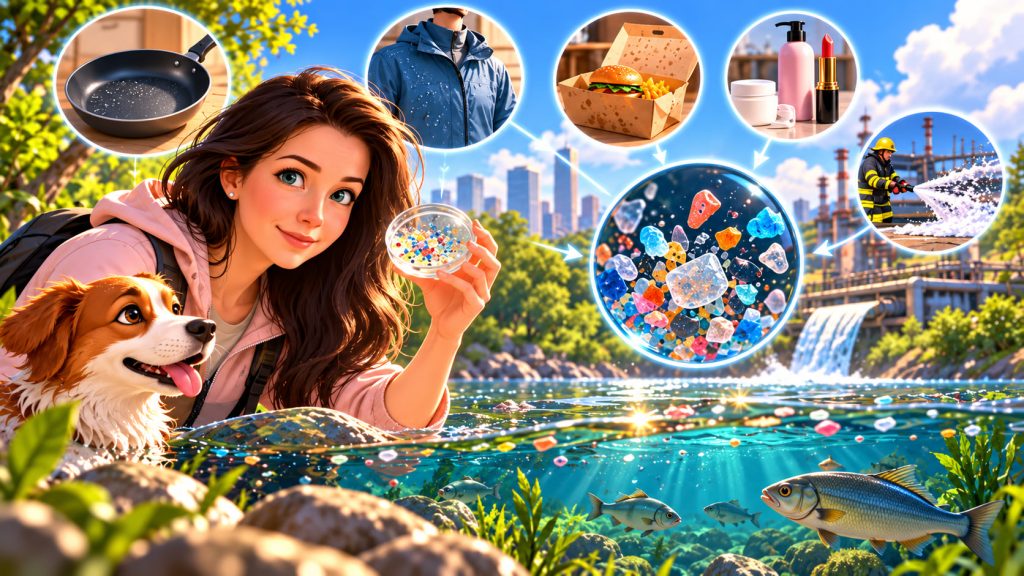
These substances are known as PFAS, or per- and polyfluoroalkyl substances. Often called forever chemicals, they have been used for decades in nonstick cookware, waterproof clothing, food packaging, and industrial processes.
Their exceptional durability made them commercially valuable. However, the same chemical properties have created one of the most challenging forms of modern environmental pollution.
Scientists have detected PFAS in drinking water, wildlife, agricultural soils, and human blood across the world.
Understanding why forever chemicals persist is essential for protecting freshwater resources, ecosystems, and human health.
What Exactly Are Forever Chemicals?
PFAS are a large family of thousands of synthetic chemicals that have been manufactured since the 1940s.
Their molecular structures contain carbon atoms bonded to fluorine atoms, creating exceptionally stable chemical arrangements.
These substances are particularly useful because many resist water, oil, grease, and high temperatures.
Two extensively studied PFAS are PFOA and PFOS, which were widely used in industrial and consumer applications.
Although their production has been restricted or phased out in many countries, environmental contamination from decades of previous use remains a serious concern.
Why Do PFAS Last So Long?
The remarkable persistence of PFAS comes largely from the strength of their carbon-fluorine bonds.
These are among the strongest single bonds commonly found in organic chemistry.
Their molecular structures make many PFAS resistant to sunlight, biological degradation, and ordinary environmental chemical reactions.
While some PFAS can transform into other compounds, many ultimately produce extremely persistent substances.
Conventional wastewater treatment and natural environmental processes often cannot completely destroy them.
Certain forever chemicals can remain in the environment for decades or longer because the processes that normally break down organic pollutants are largely ineffective against them.
Where Do Forever Chemicals Come From?
PFAS have been incorporated into numerous industrial processes and everyday consumer products.
Their water-resistant and grease-resistant properties make them particularly useful in protective coatings.
Common historical and current applications include:
- Nonstick cookware and industrial coatings.
- Water-resistant clothing and outdoor equipment.
- Stain-resistant carpets and furniture.
- Certain grease-resistant food packaging.
- Some cosmetics and personal care products.
- Specialized firefighting foams.
- Industrial lubricants and manufacturing processes.
PFAS can enter the environment during manufacturing, product use, waste disposal, and accidental releases.
Some contaminated industrial sites and firefighting training facilities have become important sources of long-term groundwater pollution.
How PFAS Spread Through Water, Soil, and Air
Forever chemicals can travel through multiple environmental pathways.
Industrial wastewater and contaminated runoff may carry PFAS into rivers, lakes, and groundwater.
Rainfall can transport certain PFAS through soil, potentially contaminating underground drinking water supplies.
Some PFAS and their chemical precursors can also travel through the atmosphere before being deposited in distant environments.
Scientists have detected these substances in remote regions far from major industrial facilities.
Their environmental behavior depends on molecular structure, mobility, and interactions with soil and water.
PFAS contamination is particularly challenging because certain compounds travel easily through water while resisting natural degradation.
How Forever Chemicals Affect Wildlife
PFAS contamination can affect aquatic and terrestrial ecosystems.
Fish, birds, mammals, and other animals may encounter these substances through contaminated water, food, and sediments.
Some PFAS accumulate in living organisms and can move through food webs.
Laboratory and wildlife studies have identified potential effects on reproduction, development, immune function, and other biological processes.
However, different PFAS exhibit different environmental behaviors and toxicological properties.
Some compounds accumulate more readily than others, making their ecological risks difficult to assess as a single group.
Can Forever Chemicals Affect Human Health?
People may encounter PFAS through contaminated drinking water, certain foods, household dust, and occupational exposure.
Research has associated exposure to specific PFAS with several health effects, including increased cholesterol levels, reduced antibody responses to certain vaccines, and changes in liver enzymes.
Studies have also linked PFOA exposure with increased risks of kidney and testicular cancer.
Other investigated effects include pregnancy-related hypertension and small reductions in birth weight.
Health risks depend on the particular chemical, exposure level, duration, and individual circumstances.
The widespread presence of PFAS makes preventing unnecessary exposure an important public-health objective.
Why Some PFAS Remain in the Human Body for Years
Environmental persistence and biological persistence are related but distinct properties.
Certain PFAS bind to proteins in human blood and tissues, making their elimination relatively slow.
Studies have estimated biological half-lives of several years for PFOA and PFOS, although individual estimates vary.
Other PFAS can leave the body considerably faster.
Continued exposure through contaminated drinking water or food can maintain elevated concentrations even when some elimination occurs.
The long biological half-lives of certain compounds make their accumulation particularly important in environmental health research.
Expert Perspective: Preventing Pollution Before It Spreads
Environmental chemist Ian Cousins and his research collaborators have investigated the worldwide distribution and persistence of PFAS.
Their research has highlighted how the extensive use of highly persistent chemicals can create contamination that spreads far beyond its original sources.
The environmental implications are significant: even after production stops, previously released substances may remain in ecosystems for generations.
Preventing unnecessary releases and carefully assessing replacement chemicals are therefore essential elements of long-term pollution management.
Reducing PFAS emissions at their source is considerably more effective than relying exclusively on removing contamination after it has spread.
Can Forever Chemicals Be Removed From Drinking Water?
Modern water treatment technologies can remove many PFAS from contaminated drinking water.
Activated carbon filtration can capture certain compounds, particularly some longer-chain PFAS.
Ion-exchange resins provide another method for removing selected substances.
Reverse osmosis uses specialized membranes to separate many dissolved contaminants from water.
However, removal is not the same as destruction.
Used filters, concentrated wastewater, and contaminated treatment materials require careful disposal or further processing.
Scientists are developing additional technologies designed to break down PFAS rather than simply transfer them into another waste stream.
What Does the Future Hold for PFAS Pollution?
Addressing forever chemicals requires coordinated action across manufacturing, waste management, water treatment, and environmental monitoring.
Several countries have introduced restrictions on certain PFAS and are considering broader controls.
Manufacturers are also developing alternative materials for applications where PFAS are not essential.
Advanced analytical techniques are improving scientists’ ability to identify previously undetected compounds.
Meanwhile, researchers are investigating destructive treatment technologies capable of breaking strong carbon-fluorine bonds.
The long-term solution involves reducing unnecessary PFAS use, preventing environmental releases, and developing reliable technologies for managing existing contamination.
Interesting Facts
- PFAS have been used in commercial and industrial products since the 1940s.
- Some PFAS can persist in the environment for generations after their original release.
- Scientists have detected PFAS in remote polar environments far from major industrial centers.
- Certain PFAS have biological half-lives of several years in humans.
- Conventional boiling does not reliably remove PFAS from drinking water.
- Some water purification systems can capture PFAS without chemically destroying them.
- Firefighting foams have historically contributed to substantial groundwater contamination near certain airports and military facilities.
- Different PFAS can have dramatically different mobility, persistence, and accumulation characteristics.
Glossary
- PFAS — Per- and polyfluoroalkyl substances, a large family of synthetic chemicals containing carbon-fluorine bonds.
- Forever Chemicals — A common name for PFAS, reflecting the exceptional environmental persistence of many compounds in this group.
- PFOA — Perfluorooctanoic acid, a historically important PFAS associated with industrial manufacturing and environmental contamination.
- PFOS — Perfluorooctane sulfonic acid, a highly persistent PFAS formerly used in various industrial and consumer products.
- Carbon-Fluorine Bond — A strong chemical bond between carbon and fluorine atoms that contributes to the stability of many PFAS.
- Environmental Persistence — The ability of a substance to remain in the environment without undergoing complete degradation.
- Bioaccumulation — The buildup of a substance within an organism when absorption exceeds elimination.
- Biological Half-Life — The time required for the amount of a substance in an organism to decrease by half.
- Groundwater Contamination — The presence of unwanted chemical or biological substances in underground water supplies.
- Activated Carbon — A highly porous material used in filtration systems to capture certain dissolved contaminants.
- Ion Exchange — A water treatment process that removes selected dissolved substances using specialized materials.
- Reverse Osmosis — A purification process that uses pressure and a semipermeable membrane to remove dissolved contaminants from water.
- Chemical Precursor — A substance that can transform into another chemical through environmental or biological processes.