Every night, billions of artificial lights illuminate our planet. Streetlights brighten highways, skyscrapers glow long after sunset, and enormous cities create luminous domes visible from hundreds of kilometers away.
Artificial lighting has transformed modern civilization, making transportation safer and allowing people to work, travel, and socialize after dark.
However, the growing brightness of our nights has an unexpected environmental cost.
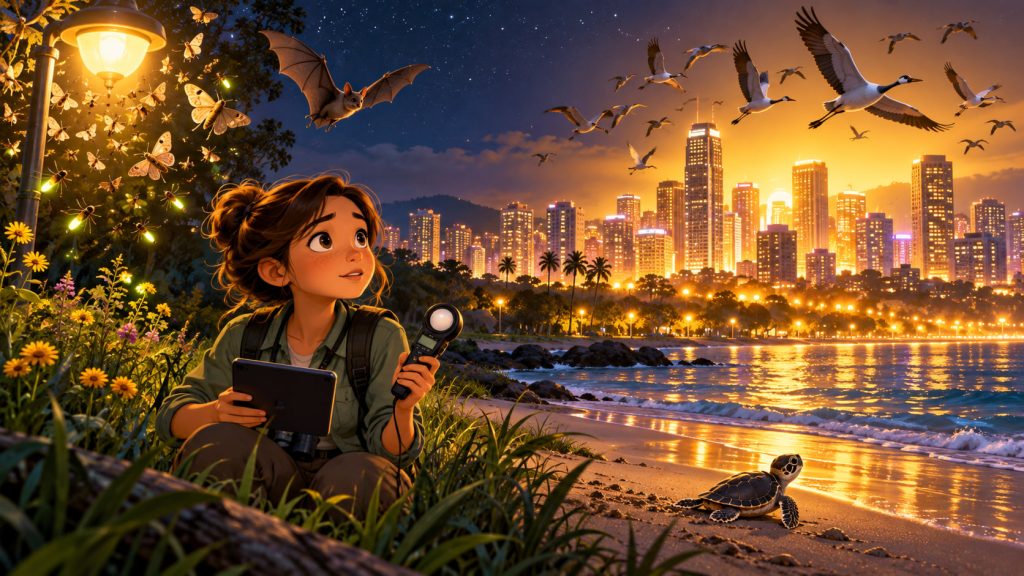
Birds become disoriented during migration, insects abandon their natural behaviors, sea turtles struggle to reach the ocean, and nocturnal animals experience disruptions to their biological rhythms.
Light pollution is becoming a major ecological problem because artificial illumination is changing natural environments that evolved with predictable cycles of daylight and darkness.
What Is Light Pollution?
Light pollution refers to excessive, unnecessary, or poorly directed artificial illumination that alters the natural nighttime environment.
It originates from streetlights, commercial buildings, advertising displays, sports facilities, industrial sites, and residential areas.
Scientists generally distinguish several forms of light pollution:
- Skyglow — Artificial brightness that illuminates the night sky above populated areas.
- Glare — Excessive brightness that causes visual discomfort or reduces visibility.
- Light trespass — Unwanted artificial light entering areas where it is unnecessary.
- Light clutter — Excessive groupings of artificial lights that can create confusion and visual distraction.
Unlike many other environmental pollutants, artificial light can affect ecosystems without leaving physical waste behind.
Its ecological consequences depend on brightness, wavelength, timing, duration, and the sensitivity of affected organisms.
Why Is the Planet Getting Brighter?
Urbanization is one of the principal drivers of increasing artificial illumination.
As cities expand, new roads, residential neighborhoods, commercial centers, and industrial facilities introduce additional lighting.
The widespread adoption of LED technology has also transformed outdoor illumination.
LEDs are energy-efficient, affordable, and capable of producing extremely bright light.
However, lower operating costs can encourage the installation of more lighting or the illumination of areas that previously remained dark.
Satellite observations and ground-based measurements have documented increasing nighttime brightness across many regions.
Energy-efficient lighting does not automatically reduce light pollution when the total amount of artificial illumination continues to increase.
How Artificial Light Disrupts Animal Biological Clocks
Most animals evolved under natural cycles of daylight and darkness.
These cycles regulate circadian rhythms, the internal biological processes controlling sleep, activity, feeding, reproduction, and hormone production.
Artificial illumination can interfere with these natural signals.
Nocturnal mammals may delay leaving their shelters, while certain birds begin singing earlier than they would under natural conditions.
Some predators benefit from artificial lighting because illuminated areas make prey easier to detect.
Other species avoid brightly lit habitats entirely.
These contrasting responses can gradually change relationships between animals and their environments.
Why Migratory Birds Are Particularly Vulnerable
Millions of birds migrate at night, using environmental cues that include stars, Earth’s magnetic field, and landscape features.
Artificial lighting can interfere with their navigation.
Brightly illuminated buildings and communication towers may attract or disorient migrating birds, increasing collision risks.
Unfavorable weather conditions can make the problem worse when birds fly at lower altitudes.
Artificial nighttime lighting can also affect migration timing, resting behavior, and energy expenditure.
Turning off unnecessary building lights during migration periods is an important conservation measure.
Reducing artificial illumination along major migration routes can help protect birds during some of their most demanding journeys.
Insects: The Hidden Victims of Light Pollution
Insects are particularly sensitive to changes in nighttime lighting.
Many moths and other nocturnal insects are attracted to artificial light, sometimes remaining near lamps instead of feeding, reproducing, or navigating normally.
This behavior can increase their vulnerability to predators and environmental exhaustion.
Artificial illumination may also interfere with nocturnal pollination.
Some flowering plants depend on moths, beetles, and other nighttime pollinators to reproduce.
When artificial lighting changes the behavior of these insects, plant reproduction and ecological interactions may suffer.
Because insects support food webs, disruptions to nocturnal insect populations can affect birds, bats, plants, and many other organisms.
Sea Turtles and the Dangerous Glow of Coastal Cities
Sea turtles provide a striking example of how artificial light can disrupt instinctive animal behavior.
After hatching, young turtles normally orient themselves toward the brighter, open horizon above the ocean.
Artificial coastal lighting can interfere with this natural navigation system.
Instead of moving toward the water, hatchlings may crawl toward illuminated buildings, roads, or parking areas.
This increases their exposure to dehydration, predators, and traffic.
Artificial lighting can also discourage adult female turtles from nesting on otherwise suitable beaches.
Protecting nesting habitats requires carefully designed coastal lighting, seasonal restrictions, and the preservation of naturally dark shorelines.
How Light Pollution Changes Entire Ecosystems
The environmental consequences of artificial illumination extend beyond individual species.
When light changes the behavior of predators, prey, pollinators, and other organisms, entire ecological communities may be affected.
Some bats exploit insects gathering around streetlights, while other bat species avoid illuminated areas.
Plants can also respond to artificial light.
Certain trees exposed to nighttime illumination may experience changes in seasonal development, including leaf emergence and autumn leaf fall.
These effects can alter ecological relationships between plants, insects, and other wildlife.
Expert Perspective: Darkness Is an Ecological Resource
Ecologist Travis Longcore has extensively studied ecological light pollution and its effects on wildlife.
His research has helped demonstrate that artificial lighting changes natural environments by disrupting animal orientation, communication, reproduction, and interactions between species.
An important principle emerging from this work is that darkness provides essential ecological conditions for many organisms.
Protecting wildlife therefore requires more than conserving physical habitats.
Natural nighttime environments must also be protected from unnecessary artificial illumination.
Light Pollution, Energy Consumption, and Climate Change
Artificial lighting also has environmental consequences through electricity consumption.
When unnecessary outdoor lights operate throughout the night, they increase energy demand.
Where electricity is generated from fossil fuels, this additional demand contributes to greenhouse gas emissions.
Excessive lighting therefore creates two interconnected environmental problems: ecological disturbance and unnecessary energy consumption.
Poorly directed lighting represents a particularly avoidable source of waste.
Illuminating the sky or surrounding habitats instead of the intended area provides little practical benefit.
How Cities Can Reduce Light Pollution
Modern lighting technology offers opportunities to protect nighttime ecosystems without eliminating essential illumination.
Well-designed lighting systems can reduce unnecessary brightness while maintaining visibility and public safety.
Important approaches include:
- Using fully shielded fixtures that direct light downward.
- Reducing unnecessary illumination of buildings and outdoor spaces.
- Installing motion sensors and automatic lighting controls.
- Lowering brightness during periods of limited activity.
- Choosing appropriate lighting colors and wavelengths.
- Protecting dark corridors connecting wildlife habitats.
- Introducing seasonal lighting restrictions near sensitive ecosystems.
Warmer-colored lighting can reduce certain ecological impacts, although its effectiveness varies between species.
The objective is to provide appropriate illumination exactly where and when it is needed while preserving natural darkness elsewhere.
Interesting Facts
- Artificial skyglow can spread far beyond city boundaries, affecting natural areas that contain no artificial lighting.
- Some migratory birds become disoriented by illuminated buildings during nighttime flights.
- Sea turtle hatchlings can mistake artificial coastal lighting for the natural brightness above the ocean.
- Certain bat species avoid illuminated habitats, while others exploit insects attracted to streetlights.
- Artificial nighttime lighting can interfere with the pollination of plants that depend on nocturnal insects.
- Fireflies use bioluminescent signals to attract mates, and excessive artificial light can disrupt their communication.
- Satellites help scientists monitor changes in artificial nighttime illumination across the planet.
- Shielded lighting fixtures can reduce unwanted illumination by directing light toward intended surfaces instead of the sky.
Glossary
- Light Pollution — Excessive, unnecessary, or poorly directed artificial illumination that alters natural nighttime environments.
- Artificial Light at Night (ALAN) — Human-generated illumination present during naturally dark periods.
- Skyglow — Artificial brightness in the night sky caused by light scattering through the atmosphere.
- Glare — Excessive brightness that causes visual discomfort or reduces visibility.
- Light Trespass — Unwanted artificial illumination entering areas where it is unnecessary.
- Circadian Rhythm — An internal biological cycle that regulates daily physiological and behavioral processes.
- Nocturnal Animals — Animals that are primarily active during the night.
- Phototaxis — The movement of an organism toward or away from a light source.
- Nocturnal Pollination — The transfer of pollen between flowers by animals active during nighttime.
- Bioluminescence — The natural production and emission of light by living organisms.
- Ecological Light Pollution — Artificial illumination that disrupts organisms, biological processes, or ecosystems.
- Shielded Lighting — Lighting designed to direct illumination toward intended areas while limiting unwanted light.
- Dark Corridor — A connected area of naturally dark habitat that allows light-sensitive wildlife to move between suitable environments.
- Photoperiod — The relative duration of daylight and darkness within a 24-hour cycle.