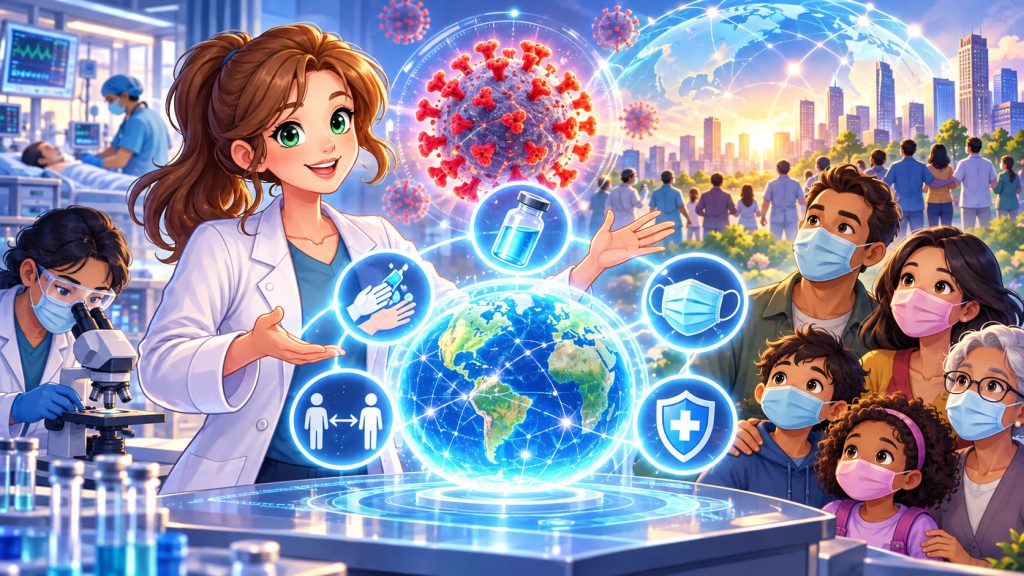
The COVID-19 pandemic became one of the most significant global events of the 21st century. Within months, a previously unknown virus disrupted international travel, overwhelmed hospitals, closed schools, and transformed everyday life for billions of people.
What began as an outbreak of unusual pneumonia in late 2019 developed into a worldwide public health emergency.
The pandemic exposed weaknesses in healthcare systems, accelerated medical innovation, and fundamentally changed how societies understand infectious diseases.
Millions of people lost their lives, while countless others experienced economic hardship, social isolation, and long-term health problems.
Yet the crisis also produced extraordinary scientific achievements.
The most important legacy of COVID-19 may be the lessons humanity learned about preparedness, medical science, international cooperation, and the importance of protecting public health.
How the COVID-19 Pandemic Began
COVID-19 is caused by a coronavirus called SARS-CoV-2.
The first recognized outbreak occurred in Wuhan, China, in December 2019, when doctors identified clusters of pneumonia cases associated with an unfamiliar respiratory infection.
In January 2020, scientists identified the virus and made its genetic sequence available to researchers worldwide.
This allowed laboratories to begin developing diagnostic tests and vaccines.
On January 30, 2020, the World Health Organization declared a Public Health Emergency of International Concern.
On March 11, 2020, the organization characterized COVID-19 as a pandemic.
The disease had already spread across numerous countries.
The speed of its international expansion demonstrated how interconnected modern societies had become.
Why Did COVID-19 Spread So Quickly?
COVID-19 spreads mainly through infectious respiratory particles released when infected individuals breathe, speak, sing, cough, or sneeze.
Some particles are small enough to remain suspended in the air, particularly in poorly ventilated indoor environments.
This form of transmission is known as airborne transmission.
One of the greatest challenges was that infected people could spread the virus before developing symptoms.
Some individuals never experienced noticeable symptoms at all.
This made traditional disease containment strategies more difficult.
Crowded indoor environments, international travel, and extensive social contact accelerated transmission.
The pandemic revealed that controlling respiratory infections requires understanding how viruses move through shared air, not simply cleaning frequently touched surfaces.
The Hidden Weaknesses of Healthcare Systems
Hospitals around the world faced extraordinary pressure during major infection waves.
Intensive care units filled rapidly.
Medical workers experienced shortages of protective equipment, while some healthcare systems struggled to provide sufficient oxygen, beds, and specialized treatment.
The crisis exposed weaknesses in medical supply chains and emergency planning.
Countries discovered that even sophisticated healthcare systems could become overwhelmed when large numbers of patients required treatment simultaneously.
The concept of healthcare surge capacity became particularly important.
This describes the ability of medical systems to expand services rapidly during emergencies.
A central lesson was that healthcare preparedness requires trained personnel, reliable supplies, flexible infrastructure, and coordinated emergency planning.
Vaccines: A Historic Scientific Achievement
One of the most remarkable developments was the rapid creation of effective COVID-19 vaccines.
The first vaccines received emergency authorizations in several countries in December 2020.
Their development benefited from decades of previous scientific research.
Some vaccines used mRNA technology, which delivers temporary genetic instructions that allow cells to produce a harmless viral protein and stimulate an immune response.
Other vaccines used viral vectors or traditional vaccine technologies.
Large clinical trials established that vaccines could substantially reduce the risk of severe COVID-19.
Real-world vaccination programs subsequently demonstrated major reductions in hospitalization and death, particularly among vulnerable populations.
Protection against infection was less durable and changed as new variants emerged.
The pandemic demonstrated that sustained investment in scientific research can make rapid medical innovation possible when an emergency occurs.
Why New Variants Changed the Pandemic
Viruses accumulate genetic changes as they replicate.
Some changes produce new viral variants with different characteristics.
During the pandemic, several variants became particularly important.
Alpha spread more efficiently than earlier strains.
Delta was associated with severe waves of infection and substantial pressure on hospitals.
Omicron spread rapidly and contained numerous mutations affecting the virus’s spike protein.
Its emergence in late 2021 changed the global epidemiological landscape.
The development of new variants demonstrated the importance of genomic surveillance.
By sequencing viral genomes, scientists can identify emerging variants and monitor their spread.
This information helps researchers evaluate vaccines, diagnostic tests, and treatment strategies.
Long COVID: The Pandemic’s Continuing Health Burden
For many patients, recovery did not end when the initial infection disappeared.
Some developed persistent symptoms lasting months or longer.
This condition is commonly called Long COVID.
Symptoms can include:
- Persistent fatigue
- Difficulty concentrating
- Shortness of breath
- Sleep disturbances
- Dizziness
- Reduced tolerance for physical activity
- Changes in smell or taste
The condition can affect people who initially experienced mild illness.
Researchers continue investigating its biological mechanisms, which may differ between patients.
Long COVID revealed that the consequences of infectious diseases cannot always be measured solely through hospitalizations and deaths.
The Importance of Ventilation and Indoor Air Quality
Before the pandemic, indoor air quality often received relatively little attention in everyday discussions about infectious disease prevention.
COVID-19 changed that.
Scientists demonstrated the importance of ventilation, filtration, and reducing exposure to airborne infectious particles.
Measures such as improved ventilation systems and portable air cleaners can reduce concentrations of airborne contaminants.
Well-fitting respiratory protection can also reduce exposure in higher-risk environments.
These measures form part of a broader strategy called layered prevention.
Rather than depending on one protective method, layered prevention combines several interventions.
Cleaner indoor air is an important public health investment that can help reduce the spread of multiple respiratory infections.
Misinformation Became a Global Challenge
The pandemic unfolded during an era of unprecedented digital communication.
Information traveled rapidly across social media platforms, messaging applications, and news websites.
Unfortunately, false or misleading claims spread alongside accurate scientific findings.
Misconceptions about vaccines, treatments, transmission, and disease severity complicated public health responses.
This phenomenon became widely known as an infodemic.
It demonstrated that access to information alone does not guarantee informed decisions.
Scientists and public health institutions must communicate clearly, explain uncertainty, and update recommendations as evidence changes.
Public trust became an essential component of effective disease control.
Mental Health and Social Consequences
The pandemic affected psychological well-being on a global scale.
Social isolation, uncertainty, illness, bereavement, and financial instability contributed to significant emotional stress.
Children and adolescents experienced interruptions to education and social development.
Many adults faced unemployment, disrupted routines, or increased caregiving responsibilities.
Healthcare workers encountered especially demanding conditions.
At the same time, remote communication, telemedicine, and digital learning expanded rapidly.
The experience demonstrated that public health emergencies affect entire societies, not merely the individuals infected by a disease.
Expert Perspective: Preparing for the Next Pandemic
World Health Organization Director-General Tedros Adhanom Ghebreyesus has repeatedly emphasized the importance of international cooperation, preparedness, and equitable access to healthcare during global health emergencies.
His public health leadership has highlighted weaknesses in international coordination and unequal access to vaccines and medical resources.
An essential lesson is that countries cannot effectively manage highly transmissible infectious threats entirely in isolation.
Rapid disease detection, transparent scientific communication, medical manufacturing capacity, and cooperation between governments are all critical.
Pandemic preparedness must become a permanent part of public health planning rather than an emergency reaction after a crisis begins.
What COVID-19 Taught Us About Global Cooperation
The pandemic demonstrated both the possibilities and limitations of international scientific cooperation.
Researchers shared viral sequences, conducted multinational clinical trials, and developed vaccines at unprecedented speed.
However, access to vaccines and treatments varied substantially between countries.
Wealthier nations often secured supplies earlier, while lower-income regions faced delays.
This exposed the importance of vaccine equity, ensuring that people have fair access to life-saving immunization regardless of geography or income.
Future pandemic responses will require stronger international manufacturing networks and more reliable distribution systems.
Is COVID-19 Over?
On May 5, 2023, the World Health Organization announced that COVID-19 no longer constituted a Public Health Emergency of International Concern.
This marked an important transition, not the disappearance of the disease.
SARS-CoV-2 continues to circulate, evolve, and cause infections.
Vaccination, population immunity, improved treatments, and better clinical experience have changed its overall impact.
However, older adults, immunocompromised individuals, and people with certain medical conditions remain at greater risk of severe illness.
The enduring lesson is that preparedness, vaccination, surveillance, and evidence-based prevention remain valuable even after an international emergency officially ends.
Interesting Facts
- COVID-19 was first recognized as an outbreak of unusual pneumonia in December 2019.
- The complete genetic sequence of SARS-CoV-2 was shared internationally in January 2020.
- The World Health Organization characterized COVID-19 as a pandemic on March 11, 2020.
- The first COVID-19 vaccines received emergency authorizations approximately one year after the disease was initially identified.
- The World Health Organization estimated approximately 14.9 million excess deaths worldwide associated directly or indirectly with the pandemic during 2020 and 2021.
- The pandemic accelerated the expansion of telemedicine and remote healthcare consultations.
- Wastewater monitoring became an important method for tracking the circulation of SARS-CoV-2 in communities.
- COVID-19 demonstrated that people without noticeable symptoms can still transmit certain respiratory viruses.
- The international COVID-19 public health emergency officially ended on May 5, 2023, although the virus continued circulating.
- Research into mRNA vaccines has contributed to the development of potential vaccines and treatments for other diseases.
Glossary
- SARS-CoV-2 — The coronavirus responsible for causing COVID-19.
- Airborne Transmission — The spread of infectious agents through particles suspended in the air.
- Healthcare Surge Capacity — The ability of healthcare systems to rapidly expand medical services during emergencies.
- mRNA Technology — A medical technology that uses messenger RNA to provide cells with temporary instructions for producing specific proteins.
- Variants — Genetically distinct forms of a virus that develop through mutations.
- Genomic Surveillance — The monitoring of genetic changes in pathogens to identify emerging strains and track their spread.
- Long COVID — A condition involving persistent or recurring symptoms following SARS-CoV-2 infection.
- Layered Prevention — The combination of multiple protective measures to reduce the risk of infection.
- Infodemic — The rapid spread of excessive, misleading, or false information during a public health emergency.
- Vaccine Equity — Fair and timely access to vaccines for populations regardless of income, geography, or social circumstances.