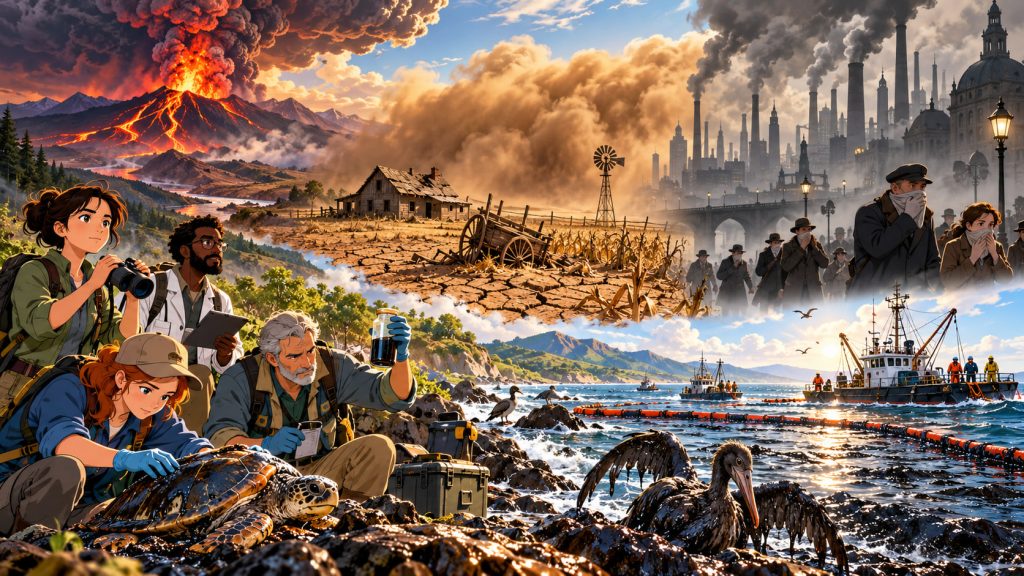
Throughout history, environmental disasters have transformed civilizations, destroyed communities, and forced humanity to reconsider its relationship with nature.
Some catastrophes began with powerful natural events, including volcanic eruptions and prolonged droughts. Others resulted from industrial pollution, irresponsible resource management, and technological failures.
Their consequences often extended far beyond the original disaster zones.
Entire industries disappeared, populations migrated, governments introduced new environmental laws, and scientific discoveries changed how societies understood ecological risks.
Some of the most important environmental policies and conservation movements emerged directly from the lessons of devastating disasters.
These historical events reveal how environmental damage can change not only landscapes but also the course of human history.
The 1815 Mount Tambora Eruption: The Year Without a Summer
In April 1815, Mount Tambora erupted on the Indonesian island of Sumbawa.
It was the most powerful volcanic eruption in recorded human history.
The explosion released enormous quantities of ash and gases into the atmosphere.
Sulfur dioxide formed volcanic aerosols that reflected some incoming sunlight and temporarily cooled Earth’s climate.
In 1816, unusually cold and unstable weather affected parts of Europe and North America.
The period became known as the Year Without a Summer.
Crop failures and food shortages caused widespread hardship.
The eruption demonstrated something scientists now understand clearly: a major volcanic event can influence climate conditions thousands of kilometers from its source.
The Dust Bowl: When American Farmland Turned Into Dust
During the 1930s, the Great Plains of the United States experienced one of the country’s worst environmental disasters.
Years of drought combined with extensive agricultural disturbance left large areas of soil vulnerable to wind.
Strong winds carried enormous clouds of dust across the region.
This process involved severe soil erosion, the removal of fertile topsoil by wind or water.
The Dust Bowl devastated agricultural production and contributed to the displacement of hundreds of thousands of people.
Many families abandoned farms and moved west in search of work.
The disaster encouraged major changes in agricultural policy.
In 1935, the United States established the Soil Conservation Service to promote better land-management practices.
The Dust Bowl demonstrated that agricultural productivity depends on protecting the soil itself.
The Great Smog of London: Pollution That Changed Public Health
In December 1952, London experienced an extraordinary air pollution disaster.
Cold weather, widespread coal burning, and stagnant atmospheric conditions trapped polluted air over the city.
A temperature inversion helped prevent contaminated air from dispersing upward.
Thick smog reduced visibility and caused severe respiratory problems.
Thousands of people died, with later estimates suggesting approximately 12,000 deaths associated with the event.
The disaster revealed the enormous health risks of uncontrolled urban air pollution.
In 1956, Britain introduced the Clean Air Act, which encouraged reductions in smoke emissions and the development of smoke-control areas.
The Great Smog became a turning point in modern air-quality regulation.
Minamata Disease: The Tragedy of Industrial Mercury Pollution
In the Japanese coastal city of Minamata, industrial wastewater containing mercury compounds contaminated the surrounding marine environment.
Microorganisms converted mercury into forms that entered aquatic food chains.
The process of bioaccumulation allowed toxic substances to build up in organisms over time.
Local residents who consumed contaminated fish and shellfish developed serious neurological illnesses.
Minamata disease was officially recognized in 1956.
Symptoms included impaired coordination, sensory disturbances, and severe neurological damage.
The disaster exposed the dangers of industrial chemicals entering food supplies.
It eventually influenced international efforts to control mercury pollution, including the Minamata Convention on Mercury adopted in 2013.
The Aral Sea Disaster: How Irrigation Destroyed a Giant Lake
The Aral Sea, located between present-day Kazakhstan and Uzbekistan, was once the world’s fourth-largest inland lake by surface area.
During the Soviet period, enormous quantities of river water were diverted to irrigate agricultural land, particularly cotton fields.
These diversions reduced the water reaching the sea.
Beginning in the 1960s, the Aral Sea shrank dramatically.
Rising salinity devastated many aquatic organisms and contributed to the collapse of commercial fisheries.
Exposed lakebed sediments also became sources of salt- and dust-laden storms.
Former fishing communities experienced unemployment, environmental degradation, and serious economic disruption.
However, restoration efforts have achieved partial success.
The Kok-Aral Dam, completed in 2005, helped restore water levels in the North Aral Sea.
The Aral Sea disaster demonstrates both the destructive consequences of poor water management and the possibilities of targeted ecosystem recovery.
Chernobyl: The Nuclear Disaster That Changed Energy Safety
On April 26, 1986, a reactor at the Chernobyl Nuclear Power Plant in present-day Ukraine exploded during a safety test.
The accident released substantial quantities of radioactive material into the environment.
Radioactive contamination affected soil, forests, water, and agricultural areas.
Large populations were evacuated or resettled, and extensive restrictions were introduced in contaminated territories.
Radiation exposure caused severe health consequences for emergency workers and increased thyroid cancer risks among people exposed as children.
The disaster also transformed international attitudes toward nuclear safety.
Governments strengthened emergency planning, international notification procedures, and reactor safety oversight.
Chernobyl remains an important example of how technological failures can produce environmental consequences lasting for decades.
The Deepwater Horizon Oil Spill: A Disaster Beneath the Ocean
In April 2010, an explosion aboard the Deepwater Horizon drilling platform caused a catastrophic offshore oil spill in the Gulf of Mexico.
Eleven workers died.
Oil continued escaping from the damaged well for approximately 87 days.
An estimated 4.9 million barrels of oil were released.
The disaster affected coastal wetlands, marine organisms, seabirds, and fishing communities.
Oil exposure can damage the health of animals and disrupt marine ecosystems through toxic effects and habitat contamination.
The accident prompted major investigations and changes in offshore drilling oversight.
It also highlighted the difficulty of containing industrial accidents in deep ocean environments.
Expert Perspective: Why Environmental Protection Requires Prevention
American marine biologist Rachel Carson helped transform public understanding of environmental pollution.
Her influential 1962 book, Silent Spring, examined how persistent chemical pesticides could affect wildlife, ecosystems, and human health.
Carson emphasized the connections between chemical contamination and the natural systems supporting life.
Her work contributed to growing public environmental awareness and influenced debates about pesticide regulation.
A central lesson from modern environmental science is that preventing ecological damage is often more effective than attempting to repair ecosystems after they have been severely disrupted.
How Environmental Disasters Changed Government Policies
Environmental catastrophes have repeatedly exposed weaknesses in existing institutions.
The Dust Bowl encouraged soil conservation programs.
London’s deadly smog accelerated air-quality legislation.
Industrial mercury poisoning contributed to stronger chemical safety controls.
Chernobyl encouraged greater international cooperation on nuclear emergencies.
These examples demonstrate the importance of environmental regulation.
Effective regulation establishes standards for industrial activities, pollution control, natural resource management, and public safety.
However, laws require reliable monitoring, enforcement, and scientific evaluation to achieve their objectives.
What Modern Society Can Learn From Past Disasters
Historical environmental disasters offer practical lessons for the future.
Several principles appear repeatedly:
- Protect natural resources before irreversible damage occurs.
- Monitor industrial pollution and emerging environmental risks.
- Maintain reliable emergency-response systems.
- Invest in scientific research and early-warning technology.
- Strengthen cooperation between governments and communities.
- Restore damaged ecosystems wherever recovery remains possible.
Modern civilization possesses advanced environmental monitoring systems that earlier generations could never have imagined.
Satellites can identify deforestation, instruments can detect atmospheric pollution, and computer models can simulate environmental risks.
The greatest lesson of environmental history is that scientific knowledge becomes most valuable when societies use it to prevent disasters rather than respond only after destruction occurs.
Interesting Facts
- The 1815 Tambora eruption contributed to unusually cold conditions during 1816, remembered as the Year Without a Summer.
- Dust from the American Dust Bowl sometimes traveled hundreds of kilometers and reached cities far from the Great Plains.
- The Great Smog of London led to major changes in British air-pollution legislation.
- Minamata disease demonstrated how industrial chemicals can contaminate food chains.
- The Aral Sea lost most of its original water volume following decades of excessive river diversion.
- Some wildlife populations continue to inhabit parts of the Chernobyl Exclusion Zone despite persistent environmental contamination.
- The Deepwater Horizon disaster became one of the largest marine oil spills in history.
- Several major environmental disasters directly influenced international agreements, regulatory reforms, and conservation programs.
Glossary
- Volcanic Aerosols — Tiny atmospheric particles produced following volcanic emissions that can influence sunlight and climate.
- Soil Erosion — The removal and transportation of soil by wind, water, or other processes.
- Temperature Inversion — An atmospheric condition in which warmer air lies above cooler air, potentially trapping pollution near the ground.
- Bioaccumulation — The gradual buildup of substances, including pollutants, inside living organisms.
- Salinity — The concentration of dissolved salts in water or soil.
- Radioactive Contamination — The presence of radioactive substances in the environment where they may create health or ecological risks.
- Marine Ecosystems — Communities of organisms and their surrounding environments in oceans and seas.
- Environmental Regulation — Laws and administrative measures designed to protect natural resources, control pollution, and reduce environmental risks.