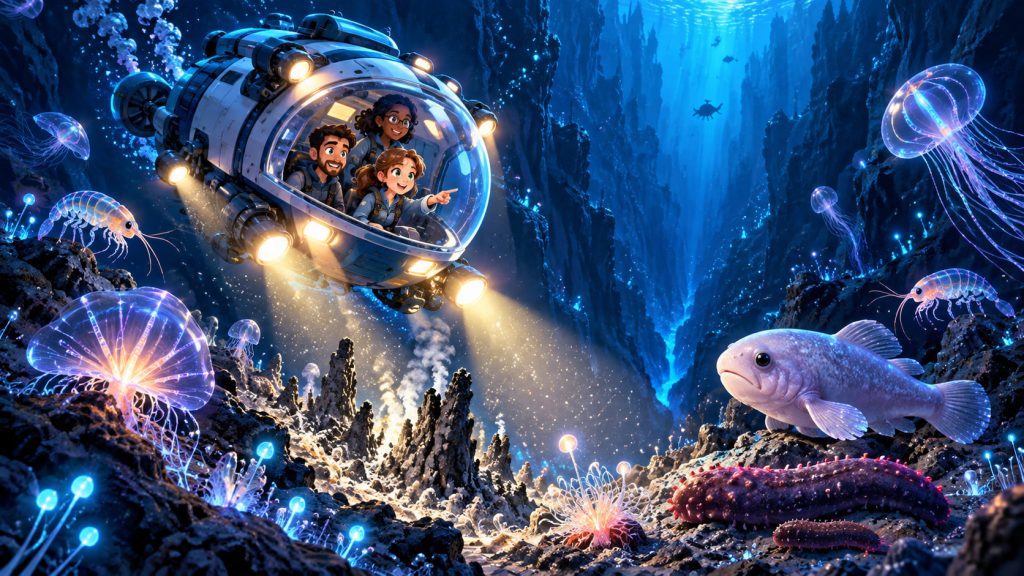
Almost 11 kilometers beneath the Pacific Ocean lies one of the most extraordinary environments on Earth.
No sunlight reaches this mysterious world. Water pressure is powerful enough to crush ordinary equipment, temperatures remain close to freezing, and food is extremely limited.
Yet this seemingly inhospitable environment is not lifeless.
Scientists have discovered remarkable organisms, unusual geological formations, and complex microbial ecosystems in the deepest parts of the ocean.
The ocean’s greatest depths contain living creatures that have evolved extraordinary adaptations to conditions humans could never survive without advanced technology.
What exactly exists at the bottom of the ocean, and how have scientists managed to explore such an extreme environment?
Where Is the Deepest Place on Earth?
The deepest known point in Earth’s oceans is called Challenger Deep.
It lies within the Mariana Trench in the western Pacific Ocean, southwest of Guam.
Modern measurements place its maximum depth at approximately 10,935 meters, or 35,876 feet.
To understand this enormous distance, imagine placing Mount Everest inside the trench.
Even the world’s highest mountain would remain submerged beneath more than two kilometers of water.
The trench formed through subduction, a geological process in which one tectonic plate moves beneath another.
In this region, the Pacific Plate descends beneath the Mariana Plate.
This ongoing movement has created one of Earth’s most dramatic underwater landscapes.
What Are Conditions Like at the Ocean Floor?
The deepest ocean trenches belong to the hadal zone, generally defined as ocean depths below 6,000 meters.
Conditions here differ enormously from those at the surface.
Sunlight is completely absent, and seawater temperatures typically remain only a few degrees above freezing.
The greatest challenge is hydrostatic pressure, the force exerted by the enormous weight of water above.
Near the bottom of Challenger Deep, pressure exceeds 1,000 times normal atmospheric pressure.
Ordinary submarines would collapse under these conditions.
Even specialized scientific equipment requires exceptionally strong materials and carefully engineered pressure-resistant structures.
Any organism living at these depths must possess biological adaptations that allow its cells and proteins to function under extreme pressure.
Strange Creatures Living in the Deepest Trenches
Despite the darkness and pressure, ocean trenches support specialized ecosystems.
Among the most abundant animals are amphipods, small crustaceans resembling shrimp.
Some species reach surprisingly large sizes compared with their shallow-water relatives.
One example is Hirondellea gigas, a deep-sea amphipod found in the Mariana Trench.
These animals feed on organic material that reaches the seafloor, including the remains of other organisms.
Scientists have also documented sea cucumbers, various worms, and other specialized invertebrates in deep trench environments.
Their bodies and metabolic processes are adapted to conditions that would severely damage most surface-dwelling animals.
Are There Fish at the Very Bottom?
Deep-sea fish are among the most fascinating ocean inhabitants.
Certain snailfish species can survive at extraordinary depths.
In 2022, researchers filmed a snailfish at 8,336 meters in the Izu-Ogasawara Trench near Japan. The finding was announced in 2023.
This became the deepest reliably documented observation of a living fish.
However, fish have not been confirmed living at the very bottom of Challenger Deep.
Scientists believe extreme pressure imposes physiological limits on how deeply most fish can survive.
At the greatest depths, invertebrates and microorganisms appear to dominate.
The deepest ocean ecosystems are not filled with giant fish or legendary sea monsters, but with highly specialized organisms adapted to extreme conditions.
How Do Deep-Sea Animals Find Food?
Without sunlight, ordinary photosynthesis cannot support life directly at the bottom of the trench.
Many deep-sea organisms depend on organic material descending from shallower waters.
This continuous fall of tiny particles is known as marine snow.
It consists of substances such as:
- Dead plankton and other organisms
- Microscopic biological fragments
- Organic waste
- Fecal pellets
- Decomposing plant and animal material
Larger food sources, including the remains of dead marine animals, can also reach the seabed.
Ocean trenches may concentrate some descending organic material because of their shape and surrounding geological features.
Even small quantities of food can support specialized communities adapted to limited resources.
Microscopic Life Beneath Extreme Pressure
Some of the most remarkable discoveries involve organisms too small to see without scientific instruments.
Researchers have identified diverse microbial communities in deep trench waters and sediments.
These microorganisms participate in the breakdown and recycling of organic material.
Some deep-sea microbes also obtain energy through chemical reactions, a process associated with chemosynthesis when that energy is used to build organic compounds.
However, ecosystems at the bottom of Challenger Deep rely substantially on organic matter originating in shallower waters.
Microorganisms are essential because they recycle nutrients and influence the chemistry of deep ocean sediments.
Even in complete darkness, microscopic life continues transforming matter and supporting biological processes.
Has Anyone Actually Reached the Bottom?
Humans have visited Challenger Deep using specially designed submersibles.
The first successful crewed descent occurred in 1960.
Swiss oceanographer Jacques Piccard and American naval officer Don Walsh reached the bottom aboard the bathyscaphe Trieste.
Their achievement demonstrated that humans could explore the deepest known ocean environment.
In 2012, filmmaker and explorer James Cameron completed a solo descent aboard Deepsea Challenger.
Later expeditions used advanced submersibles to conduct additional scientific observations and measurements.
In 2019, explorer Victor Vescovo reached Challenger Deep aboard the submersible Limiting Factor.
These missions expanded scientific knowledge of deep-sea geology, water conditions, and marine life.
How Scientists Explore Without Going Down Themselves
Human expeditions are expensive and technically challenging.
Scientists therefore frequently use robotic exploration systems.
Specialized autonomous instruments called hadal landers descend to the seabed and conduct experiments without human passengers.
These devices may carry cameras, lighting systems, baited traps, sensors, and sample containers.
Researchers also use sonar to map underwater terrain.
Some robotic vehicles can collect sediment, measure environmental conditions, and film animals in their natural habitats.
These technologies allow scientists to investigate regions that remain difficult for humans to visit directly.
Plastic Pollution Has Reached the Ocean’s Greatest Depths
One of the most troubling discoveries in deep-ocean research is the presence of human-generated pollution.
A plastic bag was documented at approximately 10,898 meters in the Mariana Trench.
Researchers have also discovered microplastics and synthetic fibers inside deep-sea animals.
A study published in 2019 examined amphipods collected from six Pacific Ocean trenches.
Of the 90 animals examined, 65 contained at least one microscopic particle, including synthetic or other manufactured fibers.
These findings demonstrate that even Earth’s most remote marine environments are connected to human activity.
Ocean currents, sinking organic material, and other transport processes can carry pollutants into deep-water ecosystems.
What Mysteries Remain Unsolved?
Despite major technological advances, the deepest ocean remains incompletely explored.
Scientists continue investigating how organisms tolerate enormous pressure, how trench ecosystems exchange nutrients, and how geological processes influence marine biodiversity.
Important questions remain about the diversity of microscopic life and the long-term effects of pollutants.
Marine biologist Alan Jamieson, a leading researcher of deep-ocean ecosystems, has spent years investigating the distribution and adaptations of animals living in ocean trenches.
His research demonstrates that hadal environments contain distinctive biological communities rather than simply being empty extensions of shallower seas.
Exploring the deepest ocean helps scientists understand the limits of life, the evolution of extreme-environment organisms, and the interconnected nature of Earth’s ecosystems.
Interesting Facts
- Challenger Deep reaches approximately 10,935 meters below sea level.
- Mount Everest would fit entirely beneath the water inside the deepest part of the Mariana Trench.
- Water pressure near the bottom exceeds 1,000 times the atmospheric pressure experienced at sea level.
- The first humans reached Challenger Deep in 1960 aboard the bathyscaphe Trieste.
- The deepest reliably filmed fish was recorded at 8,336 meters in the Izu-Ogasawara Trench.
- Amphipods have been collected from depths approaching 11 kilometers.
- A plastic bag was documented at 10,898 meters in the Mariana Trench.
- Deep-sea microorganisms help recycle organic material even where sunlight never penetrates.
- Ocean trenches are associated with tectonic activity and can experience powerful earthquakes.
Glossary
- Challenger Deep — The deepest known point in Earth’s oceans, located within the Mariana Trench in the western Pacific.
- Subduction — A geological process in which one tectonic plate moves beneath another and descends into Earth’s interior.
- Hadal Zone — The deepest ocean depth zone, generally beginning at approximately 6,000 meters.
- Hydrostatic Pressure — The pressure exerted by a fluid due to the weight of the fluid above a particular point.
- Amphipods — Small crustaceans found in marine and freshwater environments, including some of the deepest ocean trenches.
- Snailfish — A family of fishes containing species adapted to extremely deep marine environments.
- Marine Snow — Organic particles that continuously sink from upper ocean waters toward deeper environments.
- Chemosynthesis — The production of organic compounds using energy obtained from chemical reactions rather than sunlight.
- Hadal Landers — Specialized autonomous scientific devices designed to descend to and collect data from the deepest ocean environments.
- Microplastics — Small plastic particles generally measuring less than five millimeters.