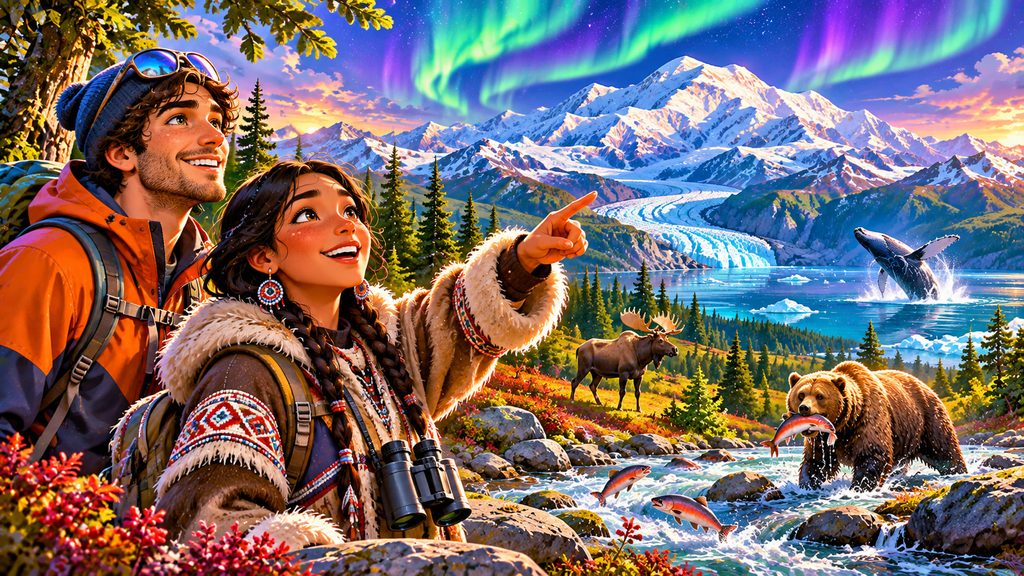
Imagine a place where enormous glaciers flow between towering mountains, brown bears hunt salmon in crystal-clear rivers, and the northern lights transform the night sky into a spectacular display of green and purple. In summer, the sun may remain visible for twenty-four hours, while winter brings extraordinary darkness to the Arctic landscape. This is Alaska, one of the most fascinating and geographically diverse regions on Earth.
Although many people imagine Alaska as a permanently frozen wilderness, the reality is far more surprising. Its landscapes include temperate rainforests, active volcanoes, enormous lakes, and coastal waters filled with marine life. Alaska is not simply America’s largest state; it is a remarkable natural laboratory where geology, wildlife, climate, and human history come together.
Why Is Alaska So Different From the Rest of America?
Alaska covers approximately 1.7 million square kilometers, making it the largest state in the United States by a considerable margin. It is more than twice the size of Texas and stretches from the temperate coastal forests of the southeast to the frozen Arctic Ocean. Its enormous territory contains mountains, tundra, wetlands, glaciers, islands, and vast stretches of wilderness.
Unlike most American states, Alaska is separated from the contiguous United States by Canada. Its remote geography has helped preserve extensive natural landscapes, while also making transportation and infrastructure particularly challenging. Many communities remain accessible primarily by aircraft or boat, demonstrating how geography continues to shape everyday life in the modern world.
Denali: The Highest Mountain in North America
One of Alaska’s most extraordinary natural landmarks is Denali, also officially known as Mount McKinley, which reaches approximately 6,190 meters above sea level. It is the highest mountain in North America and dominates a breathtaking landscape of glaciers, valleys, and snowy peaks.
Although Mount Everest stands higher above sea level, Denali rises dramatically from the surrounding lowlands, giving it one of the most impressive vertical profiles of any major mountain. Its extreme weather, powerful winds, and freezing temperatures make climbing exceptionally demanding.
The surrounding Denali National Park and Preserve protects approximately six million acres of wilderness, providing habitat for grizzly bears, wolves, moose, and Dall sheep. This vast protected landscape demonstrates how entire ecosystems can function with relatively limited human development.
Alaska’s Glaciers: Rivers of Ice That Never Stop Moving
Alaska contains tens of thousands of glaciers, ranging from small mountain ice formations to enormous ice fields covering hundreds of square kilometers. These glaciers develop when accumulated snow gradually compresses into dense ice, which slowly moves downhill under its own weight.
Despite appearing motionless, glaciers are constantly changing. Some move several meters over short periods, while others advance or retreat over years and decades. Their movement reshapes valleys, transports rocks, and creates distinctive landscapes that reveal the tremendous power of ice.
Scientists studying Alaska’s glaciers have documented substantial ice loss associated with rising temperatures. The retreat of glaciers contributes to global sea-level rise and provides visible evidence of how Earth’s climate is changing.
Why Does Alaska Experience the Midnight Sun?
One of Alaska’s strangest natural phenomena is the midnight sun, which occurs in areas north of the Arctic Circle during summer. Because Earth’s rotational axis is tilted, these northern regions experience periods when the sun remains above the horizon throughout an entire twenty-four-hour day.
During winter, the opposite phenomenon occurs, bringing periods when the sun does not rise above the horizon. In Utqiagvik, one of America’s northernmost communities, this seasonal darkness lasts for more than two months.
However, not all of Alaska experiences continuous summer daylight or winter darkness. Southern cities such as Anchorage still experience ordinary sunrises and sunsets, although seasonal daylight differences remain dramatic.
The Northern Lights: Nature’s Most Spectacular Light Show
Alaska is famous for the aurora borealis, commonly called the northern lights. These extraordinary displays occur when electrically charged particles associated with solar activity interact with Earth’s magnetic environment and collide with gases in the upper atmosphere.
The resulting energy produces glowing curtains, arcs, and waves of light that move across the night sky. Oxygen commonly produces green and red emissions, while nitrogen contributes other colors, including blue and purple.
Researchers at the University of Alaska Fairbanks study auroras using cameras, magnetic instruments, satellites, and scientific rockets. The northern lights are not merely beautiful; they provide valuable information about how the Sun interacts with Earth’s atmosphere and magnetic field.
Brown Bears, Moose, and the Extraordinary Wildlife of Alaska
Alaska supports some of North America’s most impressive wildlife populations. Brown bears gather near salmon streams during spawning seasons, while moose browse through forests and wetlands. Wolves, caribou, mountain goats, and numerous migratory birds occupy different habitats across the state.
Its coastal waters are equally remarkable, supporting humpback whales, orcas, sea otters, seals, and other marine animals. Seasonal salmon migrations transfer nutrients from the ocean into freshwater ecosystems, supporting predators, scavengers, and surrounding vegetation.
These ecological relationships demonstrate how strongly wildlife populations depend on healthy habitats. Alaska’s wilderness is not simply a collection of spectacular animals but a network of interconnected ecosystems.
A Land of Volcanoes and Powerful Earthquakes
Alaska lies along an active region of Earth’s crust where tectonic plates interact. It contains numerous potentially active volcanoes, particularly along the Aleutian Islands, where the Pacific Plate descends beneath the North American Plate.
The region also experiences powerful earthquakes. On March 27, 1964, a magnitude 9.2 earthquake struck southern Alaska, becoming the strongest earthquake ever recorded in the United States. The disaster caused widespread destruction and generated devastating tsunamis.
Geologist George Plafker’s investigations helped explain the earthquake through large-scale movement along a subduction zone, strengthening scientific understanding of plate tectonics. Alaska remains one of the world’s most important regions for studying the forces that reshape Earth’s surface.
Who Lived in Alaska Before It Became an American State?
Alaska has been inhabited by Indigenous peoples for thousands of years, long before European explorers arrived. Communities including Iñupiat, Yup’ik, Unangax̂, Tlingit, and Athabascan peoples developed diverse languages, traditions, and sophisticated ways of living in environments ranging from Arctic tundra to coastal rainforests.
Their knowledge of local ecosystems, wildlife, seasonal cycles, and navigation remains an important part of Alaska’s cultural heritage. Indigenous communities continue to preserve and develop their cultures while participating in contemporary Alaskan society.
In 1867, the United States purchased Alaska from Russia for $7.2 million, a transaction involving territory already inhabited by Indigenous peoples who were not parties to the agreement. Alaska eventually became the forty-ninth American state on January 3, 1959.
Alaska and the Future of Earth’s Climate
Alaska is particularly important to climate researchers because its northern landscapes are highly sensitive to warming. Rising temperatures influence glaciers, snow cover, coastal erosion, and permafrost, the ground that remains frozen for at least two consecutive years.
When permafrost thaws, it can destabilize roads, buildings, and other infrastructure. Decomposition of previously frozen organic material can also release greenhouse gases, creating additional interactions between Arctic ecosystems and the global climate.
Alaska’s forests, oceans, glaciers, and frozen landscapes therefore provide scientists with valuable information about environmental change. Understanding what happens in Alaska can help us better understand changes affecting the entire planet.
With towering mountains, extraordinary wildlife, ancient cultures, and natural phenomena found in few other places, Alaska remains one of Earth’s most remarkable regions. Which Alaskan experience would you most like to witness: the northern lights, an enormous glacier, the midnight sun, or wildlife living in untouched wilderness? Share your thoughts in the comments!
Interesting Facts
- Alaska is more than twice the size of Texas, making it the largest American state.
- Denali rises approximately 6,190 meters above sea level, making it North America’s highest mountain.
- Alaska contains an estimated 100,000 glaciers, although estimates vary depending on how glaciers are defined and counted.
- In northern Alaska, the midnight sun can remain visible for weeks during summer.
- The 1964 Great Alaska Earthquake reached magnitude 9.2, making it the second-largest earthquake recorded with modern instruments.
- Alaska was purchased from Russia for $7.2 million in 1867.
- The state contains both Arctic tundra and temperate rainforests, two dramatically different ecosystems.
- Some Alaskan communities cannot be reached through the ordinary highway network and depend heavily on boats or aircraft.
Glossary
- Aurora Borealis — A natural atmospheric light display caused by interactions between charged particles and gases in Earth’s upper atmosphere.
- Midnight Sun — A phenomenon in which the sun remains visible for twenty-four hours or longer in high-latitude regions during summer.
- Polar Night — A period when the sun does not rise above the horizon in areas within the polar circles.
- Glacier — A large mass of ice formed from compressed snow that moves gradually under its own weight.
- Permafrost — Ground that remains at or below freezing temperature for at least two consecutive years.
- Tundra — A largely treeless ecosystem characterized by cold conditions and low-growing vegetation.
- Subduction Zone — A region where one tectonic plate moves beneath another.
- Plate Tectonics — The scientific theory explaining the movement of Earth’s large crustal plates.
- Ecosystem — A community of living organisms interacting with one another and their physical environment.
- Climate Change — Long-term changes in temperature, precipitation, and other characteristics of Earth’s climate system.