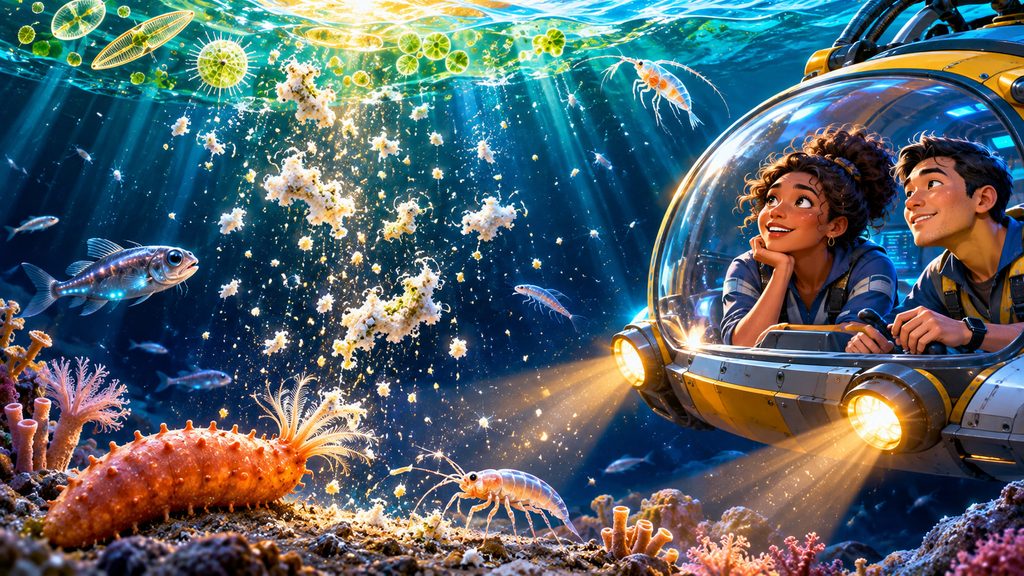
Imagine descending thousands of meters beneath the ocean’s surface, far beyond the reach of sunlight. The surrounding water is dark, cold, and seemingly empty, yet countless tiny particles drift slowly past like snowflakes falling through a winter sky. This extraordinary phenomenon is known as marine snow, and it is one of the most important processes sustaining life in the deep ocean.
Unlike ordinary snow, marine snow is not made of frozen water. It consists of organic debris, microscopic organisms, and other particles descending from the sunlit ocean toward the seafloor. This continuous underwater snowfall provides food for deep-sea creatures and helps transport carbon away from the atmosphere, making it essential to both marine ecosystems and Earth’s climate.
What Exactly Is Marine Snow?
Marine snow is a mixture of tiny particles that gradually sink through the ocean’s water column. These particles include dead plankton, fragments of marine organisms, fecal material, mucus, bacteria, and mineral grains. As they drift downward, smaller particles can stick together, forming larger aggregates that resemble fluffy underwater snowflakes.
Some marine snow particles are almost invisible, while larger clusters may reach several centimeters across. Their appearance can be surprisingly delicate, with irregular shapes that move gently through ocean currents. Although this material may seem insignificant, it forms a vital connection between life near the ocean’s surface and organisms living in the darkest depths.
How Does Marine Snow Form?
The process begins in the upper ocean, where sunlight allows microscopic organisms called phytoplankton to perform photosynthesis. These tiny organisms absorb carbon dioxide and use sunlight to produce organic material that supports marine food webs. When plankton die, are consumed, or release waste, some of their remains begin sinking.
Many marine organisms also produce sticky mucus that helps smaller particles bind together. As these fragments collide, they form larger aggregates that can sink faster than individual microscopic particles. This process transforms scattered biological debris into a continuous downward movement of nutrients and organic carbon.
Why Does the Deep Ocean Depend on Marine Snow?
Sunlight cannot penetrate the deepest parts of the ocean, meaning photosynthesis cannot support most organisms living there. Instead, many deep-sea animals depend on nutrients produced far above them. Marine snow provides an essential source of energy for creatures that filter particles from the water or collect organic matter from the seabed.
Sea cucumbers, certain crustaceans, worms, and numerous microscopic organisms benefit from this steady supply of food. Some animals capture sinking particles directly, while others feed on sediment enriched by decomposing material. Without this underwater food delivery system, many deep-sea ecosystems would have considerably less energy available to sustain life.
How Long Does Marine Snow Take to Reach the Seafloor?
The journey of a marine snow particle can be surprisingly long. Its sinking speed depends on size, density, shape, and surrounding water conditions. Small, loosely packed particles may descend slowly, while larger aggregates and dense fecal pellets can travel hundreds of meters in a day.
Some particles reach deep waters within days, while others remain suspended for weeks or longer. Ocean currents may transport them considerable distances from their original location, creating complex pathways between surface ecosystems and the seafloor. During this journey, particles can break apart, combine with other material, or become food for marine organisms.
The Ocean’s Biological Carbon Pump
Marine snow plays a major role in a natural process known as the biological carbon pump. Near the surface, phytoplankton absorb carbon dioxide during photosynthesis and incorporate carbon into their cells. When organic material sinks, some of this carbon is transported into deeper waters.
Much of the sinking material is consumed or decomposed before reaching great depths, returning carbon to the surrounding water. However, a portion travels deep enough to remain separated from the atmosphere for centuries or even longer. This natural transfer of carbon helps regulate Earth’s climate by influencing how much carbon dioxide remains in the atmosphere.
What Happens to Marine Snow During Its Descent?
Marine snow does not remain unchanged as it travels through the ocean. Bacteria colonize organic particles and break down their components, while small animals consume fragments and release waste that may form new sinking particles. Some aggregates become smaller, while others grow through collisions with surrounding debris.
These transformations influence how much carbon eventually reaches the deep ocean. Biological oceanographer Dr. Colleen Durkin of the Monterey Bay Aquarium Research Institute studies marine snow and the microorganisms associated with sinking particles. Her research helps explain how interactions between microscopic life and organic debris influence carbon transport through the ocean.
Can Marine Snow Affect Global Climate?
The ocean is one of Earth’s most important carbon reservoirs, and marine snow contributes to the movement of carbon between surface waters and the deep sea. When organic particles carry carbon downward, they can reduce the amount available for rapid exchange with the atmosphere. Carbon that reaches sufficiently deep waters may remain isolated for hundreds or thousands of years.
However, the efficiency of this process depends on marine ecosystems, ocean temperature, circulation, and the activity of microorganisms. Changes in these conditions can alter how much organic carbon sinks and how much is recycled closer to the surface. Understanding marine snow therefore helps scientists investigate how ocean ecosystems respond to environmental change.
How Do Scientists Study an Underwater Snowstorm?
Studying marine snow is challenging because particles are fragile, often microscopic, and distributed across enormous ocean depths. Scientists use remotely operated underwater vehicles equipped with cameras to observe sinking material in its natural environment. These vehicles can reveal spectacular scenes of particles drifting through dark water like an endless underwater blizzard.
Researchers also deploy sediment traps, instruments designed to collect material as it sinks. By analyzing these samples, they can measure particle composition, investigate microorganisms, and estimate the movement of carbon through different ocean layers. Advanced imaging and genetic techniques provide additional insights into the hidden biological communities traveling with marine snow.
Marine Snow and the Future of Ocean Research
Although marine snow has been studied for decades, scientists continue discovering new details about its ecological importance. Research into sinking particles can reveal how marine food webs function, how nutrients circulate, and how much organic carbon becomes stored in deep waters.
Marine snow can also carry nonbiological particles, including certain pollutants and microplastics, making its movement relevant to studies of ocean contamination. These discoveries show that even tiny drifting fragments can connect distant marine environments through complex biological and chemical processes.
Marine snow is a reminder that some of Earth’s most important natural systems operate almost entirely beyond human sight. Which fact surprises you most: that deep-sea animals depend on falling organic debris, or that these tiny particles help regulate the planet’s climate? Share your thoughts in the comments!
Interesting Facts
- Marine snow is not frozen water but a mixture of biological debris, microorganisms, and other sinking particles.
- Some marine snow aggregates can grow several centimeters across as smaller particles stick together.
- Individual particles may take days, weeks, or longer to descend through deep ocean waters.
- Marine snow provides food for numerous organisms living in regions where sunlight never reaches.
- Certain fast-sinking particles, including compact zooplankton fecal pellets, can descend more than a thousand meters per day.
- The biological carbon pump can transport carbon into deep waters where it may remain for centuries or thousands of years.
- Underwater vehicles frequently encounter dense clouds of marine snow that resemble snowfall in the darkness.
Glossary
- Marine Snow — Organic and inorganic particles that sink through the ocean, resembling underwater snowfall.
- Phytoplankton — Microscopic photosynthetic organisms that form the foundation of many marine food webs.
- Zooplankton — Small marine animals and drifting organisms that feed on plankton and other particles.
- Photosynthesis — The process through which organisms use light energy to produce organic compounds from carbon dioxide.
- Biological Carbon Pump — The natural movement of carbon from surface waters into the deeper ocean through biological processes.
- Marine Aggregate — A cluster of organic and inorganic particles bound together in seawater.
- Sediment Trap — A scientific instrument used to collect sinking particles in aquatic environments.
- Carbon Sequestration — The storage of carbon in reservoirs such as deep ocean waters or sediments for extended periods.
- Water Column — The vertical body of water extending from the ocean surface to the seafloor.
- Decomposition — The breakdown of organic material through biological and chemical processes.