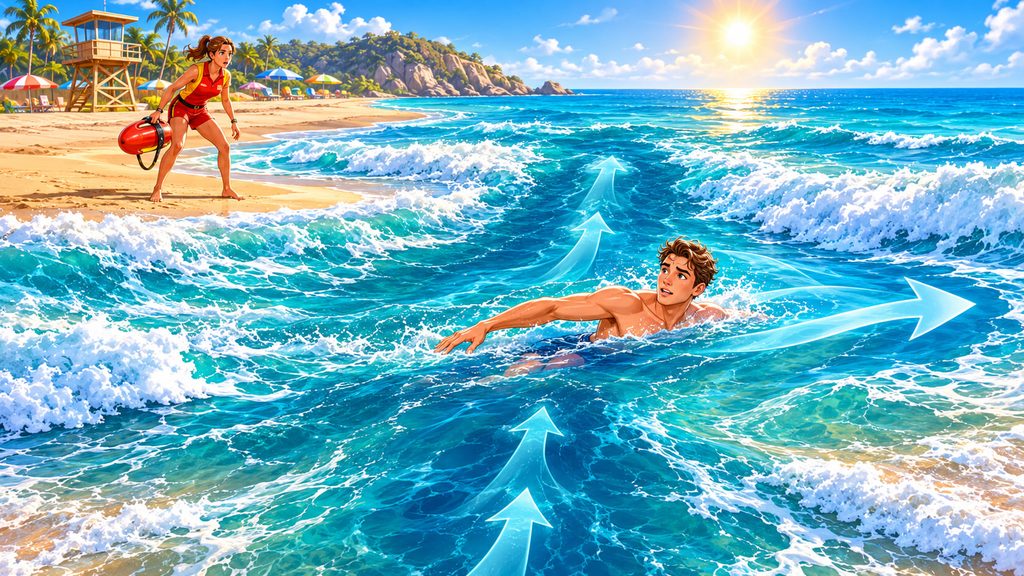
The beach is only a few strokes away. Then something changes. You swim toward the sand, but the shoreline seems to drift farther away, as though an invisible conveyor belt has switched on beneath you. An ordinary swim becomes a frightening encounter with a rip current.
The greatest danger is not being dragged underwater; it is being carried away from shore and becoming exhausted while trying to fight the flow. Knowing where rips form and how to respond can save lives.
What Is a Rip Current?
A rip current is a concentrated flow of water moving from the shoreline toward deeper water through the surf zone. Waves push water toward the beach, and some of that water returns seaward through narrow channels. The result can be a fast-moving stream cutting through the incoming waves.
Rips often develop near gaps in sandbars, underwater ridges of sand shaped by waves. They also occur beside piers, jetties, and rocks. Unlike a river, a rip is not necessarily visible as a clearly defined stream.
Why Can Rip Currents Be So Dangerous?
Their speed becomes dangerous when swimmers try to return directly to shore. NOAA reports typical speeds of one to two feet per second, with exceptional currents reaching eight feet per second. At that speed, even an excellent swimmer cannot reliably make progress against the flow.
As people struggle, their breathing accelerates and energy disappears. Panic can make it harder to think clearly or remain afloat in rough water. A rip current carries swimmers outward, not down to the seabed, but exhaustion and breaking waves can still cause drowning.
How to Recognize a Rip Current From the Beach
Before entering the sea, spend a moment watching how the waves break. One possible warning sign is a darker, relatively smooth-looking corridor between strips of foamy whitewater. Another is foam or seaweed moving steadily seaward.
A rip may also appear as an area of churning water or a break in an otherwise consistent pattern of waves. These clues can vanish in rough surf or poor lighting. Water that looks strangely calm between breaking waves may be the most dangerous place to swim.
What to Do If You Are Caught in a Rip Current
First, stay calm and keep your head above water. Avoid sprinting straight toward the beach against the current: that is often the quickest way to exhaust yourself. Breathe, float, and look for breaking waves on either side.
If you can swim comfortably, move sideways parallel to the shoreline, toward breaking waves and out of the narrow outward flow. Once the pull weakens and you have cleared the current, swim diagonally back toward the beach, allowing suitable waves to help you. If swimming becomes difficult, conserve energy.
What If You Cannot Swim Out?
Roll onto your back or tread water calmly to preserve strength. Some rip currents weaken beyond the breaking waves, while others form circulating patterns that may carry floating objects back toward shore. Never assume the sea will return you automatically.
Face the beach when possible, wave an arm, and shout for assistance. Lifeguards are trained to recognize the danger and perform water rescues. Floating and signaling for help are safer than repeatedly exhausting yourself against a current you cannot overpower.
Do Rip Currents Pull Swimmers Underwater?
Despite their reputation, rip currents are primarily horizontal flows. They move people away from the beach rather than sucking them down like a drain. Waves can knock someone beneath the surface, but that is different from the current itself pulling vertically downward.
Rip currents are also often confused with undertow and rip tides. Undertow describes a return flow near the seabed beneath incoming waves, while a rip tide properly refers to tidal flow through an inlet or similar narrow passage. Understanding the distinction helps replace an alarming myth with practical survival knowledge.
Where and When Are Rip Currents Most Likely?
Rip currents occur on ocean beaches and some large lakes, including the North American Great Lakes. Their position and strength depend on wave conditions, the shape of the seabed, and coastal structures. They can develop on pleasant sunny days when storms far offshore send energetic swell toward the coast.
Tides affect rips, but no tide level is universally safe. Even experienced swimmers should pay attention to local warnings, especially near piers and rock barriers. The best precaution is to swim at a lifeguard-patrolled beach within designated areas.
What Should You Do If Someone Else Is Swept Away?
Seeing someone struggle can trigger an immediate impulse to jump in. Unfortunately, untrained would-be rescuers can become victims themselves. Alert a lifeguard immediately, or call the local emergency number if no lifeguard is available.
Safely throw a rescue ring or other flotation device. From shore, encourage the person to float, signal for help, and move sideways out of the current if able. Do not enter dangerous surf for an improvised rescue; trained rescuers and flotation equipment are essential.
How to Make Every Beach Visit Safer
Check local surf forecasts and warning flags before swimming, and ask lifeguards about conditions. Never assume the ocean is safe because other people are in the water or the weather is beautiful. Children and inexperienced swimmers require particularly close supervision near breaking waves.
NOAA oceanographer Greg Dusek emphasizes calmness, floating, and not swimming against a rip. His practical advice reflects a simple principle: understand the water’s movement instead of trying to overpower it. Have you ever noticed a suspiciously calm channel between waves, or seen someone caught in a current? Share what you learned in the comments.
Interesting Facts
- Rip currents can reach measured speeds of eight feet per second, faster than even elite swimmers can sustain.
- They are responsible for more than 80% of rescues performed by lifeguards at U.S. surf beaches.
- A rip current can form near a gap in a sandbar or beside a jetty.
- Some rip currents circulate water back toward the beach, while others extend beyond the breaking waves.
- Rip currents occur on large freshwater lakes as well as ocean coastlines.
- A distant storm can generate waves that create dangerous rip currents on an otherwise sunny beach.
Glossary
- Rip Current — A concentrated, often fast flow of water moving away from shore through the surf zone.
- Sandbar — A submerged or partly exposed ridge of sand shaped by waves and currents.
- Undertow — A return movement of water near the seabed beneath incoming waves, distinct from a rip current.
- Rip Tide — Strong tidal water movement through an inlet or similarly confined passage, not the same as a beach rip current.
- Swell — Waves that have traveled away from the wind or storm that generated them.
- Surf Forecast — A prediction of coastal wave conditions and related hazards, sometimes including rip-current risk.