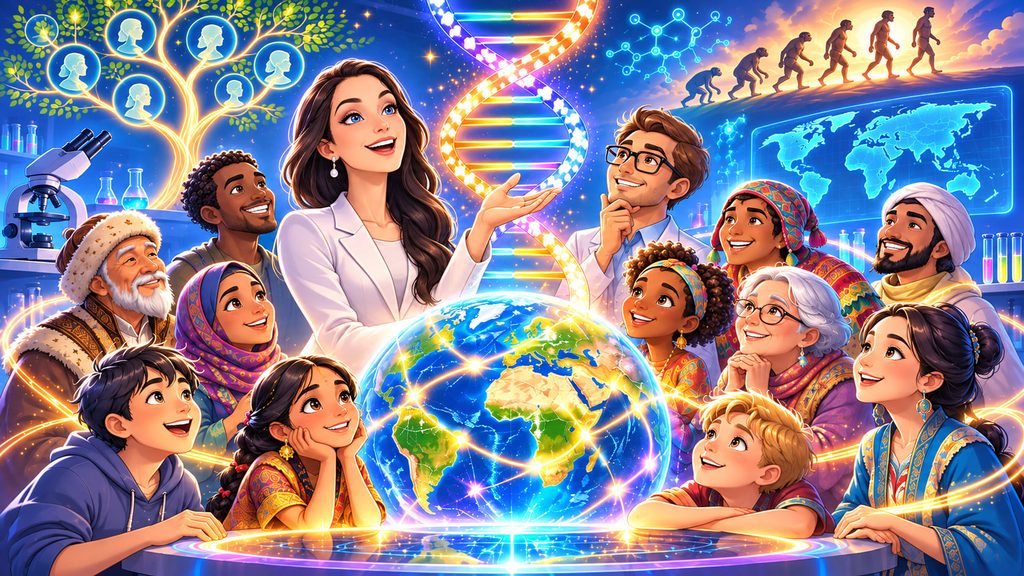
Imagine walking past a complete stranger on the other side of the world and discovering that you share an ancestor. You might speak different languages, have different appearances, and belong to entirely different cultures, yet your family histories could be connected in ways neither of you ever imagined. What sounds like an extraordinary coincidence is actually part of the fascinating story of human evolution.
Modern genetics has revealed something remarkable: all humans belong to one enormous, interconnected family. Our ancestors traveled across continents, survived dramatic environmental changes, and formed countless generations of families long before recorded history began.
From mysterious ancient ancestors to hidden connections in our DNA, scientific discoveries are revealing just how closely humanity is related.
Humans Share Approximately 99.9% of Their DNA
One of the most surprising discoveries in modern genetics is how similar humans are at the molecular level. Although people display an extraordinary variety of physical characteristics, the DNA sequences of two individuals are approximately 99.9% identical on average. This familiar estimate mainly concerns comparisons of corresponding DNA sequences, while other kinds of genetic variation add further complexity.
The remaining differences contribute to variations in appearance, inherited characteristics, and susceptibility to certain diseases. However, genetics is only part of the story because nutrition, environment, lifestyle, and individual development also influence who we become. The biological similarities connecting humans are far greater than the genetic differences separating them, making our species remarkably unified despite its visible diversity.
Every Human Has Ancient Roots in Africa
Scientific evidence indicates that Homo sapiens evolved in Africa approximately 300,000 years ago. Early human populations gradually developed the characteristics associated with our species while adapting to changing environments, discovering new resources, and developing increasingly sophisticated behaviors.
Over thousands of generations, groups of humans migrated into Asia, Europe, Australia, and eventually the Americas. These movements did not happen during one enormous journey but through multiple migrations, population expansions, and encounters with other human groups. As communities settled in different regions, their descendants developed distinct cultural traditions and genetic patterns.
Every living human population ultimately traces its evolutionary origins to Africa, a continent that still contains the greatest genetic diversity among modern humans.
Your Family Tree Is Bigger Than You Can Imagine
Most people know their parents, grandparents, and perhaps several earlier generations of relatives. However, the mathematics of ancestry reveals something astonishing when we continue tracing family relationships backward. Every person has two biological parents, four grandparents, eight great-grandparents, and a theoretically doubling number of ancestral positions with each previous generation.
After thirty generations, a family tree contains more than one billion theoretical ancestral positions. Yet this does not mean someone actually has that many different ancestors during that period, because family trees repeatedly overlap as distant relatives have children together.
Scientists call this phenomenon pedigree collapse, and it occurs in every human family tree. It explains why people from apparently unrelated families can share numerous ancestors and why the ancestry of entire populations becomes increasingly interconnected as we travel backward through history.
The Mysterious Woman Known as Mitochondrial Eve
One of the most fascinating discoveries in human genetics concerns an ancient woman commonly known as Mitochondrial Eve. She represents the most recent common ancestor of all living humans through an uninterrupted line of mothers, grandmothers, and earlier maternal ancestors.
Scientists can investigate these relationships using mitochondrial DNA, which is generally passed from mothers to their children. By comparing this genetic material in people around the world, researchers can reconstruct maternal lineages and estimate when they converged.
However, Mitochondrial Eve was neither the first woman nor the only woman alive during her lifetime. Many other women lived alongside her and contributed to the ancestry of later generations. Her unique significance comes from the fact that her direct maternal lineage survived through every generation to the present day.
Neanderthals Still Live Within Our DNA
For generations, Neanderthals were regarded as distant prehistoric relatives who disappeared without leaving a meaningful genetic legacy. Ancient DNA research dramatically changed that picture by revealing that Neanderthals interbred with some ancestors of modern humans tens of thousands of years ago.
Today, many people with ancestry outside Africa carry approximately 1–2% Neanderthal-derived DNA. These genetic fragments provide evidence of encounters between different ancient human populations, while some inherited variants have been associated with characteristics involving immunity, skin biology, and metabolism.
Nobel Prize-winning geneticist Svante Pääbo played a pioneering role in uncovering these connections through his research on ancient genomes. His work helped establish that human evolution was not simply a sequence of isolated species replacing one another, but a complex history that included migration, interaction, and genetic exchange.
Why Do Humans Look So Different?
If humans are genetically so similar, why do people around the world have different skin tones, facial features, and other physical characteristics? The explanation involves thousands of generations of evolution, migration, inherited variation, and adaptation to different environments.
Skin pigmentation provides a particularly interesting example. Melanin helps protect the skin from ultraviolet radiation, and variation in pigmentation reflects a complex evolutionary history involving sunlight exposure and other factors. Additional physical characteristics have been influenced by population history, genetic drift, natural selection, and combinations of inherited traits.
However, visible appearance tells only a small part of someone’s genetic story. Individuals who look very different may share substantial ancestry, while people with similar appearances can have surprisingly different genealogical backgrounds.
Most Human Genetic Diversity Exists Within Populations
Another remarkable discovery concerns how genetic variation is distributed throughout humanity. Population genetics research has demonstrated that most human genetic variation occurs among individuals within populations rather than between major geographical population groups.
Geneticist Richard Lewontin helped establish this finding in a landmark 1972 study, and later research using much larger genetic datasets has provided a more detailed understanding of human population history. Scientists can identify geographical patterns of ancestry, but these patterns overlap rather than forming completely separate biological divisions.
This helps explain why human genetic diversity cannot be neatly divided into a handful of isolated categories. Populations have distinct evolutionary histories, yet migration and interbreeding have continuously connected human communities.
Could Everyone on Earth Be a Distant Cousin?
The possibility that everyone is related becomes even more fascinating when scientists examine genealogical ancestry. Mathematical models suggest that the most recent common genealogical ancestor of all living humans may have lived only several thousand years ago, although the exact timing depends on historical patterns of migration and population isolation.
There is also an important difference between having an ancestor and inheriting identifiable DNA from that person. Because genetic material is reshuffled through generations, someone can be a genuine ancestor without contributing any detectable DNA to a living descendant.
This means that your family tree may contain countless connections that modern DNA testing cannot directly identify. Human ancestry extends far beyond the names, places, and relationships preserved in family records.
One Human Family With Countless Unique Stories
Humanity’s shared ancestry does not diminish the extraordinary diversity of our cultures, languages, traditions, and historical experiences. Instead, it reveals how billions of individual stories developed from deeply interconnected evolutionary roots. Every migration, meeting between communities, and new generation added another chapter to an enormous family history.
Scientific discoveries continue to reveal how closely our lives are connected through ancient populations and shared ancestors. The person living thousands of miles away may have a family history that intersects with yours in surprising ways, even if neither of you will ever know exactly where that connection occurred.
P.S. We are one family, and we have nothing to divide us—science proves this. Let’s go on air more often to talk about the fact that we are a family, that we do not want war, and let’s each do what we can, from where we are, to make this world a better and kinder place!
Interesting Facts
- Humans share approximately 99.9% of their DNA sequences on average, although the precise figure depends on how genetic differences are measured.
- Africa contains the greatest genetic diversity among modern human populations, reflecting its long evolutionary history.
- After thirty generations, a family tree contains more than one billion theoretical ancestral positions, but many represent the same individuals.
- Mitochondrial Eve was not the first woman, and the ancestral figure known as Y-Chromosomal Adam was not necessarily her contemporary.
- Many people with ancestry outside Africa carry approximately 1–2% Neanderthal-derived DNA.
- A person can have thousands of genuine genealogical ancestors from whom they inherited no detectable DNA.
- Some mathematical models suggest that all living humans share a relatively recent genealogical ancestor, potentially from only several thousand years ago.
- Human populations are genetically interconnected, with most genetic variation occurring within populations rather than between major geographical groups.
Glossary
- Homo sapiens — The scientific name of modern humans, the only surviving species of the genus Homo.
- DNA (Deoxyribonucleic Acid) — The molecule containing genetic information that influences the development and functioning of living organisms.
- Human Genome — The complete collection of genetic material contained in human cells.
- Common Ancestor — An individual or ancestral population from which multiple people or evolutionary lineages descend.
- Mitochondrial DNA — Genetic material found in mitochondria that is generally inherited through the maternal line.
- Mitochondrial Eve — The most recent common ancestor of all living humans through an uninterrupted maternal lineage.
- Y-Chromosomal Adam — The most recent common ancestor of living paternal Y-chromosome lineages.
- Pedigree Collapse — The appearance of the same ancestors in multiple branches of a family tree.
- Genetic Variation — Differences in DNA sequences between individuals or populations.
- Genetic Drift — Random changes in the frequency of genetic variants within populations over generations.
- Neanderthals — An extinct group of ancient humans who lived primarily in Europe and western Asia and interbred with some ancestors of modern humans.
- Genealogical Ancestry — Family relationships established through lines of descent, including ancestors who may not have contributed detectable DNA to a living person.