Erosion is one of the most powerful forces shaping the Earth’s surface. Over millions of years, it has carved mountains, formed valleys, and created stunning landscapes like the Grand Canyon. While erosion is a natural process, human activity has accelerated it dramatically, threatening ecosystems, agriculture, and infrastructure. Understanding how erosion works and what influences it reveals not only the dynamic beauty of our planet but also the fragility of the soil that sustains life.
What Is Erosion?
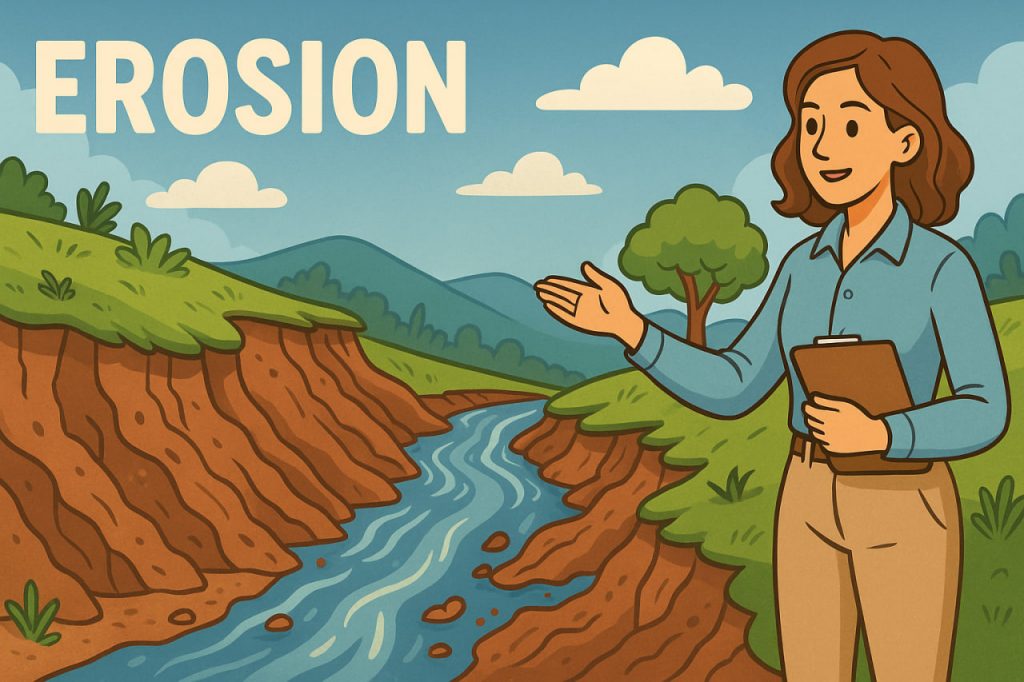
Erosion is the process by which soil, rock, and sediment are worn away and transported from one location to another by natural forces such as wind, water, ice, or gravity. It differs from weathering, which breaks down materials in place without moving them. Erosion reshapes the Earth’s surface through the continuous action of rivers, rain, glaciers, and ocean waves. Over time, these agents carve out landscapes, move sediments to new regions, and play a vital role in the Earth’s geological cycle. However, when intensified by human activity, erosion can lead to severe land degradation and loss of fertile soil.
The Main Types of Erosion
There are several primary forms of erosion, each driven by different natural forces:
- Water Erosion – Caused by rainfall, rivers, and floods. It is responsible for gully and riverbank erosion.
- Wind Erosion – Common in dry areas where loose soil and sand are carried away by strong winds, forming dunes and deserts.
- Glacial Erosion – Occurs when glaciers move slowly across land, grinding rock surfaces and transporting debris.
- Coastal Erosion – Driven by waves, tides, and currents, it wears away shorelines and cliffs.
- Soil Erosion – Specifically refers to the loss of fertile topsoil due to water or wind, often worsened by poor land management.
Each type of erosion has distinct effects but all contribute to the Earth’s ever-changing topography.
The Science Behind Erosion
Erosion begins when weathering breaks down rocks into smaller particles. Once loosened, these materials are moved by natural forces. For example, raindrops dislodge soil particles, which are then carried away by runoff. Wind picks up dust and sand grains, depositing them far away. Glaciers, massive and slow-moving, act like bulldozers, grinding mountains into valleys. Over thousands of years, this interplay of forces creates features such as river deltas, canyons, and sand dunes. According to geologist Dr. Lisa Mallory, “Erosion is both destructive and creative — it destroys old landscapes but gives birth to new ones.”
Human Influence on Erosion
While erosion has always occurred naturally, human activities have accelerated it to alarming rates. Deforestation, overgrazing, mining, and construction remove vegetation that protects soil from being washed or blown away. Agriculture, especially when practiced without crop rotation or contour plowing, leaves soil exposed and vulnerable. Urban development also increases erosion by replacing natural land with impermeable surfaces, causing faster water runoff. The Food and Agriculture Organization (FAO) estimates that the world loses 24 billion tons of fertile soil every year, mostly due to human-caused erosion. This loss threatens global food security and water quality.
The Impact of Erosion on the Environment
Erosion affects more than just landscapes — it influences entire ecosystems. Topsoil erosion reduces agricultural productivity by stripping away nutrient-rich layers. Sediments carried by rivers can clog waterways, harm fish habitats, and increase flooding risks. Coastal erosion destroys wetlands and beaches that serve as natural barriers against storms. In mountainous regions, landslides triggered by erosion can devastate communities. Erosion also contributes to climate change, as degraded soils lose their ability to store carbon effectively. Protecting soil and stabilizing landscapes are therefore essential to environmental sustainability.
Preventing and Controlling Erosion
Several strategies can reduce erosion and protect vulnerable areas. Planting vegetation, especially deep-rooted plants and trees, helps anchor the soil. Terracing and contour plowing slow down water flow on slopes, reducing soil loss. In coastal regions, mangrove restoration and sea walls protect shorelines. Scientists are also developing biodegradable erosion control mats and geo-textiles to stabilize soil. Urban planners now incorporate green infrastructure such as rain gardens and permeable pavements to manage runoff. According to soil scientist Dr. Rattan Lal, “Every hectare of protected soil is a safeguard for future generations — soil is not renewable within a human lifetime.”
The Role of Erosion in Shaping the Earth
Despite its destructive potential, erosion is a vital part of the planet’s natural renewal process. It creates fertile floodplains where agriculture flourishes, sculpts unique geological formations, and contributes to sediment cycles that sustain ecosystems. The Grand Canyon, for example, was formed by millions of years of water erosion by the Colorado River. In this sense, erosion is both an artist and a recycler — continuously reshaping the Earth’s surface. Recognizing this balance helps humanity learn how to work with, rather than against, natural forces.
Future Challenges and Research
As climate change intensifies rainfall and storm events, the rate of erosion is expected to increase worldwide. Rising sea levels will accelerate coastal erosion, threatening coastal cities and communities. Scientists are now using satellite imaging and AI-driven modeling to predict erosion patterns and guide sustainable land management. Future innovations in bioengineering may allow humans to design resilient ecosystems that naturally resist erosion. The challenge is to balance progress with preservation — ensuring that development does not destroy the very soil upon which civilization stands.
Interesting Facts
- It can take up to 1,000 years to form just 2 centimeters of topsoil, but only minutes to wash it away.
- The Grand Canyon formed over 5–6 million years due to river erosion.
- Wind erosion can transport dust particles across entire continents.
- Iceland loses over 9,000 tons of soil per day due to volcanic erosion and deforestation.
- Sediment from the Amazon River feeds the Atlantic Ocean with over 1 billion tons of material each year.
Glossary
- Erosion – The process of wearing away and transporting soil, rock, and sediment.
- Weathering – The breakdown of rocks into smaller particles without movement.
- Topsoil – The uppermost, nutrient-rich layer of soil essential for plant growth.
- Deforestation – The removal of forests, increasing vulnerability to erosion.
- Sediment – Particles of rock, soil, or minerals transported by wind or water.
- Runoff – Water flow that carries soil and debris from land surfaces.
- Terracing – Shaping slopes into flat steps to reduce water erosion.
- Mangrove – Coastal trees whose roots protect shorelines from erosion.
- Carbon Sequestration – The storage of carbon in soil or vegetation to reduce atmospheric CO₂.
- Geo-textile – Fabric used to stabilize soil and prevent erosion in construction and agriculture.