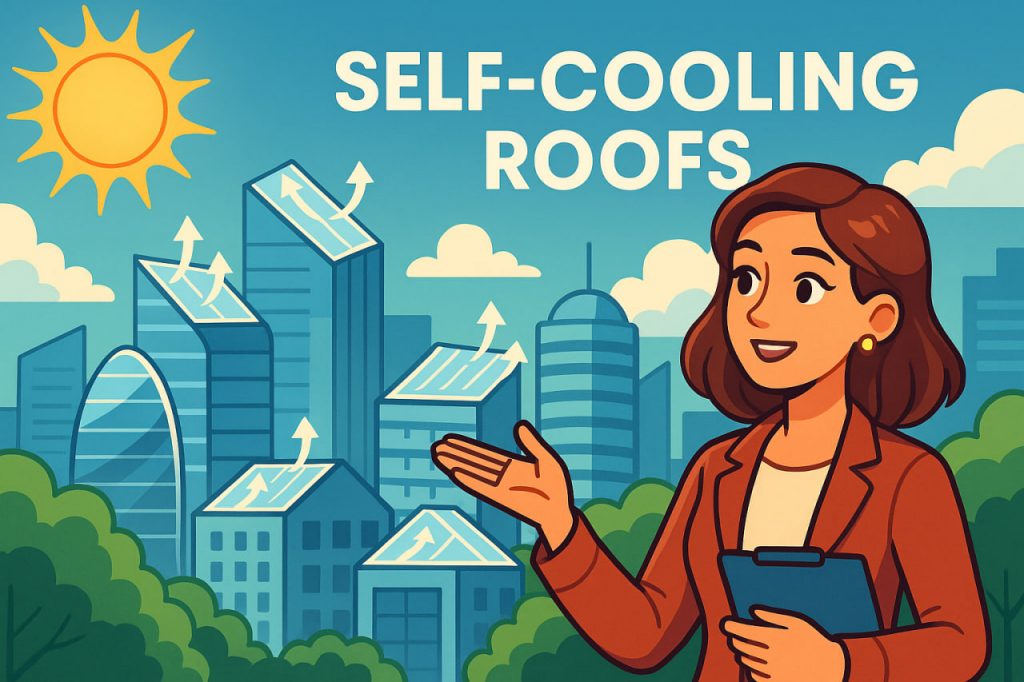
In a world increasingly affected by urban heat and energy demand, self-cooling roofs are emerging as one of the most promising innovations in green architecture. These roofs have the ability to reflect sunlight and release heat without consuming electricity, helping to reduce indoor temperatures and cut down on air conditioning costs. By harnessing the principles of radiative cooling and advanced materials science, self-cooling roofs are transforming how buildings interact with the environment — creating cooler cities and a more sustainable future.
The Science Behind Self-Cooling Roofs
Self-cooling roofs work through a process called passive radiative cooling, which allows surfaces to release heat directly into outer space through infrared radiation. Unlike conventional roofs that absorb sunlight and trap heat, these advanced materials reflect most of the incoming solar energy while efficiently emitting thermal radiation through the atmospheric transparency window — a range of wavelengths (8–13 micrometers) that can pass through the atmosphere without being absorbed. This means that even under direct sunlight, a self-cooling roof can remain several degrees cooler than the surrounding air, reducing indoor heat accumulation naturally.
Materials That Make It Possible
The effectiveness of a self-cooling roof depends on the materials used in its construction. Traditional white or reflective coatings can help, but modern nanostructured materials and polymer films take cooling to the next level. Some self-cooling materials contain microscale glass or ceramic particles that scatter sunlight efficiently while allowing heat to escape. Researchers at Stanford University developed a photonic metamaterial — a thin, multilayered structure made of silica and hafnium oxide — capable of maintaining a surface temperature up to 5°C below ambient even under full sun. These materials are lightweight, durable, and compatible with existing roofing systems, making them ideal for widespread adoption.
Energy and Environmental Benefits
The potential benefits of self-cooling roofs extend far beyond individual buildings. By reducing the need for air conditioning, they lower electricity consumption and decrease greenhouse gas emissions from power plants. According to a study published in Nature Sustainability, large-scale implementation of radiative cooling roofs in cities could lower average urban temperatures by up to 1.5°C (2.7°F) — a significant reduction that could mitigate the urban heat island effect. Furthermore, cooler buildings experience less thermal stress, extending the lifespan of roof materials and lowering maintenance costs.
Integration with Smart Cities
Self-cooling roofs are an essential part of the smart city vision, where buildings respond intelligently to environmental conditions. When combined with solar panels, green roofs, and intelligent ventilation systems, they can create highly efficient, self-regulating urban ecosystems. Some next-generation designs even integrate phase-change materials (PCMs) that store and release heat depending on the time of day, further stabilizing indoor temperatures. Urban planners are exploring how to combine self-cooling surfaces with reflective pavements and walls to create “cool districts” that promote comfort and sustainability.
Expert Opinions
Architectural engineer Dr. Aaswath Raman, one of the pioneers in radiative cooling technology, emphasizes that “the ability to cool without power is a game-changer for sustainable design.” Similarly, climate scientist Dr. Priya Balasubramanian notes that self-cooling roofs could make a major difference in developing countries, where energy access is limited but heat exposure is high. Experts agree that scaling up production and ensuring affordability will be key to integrating this technology globally.
Challenges and Ongoing Research
Despite their promise, self-cooling roofs face a few challenges. Manufacturing high-performance cooling materials can be expensive, and durability under harsh weather conditions remains a concern. Researchers are developing new coatings that resist dirt accumulation and UV degradation to maintain reflectivity over time. Another area of active study is color tuning — finding ways to create self-cooling roofs in different colors rather than just white or metallic shades. This would allow architects to combine energy efficiency with aesthetic design, broadening their appeal for residential and commercial use.
The Global Impact and Future Outlook
As climate change intensifies, urban environments are becoming hotter and less livable. Self-cooling roofs could play a vital role in mitigating these effects, particularly in megacities across Asia, Africa, and the Middle East. Governments are already introducing incentives for reflective roofing under green building standards like LEED and BREEAM. In the future, it is likely that passive cooling materials will become standard in construction, helping humanity adapt to rising temperatures while reducing energy dependency. The combination of science, design, and sustainability embodied in self-cooling roofs represents a glimpse of how innovation can harmonize technology with nature.
Interesting Facts
- Self-cooling materials can emit up to 94% of absorbed heat into outer space.
- The coolest roofs can stay up to 10°C (18°F) cooler than conventional roofs under sunlight.
- Cities covered with reflective materials can save up to 20% on total cooling energy.
- Some experimental coatings are color-customizable, allowing both function and design freedom.
- Radiative cooling has been used since ancient times — Persians used reflective clay pots to make ice at night in the desert.
Glossary
- Radiative Cooling – A natural process where a surface emits heat as infrared radiation into space.
- Metamaterial – An engineered structure with properties not found in naturally occurring materials.
- Urban Heat Island Effect – A phenomenon where urban areas become significantly warmer than their rural surroundings.
- Phase-Change Material (PCM) – A substance that absorbs or releases heat as it changes between solid and liquid states.
- LEED – Leadership in Energy and Environmental Design, a global green building certification system.
- Albedo – The measure of how much sunlight a surface reflects compared to how much it absorbs.
- Infrared Radiation – Electromagnetic radiation emitted as heat energy.
- Polymer Film – A thin layer of synthetic material with specific reflective and emissive properties.
- Photonic Structure – A material designed to control the flow of light at specific wavelengths.
- Reflectivity – The ability of a surface to reflect light and radiation.