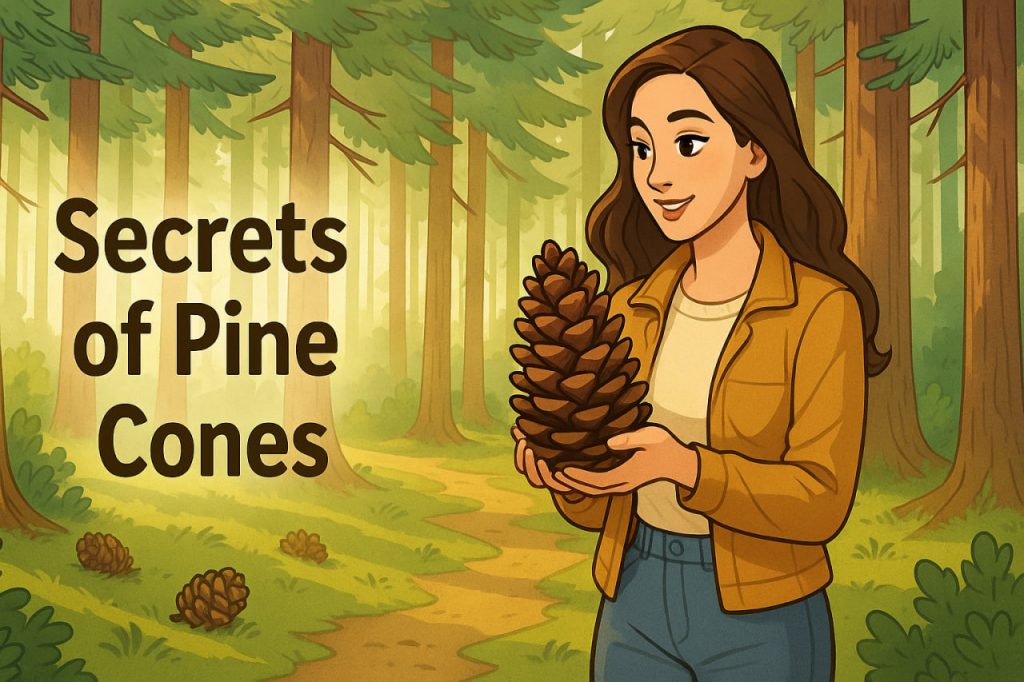
Pine cones are one of nature’s most fascinating creations—simple in appearance, yet remarkably complex in function. Found on coniferous trees such as pines, firs, and spruces, these woody structures play a vital role in the reproduction and survival of forests. They serve as natural seed containers, protecting the next generation of trees from harsh weather, predators, and disease. Beyond their biological importance, pine cones have captured human imagination for centuries, symbolizing growth, fertility, and the cycle of life. From ancient art to modern science, these humble forest treasures remind us of nature’s brilliant design and resilience.
The Biology and Function of Pine Cones
A pine cone is the reproductive organ of a conifer tree, responsible for housing and dispersing seeds. Conifers produce two types of cones: male cones and female cones. Male cones are small and soft, releasing pollen into the air during spring. Female cones are larger, with tough woody scales that protect developing seeds. When pollen from male cones reaches female cones through the wind, fertilization occurs, and seeds begin to mature beneath the scales. Once ready, the cone opens to release the seeds, allowing them to travel by wind, gravity, or animals to new locations where they may grow into trees. Botanist Dr. Amelia Grant notes, “Each pine cone is a marvel of adaptation—built to guard life during the harshest conditions and release it only when survival is possible.”
How Pine Cones Respond to the Environment
Pine cones are not passive structures—they actively respond to environmental changes. Their scales open and close depending on humidity and temperature. In dry conditions, cones open, allowing seeds to disperse when they are most likely to take root. In wet or cold weather, they close tightly to prevent seeds from being damaged or wasted. This movement is purely mechanical, driven by the swelling and shrinking of specialized tissues within the cone. Some species, like the lodgepole pine, even require the heat from forest fires to release their seeds. This remarkable adaptation ensures that new trees grow in nutrient-rich soil left behind after the fire. Pine cones thus play a crucial role in forest regeneration and ecological balance.
The Diversity of Pine Cones
There are more than 120 species of pine trees, and each produces distinct cones in shape, size, and structure. Some cones, like those of the sugar pine, can grow over half a meter long, while others, such as those from mountain pines, are as small as a walnut. The texture and arrangement of the scales vary as well, creating patterns that have inspired artists and designers for centuries. In addition to pines, other conifers like cedars, firs, and spruces produce their own versions of cones, often differing in color, rigidity, and seed dispersal methods. These variations demonstrate how evolution tailors every aspect of plant life to its environment.
Pine Cones in Culture and Symbolism
Beyond their biological function, pine cones hold deep symbolic and cultural meaning. In ancient civilizations, they were associated with eternal life and spiritual enlightenment. The pine cone motif appears in Greek and Roman art, often linked to the staff of Dionysus or the pineal gland—a part of the human brain believed to connect to the soul. In Christianity, pine cones have been used to represent resurrection and immortality. Today, they remain a beloved symbol of winter, holidays, and natural beauty. They are used in decorations, crafts, and aromatherapy, reminding people of nature’s harmony even in modern homes. Anthropologist Dr. Natalia Perez explains, “The pine cone bridges the material and spiritual—it’s a natural form that speaks of both creation and continuity.”
Modern Uses and Scientific Applications
Pine cones are not only admired for their beauty but also studied for their practical properties. Engineers and designers analyze their structure to develop biomimetic technologies—inventions inspired by natural designs. For example, the way pine cone scales open and close with humidity has inspired smart materials that adjust automatically to environmental changes. Pine resin and cone extracts are also used in traditional medicine, fragrances, and even biodegradable packaging. These applications highlight how ancient natural mechanisms can inspire sustainable innovation in the modern world.
Interesting Facts
- Pine cones can stay closed for several years until the right conditions for seed release occur.
- The world’s largest pine cone comes from the Coulter pine and can weigh up to 5 kilograms.
- Pine cones were once used as natural barometers, predicting weather based on how open or closed they appeared.
- The Fibonacci sequence—a mathematical pattern found in nature—can be observed in the spiral arrangement of pine cone scales.
- Female cones can take up to three years to mature and release their seeds.
Glossary
- Conifer — A type of tree that produces cones and usually has needle-like leaves.
- Pollination — The transfer of pollen from male to female reproductive structures, leading to fertilization.
- Biomimetic — A design or process inspired by models found in nature.
- Pineal gland — A small gland in the human brain associated with biological rhythms and spiritual symbolism.
- Resin — A sticky organic substance produced by trees, used for protection and various industrial purposes.