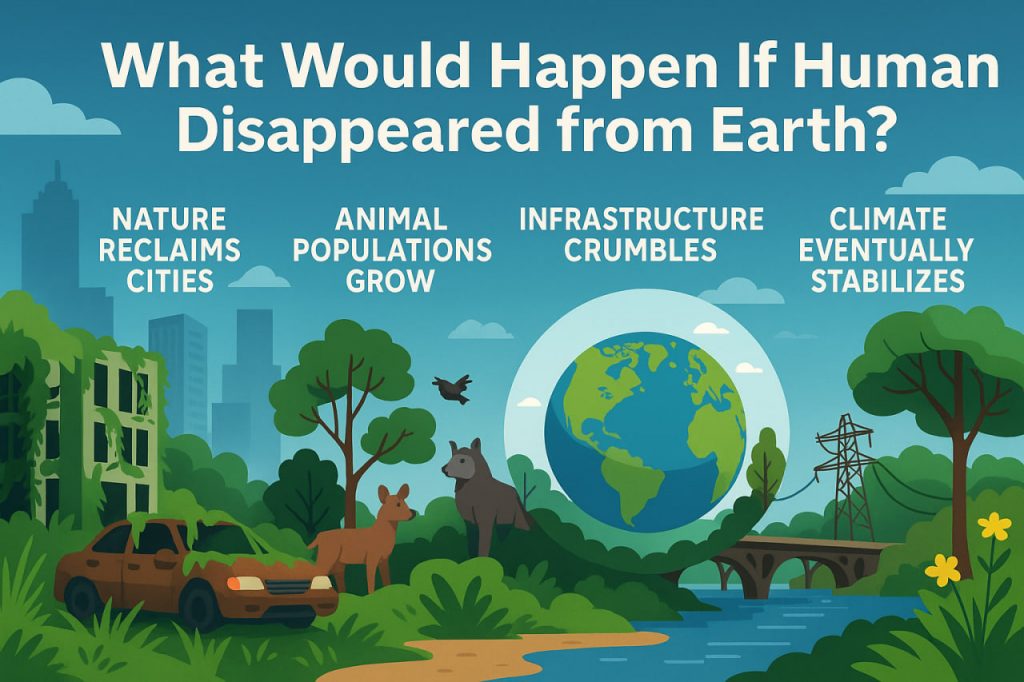
If humanity vanished in an instant, the planet would not collapse into chaos — instead, it would gradually reset itself. Without human influence, cities, wildlife, oceans, and climate systems would begin transforming within hours. This scenario offers a powerful perspective on how much human activity shapes the planet, as well as how resilient nature truly is. Scientists use ecological modeling, urban decay studies, and wildlife observations in abandoned regions (like Chernobyl or deserted towns) to understand what Earth would look like without people.
The First Hours: A Silent Planet
In the first minutes after humans disappear, machines continue running without supervision. Planes in the sky would crash once they ran out of fuel, and cars left in motion would roll until they stopped. Power stations would operate briefly until fuel or monitoring systems failed. Within hours, most of the world would fall into darkness as electrical grids collapse. According to environmental engineer Dr. Lena Horowitz, “Our absence would be felt immediately through the shutdown of complex systems that require constant human monitoring.”
Days to Months: Animals Take Over Human Spaces
Domestic animals would face mixed fates — some pets might survive by returning to wild behaviors, while others dependent on humans would struggle. Wild animals, however, would expand rapidly. Wolves, deer, boars, and birds would reclaim cities, moving freely through streets and abandoned parks. Without traffic and human noise, ecosystems would rebalance surprisingly quickly. In some regions, predators that were once rare would return, creating healthier and more stable food chains.
1 to 10 Years: Nature Reclaims Cities
Plants would begin cracking through pavement, and grasses and young forests would consume suburbs. Vines would climb buildings, and tree roots would break through old structures. Pollution levels would drop dramatically as factories remain offline. Wildlife biologist Dr. Yuuki Matsuda notes, “Urban environments would become patchwork forests within a decade, filled with species that humans had unknowingly suppressed.”
Decades to Centuries: Infrastructure Crumbles
Bridges rust, skyscrapers collapse, and homes rot as weather, gravity, and plant roots destroy man-made structures. Subways flood within weeks due to lack of pumping systems. Steel beams corrode, dams break, and roads vanish beneath soil and vegetation. Oceans begin healing from overfishing, with fish populations rebounding and coral reefs slowly recovering from bleaching once the pressure of human activity disappears.
Thousands of Years: Earth Becomes a Wild Planet Again
Large animals such as elephants, bison, and big cats may reclaim territories humans once dominated. Forests expand across continents, and new ecosystems evolve. Most human artifacts decay completely, except for a few durable materials like plastics, radioactive waste, and stone monuments. Given enough time, even these traces fade.
Millions of Years: Only Fossils Remain
Continents shift, forests grow and vanish, species evolve and go extinct. Human structures disappear entirely, and only subtle geological layers or isolated artefacts hint that humanity ever existed. Paleontologist Dr. Marcus El-Adly explains, “In geological terms, humans are a brief event — but our chemical footprint in sediments may remain detectable for millions of years.”
Interesting Facts
- Chernobyl and the Korean DMZ show how quickly wildlife rebounds in the absence of humans.
- New York City’s subway system would flood within 36 hours without pumps.
- Many cities would be covered in vegetation within 20–50 years.
- Plastic may last hundreds of thousands of years, making it one of the longest-lasting human traces.
Glossary
- Ecosystem — a community of living organisms interacting with their environment.
- Biodiversity — the variety of life within an ecosystem or region.
- Infrastructure — buildings, roads, bridges, and systems humans rely on.
- Tipping point — a threshold beyond which change becomes irreversible.