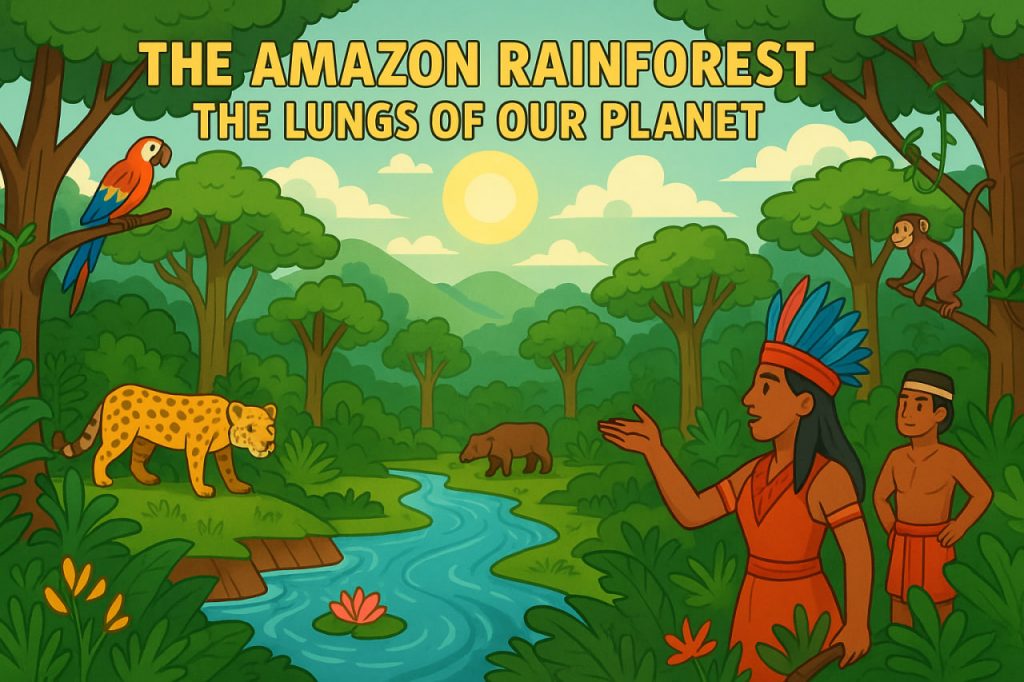
The Amazon Rainforest, stretching across nine South American countries, is the largest tropical rainforest on Earth — a living treasure of biodiversity and an essential regulator of the global climate. Covering more than 5.5 million square kilometers, it is often called the “lungs of the planet” because of its immense role in producing oxygen and absorbing carbon dioxide.
A Natural Wonder of Life
The Amazon is home to an estimated 390 billion trees belonging to around 16,000 species. Its dense canopy and humid air create one of the most complex ecosystems on Earth, supporting:
- 2.5 million species of insects,
- over 1,300 bird species,
- 427 mammals,
- and tens of thousands of plants.
Many of these species exist nowhere else on the planet. From colorful macaws and jaguars to medicinal plants and rare orchids, the Amazon remains an invaluable genetic library for science and medicine.
Ecologist Dr. Luisa Andrade says:
“Every leaf, every insect, every drop of water in the Amazon plays a role in keeping our planet’s balance. Losing it means losing part of Earth’s heartbeat.”
The Climate Connection
The Amazon acts as a carbon sink, absorbing billions of tons of carbon dioxide each year. It also influences rainfall patterns across South America — and even beyond — through evapotranspiration, a process where plants release water vapor into the atmosphere.
Without the Amazon, global temperatures would rise faster, and droughts and floods would become more extreme. Scientists warn that deforestation is pushing parts of the rainforest toward an irreversible “tipping point”, where large areas could transform into dry savannas.
The Threats
The Amazon faces multiple challenges caused by human activity:
- Deforestation for cattle ranching, soy farming, and logging.
- Illegal mining that contaminates rivers with mercury.
- Wildfires, often started to clear land for agriculture.
- Infrastructure projects like roads and dams that fragment ecosystems.
Between 1978 and 2020, the Amazon lost around 17% of its forest cover — an area larger than France.
The Fight to Protect the Forest
Efforts to save the Amazon come from indigenous communities, scientists, governments, and international organizations. Indigenous peoples manage about 30% of the remaining rainforest, often proving to be its most effective guardians.
Conservation strategies include:
- Reforestation programs to restore damaged areas.
- Sustainable agriculture that reduces pressure on land.
- Satellite monitoring to track illegal deforestation in real time.
- Ecotourism to create income while preserving the forest.
Biologist Dr. Rafael Torres emphasizes:
“Protecting the Amazon is not just about saving trees — it’s about saving the climate, water, and life itself.”
Interesting Facts
- The Amazon River discharges 20% of all freshwater entering the oceans.
- Some rainforest trees reach heights of 60 meters (200 feet).
- Over 400 indigenous tribes live in the Amazon Basin, many with unique languages and traditions.
- Scientists believe only 1% of Amazonian plant species have been studied for medicinal potential.
Glossary
- Carbon sink — a natural system that absorbs more carbon dioxide than it releases.
- Evapotranspiration — the process by which water is transferred from land to the atmosphere by evaporation and plant transpiration.
- Deforestation — the clearing or removal of forests by human activity.
- Biodiversity — the variety of plant and animal life in a particular ecosystem.