The world’s oceans cover more than 70% of Earth’s surface and are vital for climate regulation, weather systems, biodiversity, and human life. Yet today they face a critical threat: pollution caused by plastic waste, chemicals, oil spills, and abandoned fishing gear. Cleaning the oceans is not simply an environmental mission — it is a global necessity that can define the future of life on Earth.
The Scale of the Problem
Every year, around 11 million tons of plastic enter the ocean. Over time, this waste breaks into microplastics that infiltrate fish, seabirds, and even human bodies. Marine biologist Dr. Maya Torres explains:
“If we don’t act now, by 2050 there could be more plastic than fish in the ocean by weight. But we already have the tools to prevent that future.”
Technologies That Can Clean the Ocean
Modern science offers several innovative solutions for ocean cleanup:
1. Ocean Cleanup Systems
Large floating barriers collect waste carried by ocean currents, especially in polluted areas like the Great Pacific Garbage Patch.
2. River Interceptors
Since most ocean plastic comes from rivers, autonomous solar-powered machines placed at river mouths can stop waste before it reaches the sea.
3. Autonomous Cleaning Robots
Drones and robots designed to collect floating debris help clean coastal zones and ports.
4. Biodegradable Materials
Replacing traditional plastics with biodegradable alternatives can reduce the amount of long-lasting waste entering the ocean.
5. Recyclable Fishing Gear
Fishing nets make up over 40% of large plastic debris. Recyclable or biodegradable nets drastically cut down this form of pollution.
Human Actions Matter Too
Technology alone cannot solve the problem. Everyday actions are equally important:
- reducing single-use plastics
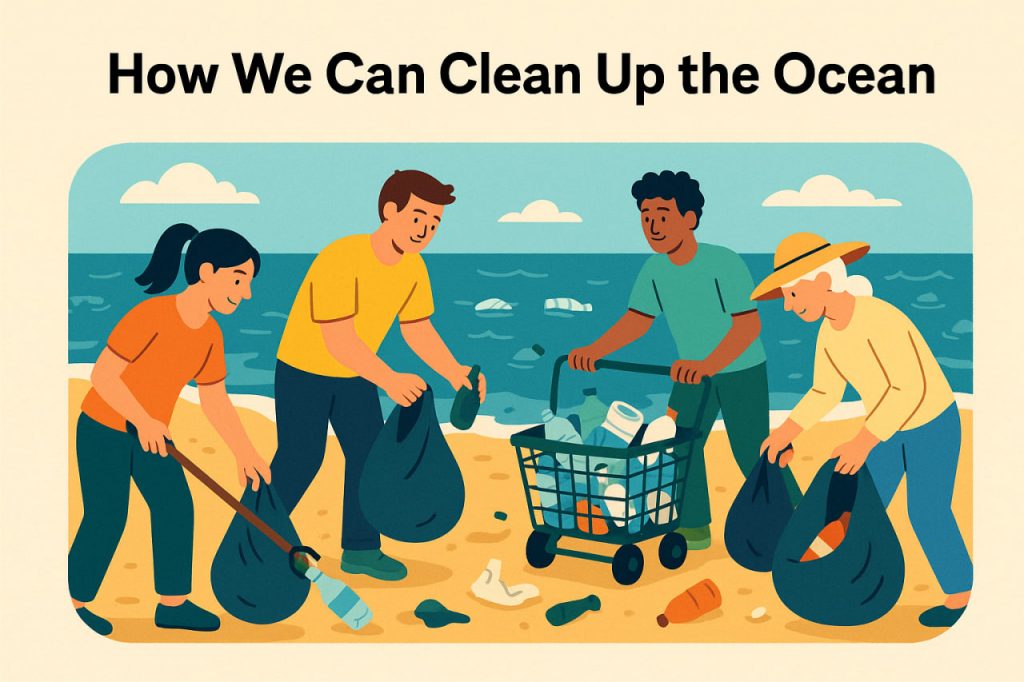
- participating in coastal cleanups
- choosing sustainable seafood
- supporting companies with eco-friendly packaging
Environmental engineer Dr. Lina Morozova emphasizes:
“Ocean cleanup starts at home — with every bottle recycled and every plastic bag avoided.”
Interesting Facts
- About 90% of seabirds have plastic in their stomachs.
- Coral reefs supply food and protection to over 25% of marine life.
- Microplastics were discovered even in the Mariana Trench, the deepest point on Earth.
- Over 3 billion people rely on the ocean for food and livelihoods.
Glossary
- Microplastics — tiny plastic particles under 5 mm in size.
- Biodegradable — capable of decomposing naturally by microorganisms.
- Ecosystem — a community of living organisms interacting with their environment.
- Gyre — a large system of rotating ocean currents.