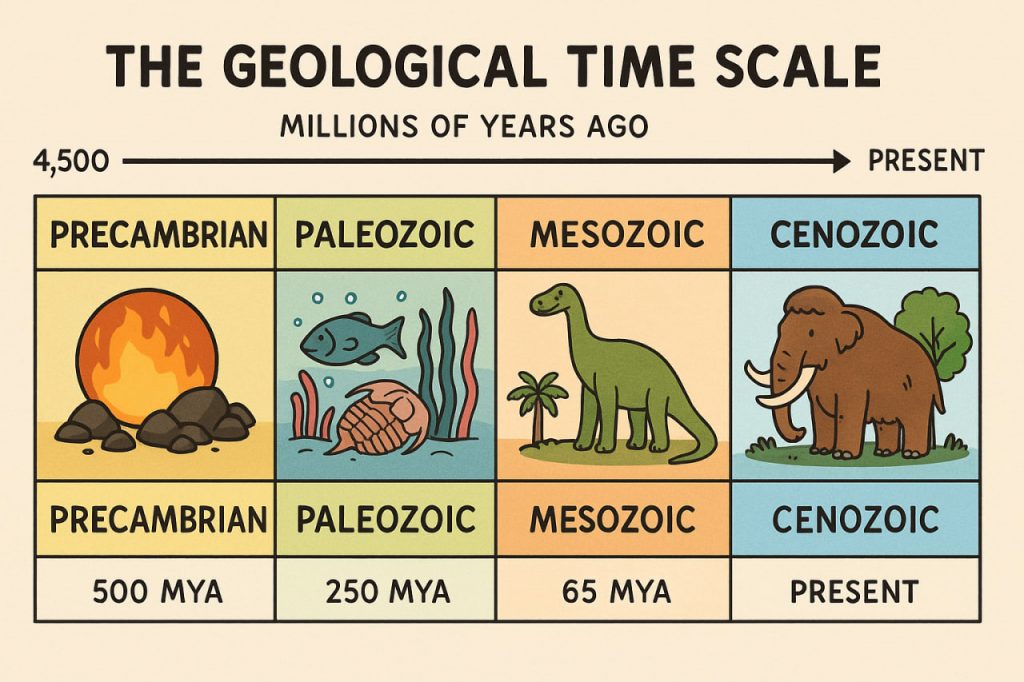
After its formation about 4.54 billion years ago, Earth went through several dramatic geological stages that transformed it from a molten sphere into the vibrant, life-sustaining planet we know today. Each stage, called an eon, marks major changes in climate, geology, and the evolution of life.
Hadean Eon (4.54–4.0 billion years ago)
The earliest stage of Earth’s history was violent and extremely hot. The planet’s surface was covered in magma oceans, and constant asteroid impacts shaped the young world. There were no continents, no oceans, and no life. Earth’s first atmosphere was toxic, composed of volcanic gases and almost no oxygen. Over time, the crust slowly began to cool, and water vapor condensed to form early oceans.
Archean Eon (4.0–2.5 billion years ago)
During the Archean, Earth transformed into a water-rich planet. Oceans stabilized, and the first solid continental crust began to form. Most importantly, the first life appeared — simple single-celled organisms such as bacteria and archaea. Among them were cyanobacteria, which began releasing oxygen through photosynthesis, slowly changing the composition of Earth’s atmosphere.
Proterozoic Eon (2.5 billion–541 million years ago)
This eon brought dramatic climate and biological changes. Oxygen levels gradually increased in a major event called the Great Oxygenation Event, which allowed more complex life to develop. The first multicellular organisms appeared in the oceans. Earth also experienced several severe ice ages, including “Snowball Earth” periods when ice may have reached the equator.
Phanerozoic Eon (541 million years ago–present)
This final and ongoing eon contains most of the life we know today. It began with the Cambrian explosion, a rapid diversification of animals. Forests, insects, amphibians, dinosaurs, mammals, and eventually humans evolved during this time. Continents drifted, collided, and separated, forming and breaking apart supercontinents such as Pangaea.
Interesting Facts
- Earth has existed for about one-third of the age of the universe.
- Life began in the oceans long before land existed.
- Oxygen was once a deadly gas to early life forms.
- The majority of Earth’s species have gone extinct — extinction is a natural part of evolution.
Glossary
- Eon — the largest division of geological time.
- Cyanobacteria — early microorganisms that produced oxygen through photosynthesis.
- Great Oxygenation Event — a major rise in atmospheric oxygen about 2.4 billion years ago.