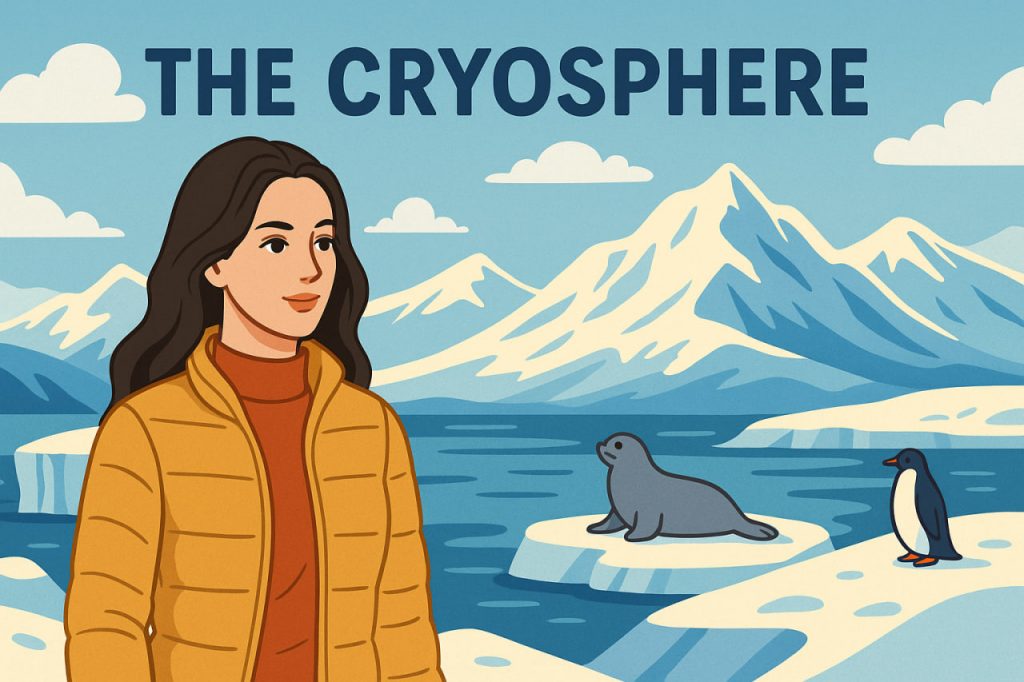
The cryosphere refers to all of Earth’s frozen water, including glaciers, ice caps, sea ice, snow cover, permafrost, and frozen lakes and rivers. These icy components play a vital role in regulating the planet’s climate, reflecting sunlight, storing freshwater, and influencing global weather patterns. Although often associated with remote polar regions, the cryosphere impacts ecosystems, sea levels, and even agriculture around the world. Scientists closely monitor changes within the cryosphere because shifts in ice coverage can signal broader environmental transformations linked to climate change. As global temperatures rise, many cryospheric systems are shrinking, melting faster, or becoming less stable. Understanding how the cryosphere functions is crucial for predicting future climate trends and preparing for environmental challenges.
Components of the Cryosphere
The cryosphere includes several distinct elements, each contributing uniquely to Earth’s climate system. Glaciers and ice sheets store roughly two-thirds of the world’s freshwater, slowly releasing it into rivers and oceans. Sea ice forms on the ocean’s surface, creating reflective surfaces that help cool the planet by bouncing sunlight back into space. Snow cover acts as temporary insulation for soil and vegetation, while also influencing seasonal water availability. Permafrost—land that remains frozen for at least two consecutive years—stores large amounts of carbon within frozen soils. Cryosphere specialist Dr. Ingrid Larsen emphasizes that each component interacts with others, forming a complex system that responds sensitively to temperature changes. Her research shows that even small temperature shifts can lead to substantial changes in ice stability and distribution.
Why the Cryosphere Matters for Climate and Ecosystems
The cryosphere plays a key role in maintaining Earth’s energy balance, largely due to its high reflectivity, known as albedo. When snow and ice cover decrease, darker land and ocean surfaces absorb more heat, accelerating warming in a feedback loop. This process, called Arctic amplification, causes polar regions to warm faster than the global average. Glaciologist Dr. Vincent Hale notes that melting glaciers and ice sheets directly contribute to rising sea levels, threatening coastal communities and marine ecosystems worldwide. The cryosphere also influences ocean circulation by releasing freshwater into the seas, which affects global climate patterns. Additionally, frozen habitats support unique ecosystems, including polar bears, penguins, seals, and various algae adapted to extreme cold.
Current Trends and Scientific Research
Modern research shows significant changes occurring throughout the cryosphere, including rapid glacier retreat, thinning Arctic sea ice, and increased thawing of permafrost. These trends are closely monitored using satellite imaging, climate models, and on-site field measurements. Scientists study not only how ice is melting but also how these changes affect global systems such as sea-level rise, methane release, and weather extremes. Researchers are also developing improved climate models to predict how cryospheric changes will progress through the 21st century. Many studies highlight the importance of reducing greenhouse gas emissions to slow melting and protect vulnerable regions. While uncertainties exist, experts agree that cryosphere changes will shape future climate conditions and environmental policy decisions.
Interesting Facts
Some glaciers move several meters per day, creating creaks and rumbles known as “glacial music.”
Antarctica holds about 90% of the world’s ice and 70% of its freshwater.
Sea ice in the Arctic naturally expands in winter and melts in summer, but its minimum extent has declined sharply over the last few decades.
Permafrost contains ancient plants, microbes, and even preserved animal remains like woolly mammoths.
Glossary
- Albedo — the measure of how much sunlight a surface reflects.
- Permafrost — ground that remains frozen for at least two years.
- Arctic Amplification — the phenomenon where polar regions warm faster than the rest of the planet.
- Ice Sheet — a massive, continent-sized layer of ice found in Greenland and Antarctica.