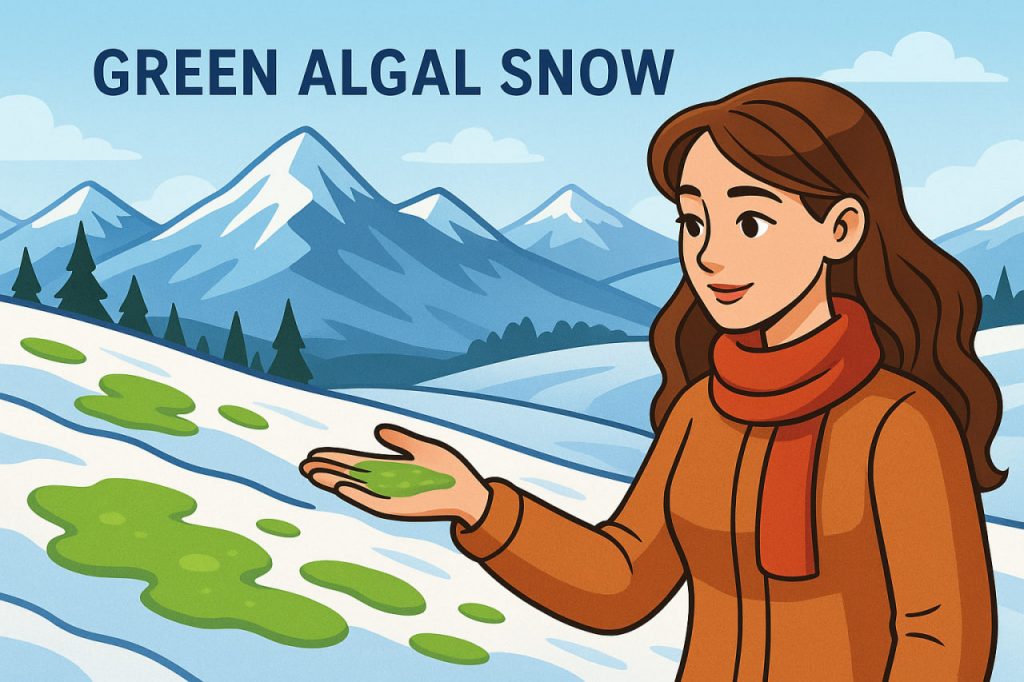
Green algal snow is a striking natural phenomenon observed in cold, snowy regions where microscopic algae grow directly on the snow’s surface. Although snow is typically associated with purity and whiteness, certain algal species can tint it green, red, or even orange depending on their pigmentation and life cycle. Green algal snow occurs most often in polar regions, high mountain environments, and remote icy landscapes where seasonal sunlight activates dormant algal spores. Despite its unusual appearance, this process is entirely natural and has been documented for centuries by explorers and scientists. Researchers emphasize that algal snow plays an important ecological role, influencing nutrient cycles, melting rates, and microbial diversity in frozen habitats. Understanding how and why algal blooms occur on snow helps scientists monitor climate change and study life in extreme environments.
How Green Algal Snow Forms
Green algal snow develops when cold-adapted microalgae, often from the genus Chloromonas, begin to photosynthesize and reproduce on melting snow surfaces. These microorganisms are capable of surviving freezing temperatures and extremely low nutrient availability, thanks to their protective pigments and specialized cellular structures. When sunlight becomes more intense in late spring or early summer, the algae awaken and spread rapidly, forming visible green patches across the snow. Environmental biologist Dr. Aria Jensen explains that algal growth accelerates as snow melts because liquid water provides the moisture algae need to thrive. Another expert, cryosphere researcher Dr. Leon Fischer, notes that darker algae can decrease snow reflectivity, causing slightly faster melting and influencing local temperature dynamics. This combination of biological activity and physical change makes green algal snow a unique indicator of environmental conditions.
Ecological Importance and Climate Connections
Although green algal snow may seem like a minor curiosity, its ecological effects are significant. Algae contribute organic matter to nutrient-poor polar ecosystems, supporting microorganisms and small invertebrates that rely on them as a food source. In some regions, algal snow communities form the base of complex microbial networks. Scientists are particularly interested in how climate change influences the frequency and distribution of algal blooms on snow. As temperatures rise and snow cover decreases, some areas may experience more intense algal blooms due to longer melt seasons. Conversely, shrinking snowfields may reduce habitat availability for cold-adapted algae. Studying these patterns helps researchers understand broader climate trends and anticipate changes in fragile ecosystems.
Scientific Research and Future Perspectives
Modern research on algal snow uses techniques such as satellite imaging, genetic sequencing, and field sampling to determine how algal populations respond to environmental change. Scientists also examine how pigments produced by algae protect them from ultraviolet radiation and extreme temperatures. These pigments sometimes cause snow to appear green or even red, depending on the species and environmental conditions. Researchers hope that deeper knowledge of these organisms will reveal how life can adapt to harsh climates, potentially informing studies on extraterrestrial environments. Because algal snow affects snowmelt rates, scientists also incorporate it into climate models to better predict melting patterns and water availability in alpine and polar regions.
Interesting Facts
Some species of snow algae can remain dormant for years before reactivating under the right conditions. Green algal snow has been observed in Antarctica, the Arctic, the Himalayas, and even parts of Alaska. Historical explorers once believed colored snow was caused by mineral deposits before algae were discovered. Satellite images can detect large patches of green algal snow from space due to changes in surface reflectivity.
Glossary
- Cryosphere — frozen regions of Earth, including snow, glaciers, and polar ice.
- Photosynthesis — the process by which organisms convert sunlight into energy.
- Pigmentation — natural coloring produced by biological pigments inside cells.
- Reflectivity (Albedo) — the ability of a surface to reflect sunlight, affecting temperature and melting rates.