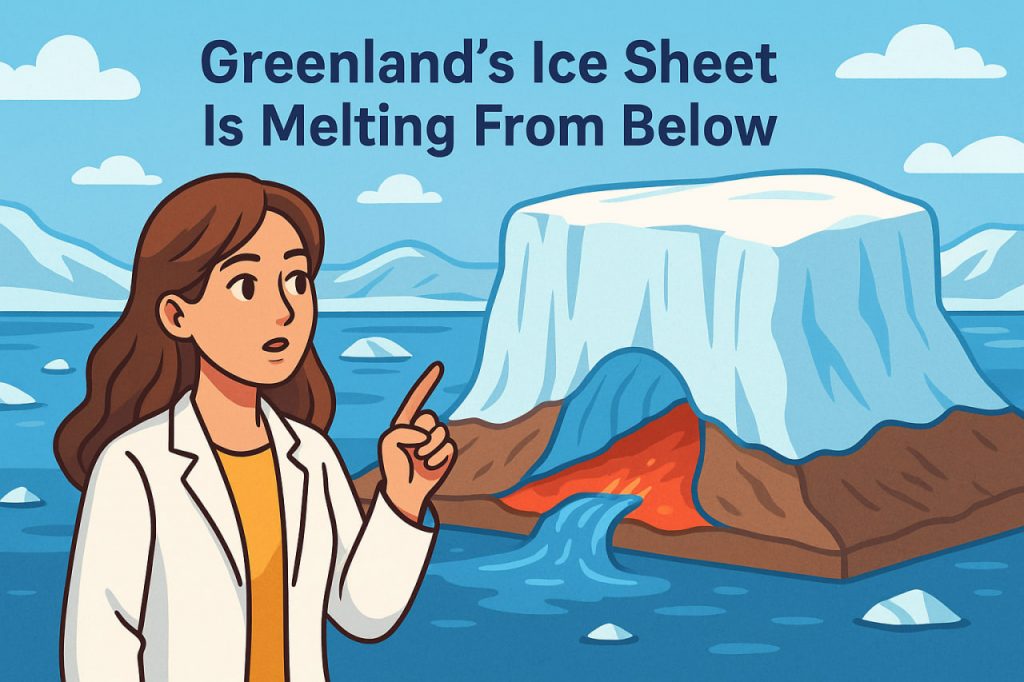
The Greenland Ice Sheet, one of the largest bodies of frozen freshwater on Earth, has long been understood to be melting from the top due to rising air temperatures. However, recent scientific discoveries show that it is also melting from below, driven by complex oceanic and geothermal processes. This bottom-up melting accelerates the overall loss of ice, destabilizes glaciers, and contributes more quickly to global sea-level rise than previously estimated. Because the base of the ice sheet is hidden beneath thousands of meters of ice, these processes remained unclear for decades, but new satellite measurements, radar mapping, and deep-ocean observations have revealed the true scale of subsurface changes. Understanding these hidden mechanisms is crucial for predicting the future of coastal communities, Arctic ecosystems, and global climate patterns.
Warm Ocean Currents and Subglacial Melting
One of the primary drivers of bottom melting in Greenland is the intrusion of warm Atlantic water that flows deep beneath the ice shelves and marine-terminating glaciers. These currents, which have warmed steadily due to global climate change, deliver enough heat to melt the ice from the underside, carving deep channels and weakening the structural integrity of glaciers. As the base thins, glaciers slide faster toward the ocean, increasing the rate of ice discharge. According to climate oceanographer Dr. Helen Graves:
“The most powerful melting is happening out of sight.
Warm water enters narrow fjords and erodes the ice from below long before the surface shows visible change.”
This subsurface erosion explains why some glaciers retreat rapidly even when surface temperatures are colder than average.
Geothermal Heat Beneath the Ice
Another less intuitive source of bottom melting comes from geothermal heat emerging from Earth’s crust beneath Greenland. The island sits on a region with naturally elevated geothermal activity, where volcanic and tectonic forces warm the bedrock. Although this heat is modest compared to the sun’s energy, it is constant and acts over thousands of years. When combined with pressure from the thick ice above, this warmth can create a layer of liquid water at the base of the ice sheet. This water acts like a lubricant, enabling the ice to flow more quickly toward the ocean. Scientists emphasize that geothermal heat is not caused by human activity, but it enhances the effects of modern warming, making Greenland’s response to climate change more dramatic and unpredictable.
Subglacial Lakes and Water Pathways
As the ice sheet melts from below, it forms vast networks of subglacial lakes, channels, and rivers that transport meltwater toward the ocean. These hidden waterways play a major role in shaping how rapidly glaciers move. When water pressure builds beneath the ice, it can lift the sheet slightly, reducing friction and allowing it to slide faster. Some of these lakes drain suddenly, releasing massive pulses of water that accelerate glacial flow for weeks or months. Researchers map these networks using ice-penetrating radar to understand how bottom melting reshapes the internal dynamics of Greenland’s ice sheet. The discovery of these complex systems has transformed our understanding of how ice sheets behave under warming conditions.
Ice–Ocean Interactions and Glacier Destabilization
Where glaciers meet the ocean, the interaction between ice and seawater becomes even more important. Melting from below creates overhangs and cavities that destabilize glacier fronts, making them more prone to fracturing and calving. Large icebergs break off more frequently when the base weakens, contributing to faster ice loss. Scientists observe that in regions where warm water reaches deep fjords, glaciers can retreat kilometers within a few years. This rapid change highlights how bottom melting accelerates processes that once took centuries. Experts warn that these interactions must be included in sea-level rise predictions to avoid underestimating future risks.
Global Implications and Future Research
The accelerated melting of Greenland’s ice sheet, especially from below, has major global consequences. Rising sea levels threaten coastal cities, island nations, and vital infrastructure. Changes in freshwater flow into the North Atlantic can disrupt ocean circulation systems, potentially altering weather patterns across Europe and North America. To understand these risks, scientists combine satellite monitoring, autonomous underwater vehicles, and advanced climate models to study ice–ocean interactions in greater detail. Continued research is essential, as the rate of bottom melting will influence global climate stability for decades to come.
Interesting Facts
- Greenland’s ice sheet contains enough frozen water to raise global sea levels by over 7 meters if fully melted.
- Some fjords in Greenland are deeper than 1,000 meters, allowing warm ocean currents to reach the base of giant glaciers.
- Radar data revealed more than 60 subglacial lakes beneath the ice sheet—many were unknown just a decade ago.
- Some glaciers accelerate by up to 300% when sudden subglacial lake drainage occurs.
- The ice at Greenland’s center is so thick that its base is pushed below sea level by the weight of the ice itself.
P.S. Recent news reports indicate that processes in the subsurface beneath Greenland are having an increasingly significant impact on the melting of ice.
Glossary
- Subglacial Melting — melting that occurs at the base of an ice sheet due to oceanic, geothermal, or pressure-related heat.
- Geothermal Heat — natural heat rising from Earth’s interior, warming the bedrock beneath glaciers.
- Fjord — a long, narrow, and deep coastal valley carved by glaciers and flooded by the sea.
- Calving — the process by which large chunks of ice break off from glacier fronts and form icebergs.
- Subglacial Lake — a body of water trapped beneath a glacier or ice sheet.