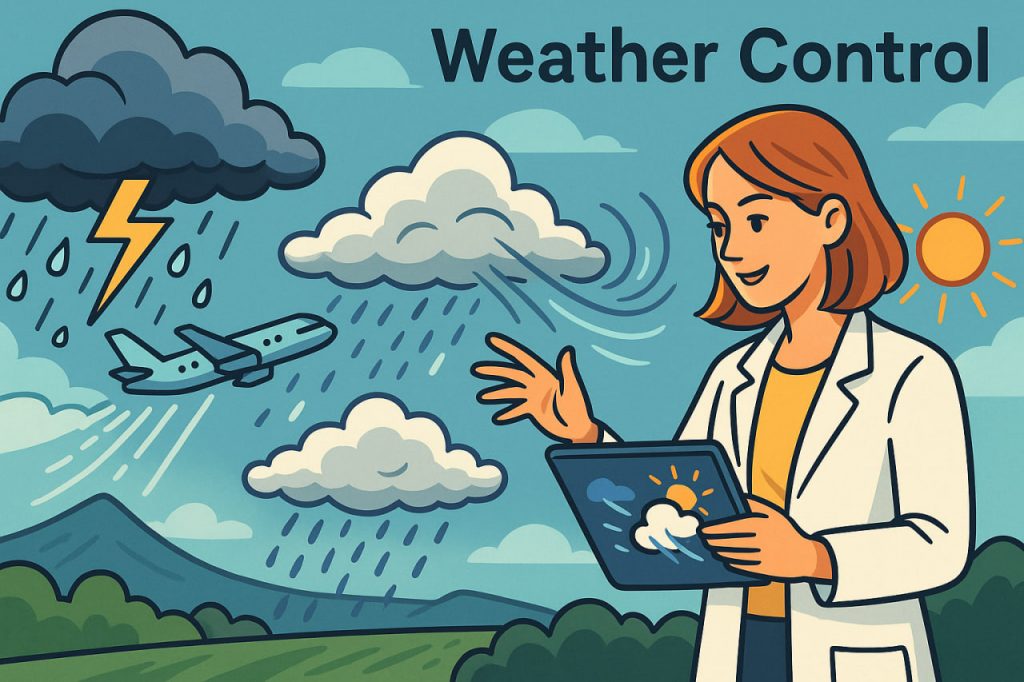
Humanity has always been fascinated by the idea of influencing the weather, from ancient rain rituals to modern atmospheric science. Today, weather control technologies aim not to dominate nature completely, but to slightly adjust certain processes such as rainfall, hail, or fog in specific regions. These methods are used mainly to protect agriculture, improve aviation safety, and support water resources in drought-prone areas. At the same time, scientists and ethicists warn that the atmosphere is a complex and delicate system, and even small interventions can have unexpected side effects. Because of this, responsible weather modification requires careful scientific evaluation, international dialogue, and strict regulations. Understanding how these technologies work helps society decide where they can be useful and where their risks may outweigh potential benefits.
Principles of Weather Modification
Most modern weather control techniques focus on modifying microphysical processes inside clouds rather than creating storms from nothing. Clouds are made of tiny water droplets and ice crystals that constantly interact, collide, and change state depending on temperature, humidity, and air currents. By introducing additional particles or heat into these systems, scientists try to make certain outcomes—like rainfall or reduced hail—more likely. Importantly, these technologies cannot guarantee specific weather on demand; they can only shift probabilities within existing atmospheric conditions. For example, a dry cloud with very little moisture will not produce rain even if it is seeded, whereas a naturally developing storm cloud might respond more noticeably. This probabilistic nature explains why field experiments often require many years of data before scientists can confidently estimate effectiveness. It also highlights why weather modification is best viewed as risk management, not as a magical control panel for the sky.
Cloud Seeding and Precipitation Enhancement
The most widely known weather modification technique is cloud seeding, which aims to enhance rainfall or snowfall from existing clouds. In many projects, aircraft or ground-based generators release substances such as silver iodide, potassium iodide, or hygroscopic salts into suitable clouds. These particles act as nuclei around which water droplets or ice crystals can form more easily, potentially increasing the amount of precipitation that reaches the ground. Cloud seeding is used in some regions to support agriculture, replenish reservoirs, or increase snowpack in mountainous areas that feed major rivers. According to atmospheric researcher Dr. Laura Kim:
“Cloud seeding is not about creating rain out of clear blue skies.
It gently nudges natural clouds, helping them release moisture that might otherwise remain suspended.”
Despite its promise, cloud seeding remains controversial because its effectiveness varies with weather conditions, and it can be difficult to separate natural variability from human influence in complex storm systems.
Hail Suppression and Storm Modification
In many agricultural regions, hailstorms pose a serious threat to crops, infrastructure, and even human safety. As a result, some weather modification programs focus on hail suppression, attempting to reduce the size or frequency of damaging hailstones. Techniques often involve seeding storm clouds with silver iodide or other particles at specific altitudes, encouraging the formation of many smaller ice particles instead of fewer large ones. Smaller hailstones may still reach the ground, but they are less likely to destroy crops or shatter windows. Some programs also experiment with ground-based cannons or rockets that release seeding materials into developing storms. However, the scientific community continues to debate how consistently these methods work, because hail formation depends on a complex combination of updraft strength, temperature layers, and moisture. Many experts argue that hail suppression should be accompanied by insurance, resilient infrastructure, and better forecasting, rather than being seen as a single, guaranteed solution.
Fog Dissipation and Visibility Improvement
Another important application of weather control technologies is fog dissipation, particularly around airports, harbors, and busy transportation corridors. Dense fog can dramatically reduce visibility, increasing the risk of accidents and causing costly delays. To address this, engineers use techniques that either warm the air or alter the microphysics of fog droplets. Some methods involve burning fuel or using heaters to slightly raise the temperature near the surface, helping fog evaporate. Others use sprays containing hygroscopic salts or dry ice to encourage droplets to grow larger and fall out of the air more quickly. According to aviation safety consultant Dr. Michael Torres:
“Fog-dissipation systems are most effective when combined with accurate forecasting and modern navigation technology,
turning dangerous low-visibility conditions into manageable operational challenges.”
These interventions are generally applied on a small, localized scale and are carefully monitored to minimize environmental impact, making them one of the more practical forms of weather modification in regular use.
Large-Scale Climate Engineering: Ambitious and Controversial
Beyond localized projects, some researchers explore far more ambitious ideas known as climate engineering or geoengineering. These proposals seek to influence global or regional climate patterns rather than individual storms or fog banks. Concepts include injecting reflective particles into the stratosphere to reduce incoming sunlight, brightening marine clouds over oceans, or enhancing carbon capture through large-scale biological or chemical processes. While these ideas attract attention as potential tools against climate change, they also raise serious concerns. The global climate system is tightly interconnected, so altering one region’s temperature or precipitation could unintentionally disrupt monsoon patterns, ocean currents, or biodiversity elsewhere. Ethical questions also arise: Who controls the thermostat of the planet, and how are potential winners and losers compensated? For now, most experts advocate focusing on emissions reduction, renewable energy, and adaptation strategies, treating climate engineering only as a last-resort research area rather than an immediate policy tool.
Interesting Facts
- Some cloud seeding programs report precipitation increases of 5–15%, but results vary widely depending on local conditions and research methods.
- Early weather modification experiments in the mid-20th century inspired both optimistic visions of “weather on demand” and strong public skepticism.
- Military planners once explored using weather modification for strategic purposes, leading to international agreements that ban hostile uses of environmental modification.
- Fog-dissipation technologies helped pioneer improvements in airport safety procedures, combining atmospheric science with advanced navigation systems.
- Discussions about geoengineering have encouraged scientists and policymakers to rethink global cooperation, because atmospheric changes do not respect national borders.
Glossary
- Cloud Seeding — the introduction of particles such as silver iodide or salt into clouds to encourage the formation of raindrops or snowflakes.
- Hygroscopic Particles — tiny substances that attract water vapor, helping cloud droplets or fog droplets grow and change.
- Hail Suppression — weather modification techniques aimed at reducing the size or impact of hailstones in severe thunderstorms.
- Geoengineering — large-scale technological interventions in the Earth’s climate system, often proposed as potential responses to climate change.
- Fog Dissipation — targeted methods used to thin or remove fog in limited areas, typically to improve visibility for transportation.