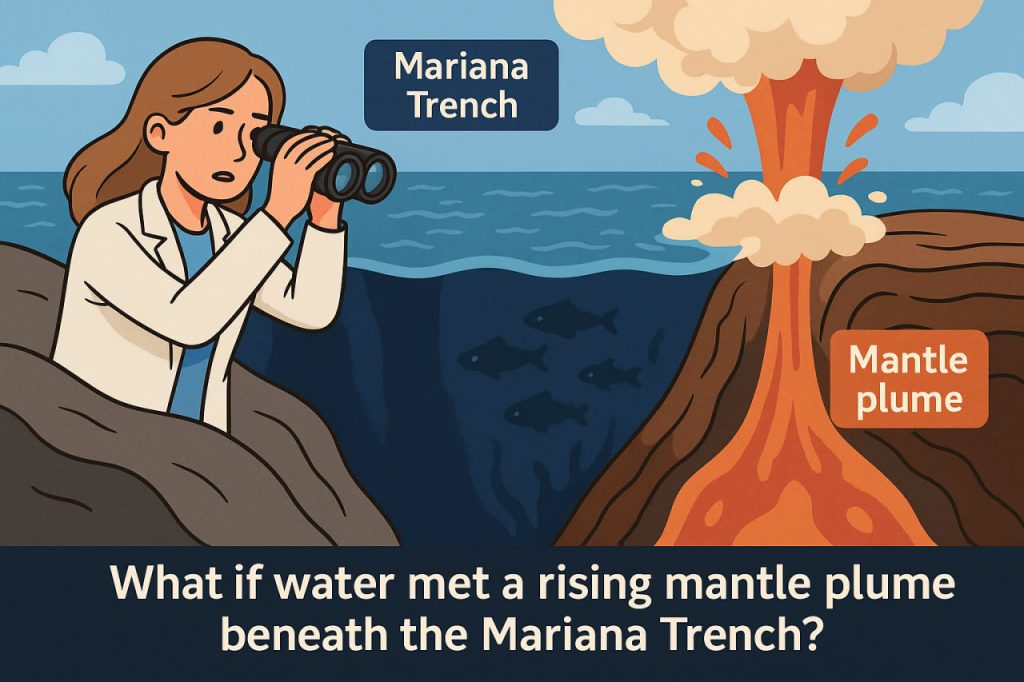
The Mariana Trench is the deepest part of the world’s oceans, plunging nearly 11 kilometers beneath the surface. It lies above a subduction zone where the Pacific Plate dives beneath the Philippine Plate, creating extreme pressures, intense heat, and complex geological processes. Deep below the trench, within Earth’s mantle, powerful mantle plumes occasionally rise — columns of hot, buoyant rock originating from deep within the mantle. These plumes can create volcanic islands, hydrothermal systems, and major disruptions to the oceanic crust. A direct interaction between seawater and a rising mantle plume beneath the Mariana region would represent one of the most extreme geological encounters possible. While highly unlikely due to the stability of plate boundaries, this scenario helps scientists understand how water, pressure, and molten rock interact at the deepest parts of the Earth.
What a Mantle Plume Is and How It Behaves
A mantle plume is a rising column of superheated mantle material that ascends slowly toward the crust. Temperatures within a plume can reach over 1,600°C, enough to partially melt surrounding rock as it rises. If such a plume were to ascend beneath the Mariana Trench, it would encounter one of the thickest and coldest sections of oceanic crust. Subducting plates there act as barriers, making direct contact between a plume and seawater extremely rare. According to geophysicist Dr. Linnea Hart:
“If a mantle plume managed to penetrate the subduction zone beneath the Mariana Trench, it would trigger dramatic geological change —
the forces involved are far beyond normal volcanic activity.”
The interaction would depend on whether the plume breaches the crust or remains trapped beneath it.
Scenario 1: The Plume Melts Through the Crust
If a mantle plume overcame the cold and dense subducting slab, it could melt through the crust beneath the trench floor. This would create intense volcanic activity, generating new magma chambers and possibly forming a chain of submarine volcanoes. As the rising magma approached the seafloor, seawater would rush into fractures, causing explosive phreatomagmatic eruptions. These eruptions occur when water flashes into steam on contact with molten rock, producing violent blasts and sending ash and minerals into the water column. Over time, such activity could build volcanic cones, alter the trench landscape, and even push portions of the seafloor upward.
Scenario 2: Water Reaches Hot Mantle Material
Should deep ocean water reach partially molten mantle rock, the reaction would be extreme. Under immense pressure, seawater would rapidly heat, dissociate, and create supercritical fluids — neither liquid nor gas, but an ultra-hot, highly reactive state. This supercritical water could penetrate cracks, accelerate melting, and trigger additional hydrothermal systems. Chemical reactions would release hydrogen, methane, and mineral-rich fluids, producing vast hydrothermal vents unlike any on Earth. These vents could support unique biological ecosystems adapted to intense heat and pressure.
Scenario 3: Major Geological Reconfiguration
Mantle plumes exert upward force; if this happened beneath the Mariana Trench, it could shift tectonic plates significantly. The subduction zone might deform, splitting the trench or raising new topographic features. Over thousands of years, an uplifted region could form seamounts or even new volcanic islands. This kind of reconfiguration resembles processes that created hotspots like Hawaii or Iceland, but in the deepest place on Earth, the results would be far more dramatic.
Effects on Marine Life and the Environment
A mantle plume interacting with water beneath the trench would produce heat, chemical changes, and new hydrothermal vents. Deep-sea organisms living in the trench depend on stable conditions; sudden heating or chemical shifts could harm or eliminate species adapted to extreme cold and pressure. However, new ecosystems might form around hydrothermal vents, supporting bacteria and extremophiles that thrive on chemical energy instead of sunlight.
Could This Trigger Tsunamis or Global Effects?
If the plume caused large-scale seafloor uplift or explosive submarine eruptions, it could generate local or regional tsunamis. The magnitude would depend on how fast and how much the seafloor moved. Global consequences — such as changes to sea level or major climate effects — are unlikely, but long-term volcanic emissions could influence ocean chemistry over centuries.
Interesting Facts
- The Mariana Trench reaches 10,984 meters deep, making water there nearly as dense as rock due to pressure.
- Supercritical water forms at 374°C, a temperature easily exceeded by mantle plumes.
- Subduction zones recycle millions of tons of water into Earth’s mantle each year.
- Some hydrothermal vents emit fluids hotter than 400°C, yet remain liquid due to pressure.
- The Pacific Plate subducts beneath the Philippine Plate at up to 10 cm per year.
P.S. There are also volunteer projects dedicated to this topic and experimental mathematical models that suggest a major catastrophe that could occur in the near future due to the destabilization of the Earth’s core and the rise of hot and metal-rich magma from the core to the Earth’s lithosphere. If you are interested in this topic, please leave a comment.
Glossary
- Mantle Plume — a rising column of hot mantle rock that can create volcanic activity.
- Phreatomagmatic Eruption — an explosion caused when water contacts magma.
- Supercritical Fluid — a state of matter above critical temperature and pressure where liquid and gas merge.
- Hydrothermal Vent — a seafloor opening releasing superheated, mineral-rich fluids.
- Subduction Zone — the area where one tectonic plate sinks beneath another.