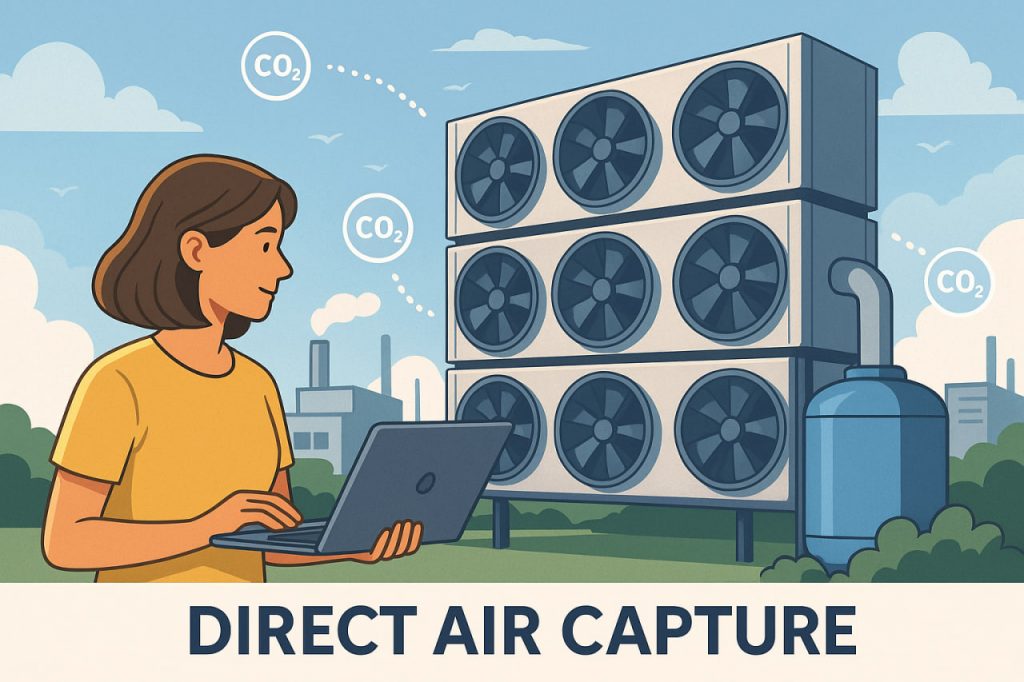
Direct Air Capture (DAC) systems are an innovative climate technology designed to remove carbon dioxide directly from the air, helping reduce global greenhouse gas concentrations. Unlike traditional carbon capture methods that target emissions at the source (such as power plants), DAC units extract CO₂ from ambient air, making them a powerful tool for addressing both past and present emissions. These systems use specialized filters, chemical solvents, and controlled heating processes to separate CO₂ from the atmosphere, compress it, and either store it underground or repurpose it for industrial applications. As countries search for effective ways to mitigate climate change, DAC technology is becoming a major focus for scientists, policymakers, and environmental organizations. This approach cannot replace emission reductions, but it can complement them by removing residual carbon we cannot eliminate through lifestyle or energy-system changes alone.
How Direct Air Capture Technology Works
Direct Air Capture systems function by pulling large volumes of air through sorbent materials that chemically bind with CO₂. Fans draw air into the system, where special filters or liquid solvents capture carbon molecules. The captured CO₂ is then released by heating or applying chemical reactions, allowing it to be collected in high concentration. Once purified, it can be compressed for long-term storage or industrial reuse. According to environmental engineer Dr. Melissa Grant:
“DAC systems act like artificial trees —
but with the advantage of being measurable, scalable, and strategically located.”
Because CO₂ is evenly mixed throughout Earth’s atmosphere, DAC can operate anywhere, making it flexible for global deployment.
Storage, Utilization, and Long-Term Carbon Management
After CO₂ is captured and concentrated, it must be managed responsibly. Many DAC facilities inject CO₂ deep underground into geological formations where it mineralizes into stable rock over time. This form of storage is considered one of the safest and most permanent carbon-removal options. Other projects repurpose captured CO₂ for synthetic fuels, building materials, carbonated beverages, or agricultural enhancements. While these uses do not permanently remove CO₂ unless locked into solid materials, they help reduce dependence on fossil-based carbon sources. Sustainable carbon management requires balancing removal, storage, and circular reuse strategies to maximize environmental benefits.
Energy Requirements and Environmental Considerations
One of the main challenges of DAC technology is its high energy demand. Capturing CO₂ from ambient air requires more energy than capturing it directly from industrial exhaust because atmospheric CO₂ is far more diluted. For DAC to be truly sustainable, the energy powering it must come from low-carbon or renewable sources such as solar, wind, geothermal, or waste heat from industrial processes. Engineers are continually improving sorbents and system designs to reduce energy consumption and increase efficiency. As the technology matures, DAC systems are expected to become more affordable, scalable, and environmentally friendly.
Role of DAC in Climate Mitigation
DAC is not a substitute for reducing emissions, but it plays a critical role in global climate goals. Many climate models show that even with aggressive emission cuts, additional carbon removal technologies will be necessary to keep global warming within acceptable limits. DAC helps address “hard-to-eliminate” emissions from aviation, agriculture, shipping, and industrial manufacturing. It also helps compensate for historical emissions already accumulated in the atmosphere. By combining emission reductions with targeted carbon removal, societies can move toward net-zero and eventually net-negative emissions.
Future Development and Global Expansion
The future of DAC technology depends on scaling up current systems, improving energy efficiency, and reducing costs. New sorbent materials, modular DAC units, and integration with renewable-energy hubs show promising potential. Governments and private companies worldwide are investing in large-scale DAC facilities that could remove millions of tons of CO₂ annually. As awareness grows, DAC is becoming a central component of international climate strategies and collaborative research efforts.
Interesting Facts
- Direct Air Capture can remove CO₂ from anywhere on Earth, because atmospheric carbon is globally mixed.
- Some DAC plants operate with 100% renewable energy, minimizing their environmental footprint.
- Mineral storage can lock CO₂ into solid rock for millions of years.
- The world’s first large-scale DAC plant, Orca in Iceland, can capture 4,000 tons of CO₂ per year.
- DAC can support the development of synthetic carbon-neutral fuels for aviation and transport.
Glossary
- Sorbent — a material that absorbs or chemically binds to CO₂ in DAC systems.
- Geological Storage — injecting captured CO₂ into underground rock formations for long-term containment.
- Ambient Air — the natural air in the surrounding environment, containing diluted CO₂.
- Synthetic Fuel — fuel created through chemical processes using captured carbon instead of fossil resources.
- Net-Negative Emissions — removing more CO₂ from the atmosphere than is emitted.