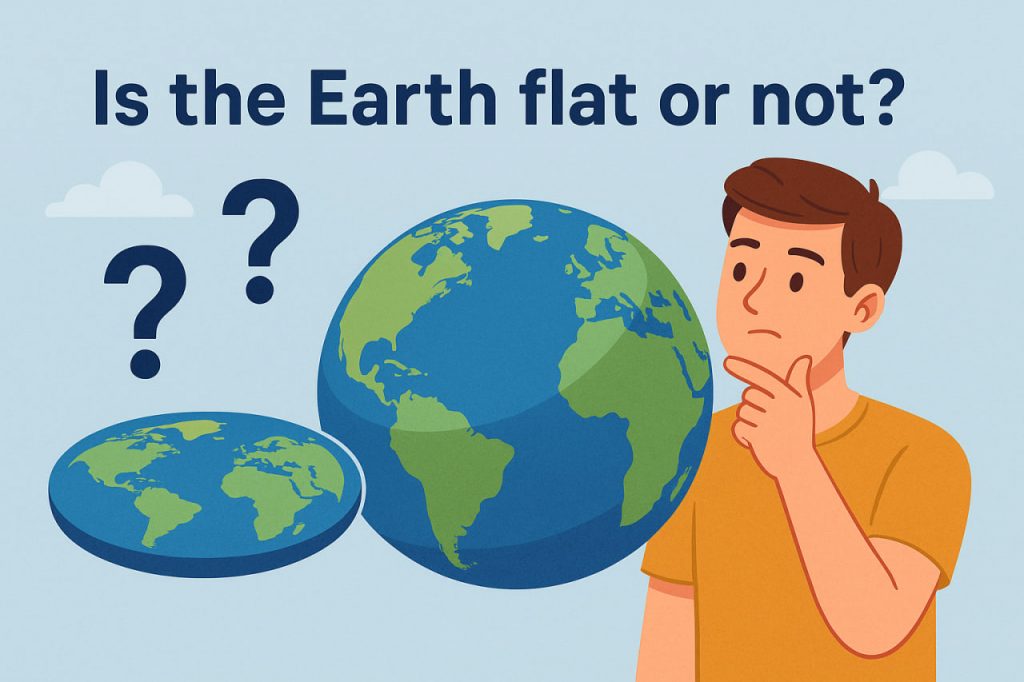
The question of whether the Earth is flat or round has been answered by science for centuries, yet it still appears in modern discussions. Today, all verified scientific evidence clearly shows that Earth is an oblate spheroid — a slightly flattened sphere. This conclusion is supported by astronomy, physics, satellite imaging, navigation, and direct observations from space. The idea of a flat Earth persists mainly due to misinformation and misunderstandings of scientific principles. Understanding why Earth is round not only clarifies the nature of our planet but also demonstrates how scientific reasoning, evidence-based methods, and global observations come together to describe reality. By examining the evidence from multiple fields, we can see that Earth’s true shape is one of the most well-supported scientific facts in history.
Evidence From Space and Direct Observation
One of the strongest proofs of Earth’s curvature comes from space exploration. Satellites orbit the planet precisely because it is round, and thousands of real-time images from space agencies show Earth as a sphere. Astronauts witness the curvature directly, and spacecraft navigation relies on calculations that only work on a spherical world. According to aerospace engineer Dr. Elena Roberts:
“Every satellite, every launch trajectory, every space mission relies on Earth’s curvature —
the physics simply wouldn’t work if our planet were flat.”
The consistency of these observations over decades leaves no scientific doubt about Earth’s round shape.
How Gravity Reveals Earth’s Shape
Gravity also provides powerful evidence. On a flat Earth, gravity would pull objects directly downward in a uniform direction, causing unusual effects at the edges. Instead, gravity pulls toward Earth’s center of mass, which naturally forms a spherical shape. This explains why people on opposite sides of the planet stand upright relative to their ground and why weight remains consistent globally with small variations caused by mountains and rotation. Earth’s equatorial bulge — created by rotation — results in the slightly flattened sphere scientists describe as an oblate spheroid.
Navigation, Travel, and the Horizon
The behavior of the horizon is another strong clue. Ships disappear bottom-first as they sail away, an effect impossible on a flat plane. Airplane routes also follow curved paths called great circles, which only make sense on a round Earth. GPS systems depend on satellite triangulation, a method that cannot function accurately unless Earth is spherical. Long-distance flights, time zones, and global circumnavigation all confirm Earth’s curvature through everyday experience.
Astronomy and Planetary Motion
Observing other planets shows that spherical shapes are a universal result of physics. From Mars to Jupiter, celestial bodies form spheres due to gravitational forces acting uniformly in all directions. Earth’s shadow on the Moon during a lunar eclipse is always round, which would not happen with a flat disk. These consistent astronomical patterns provide additional confirmation that Earth is not flat, but behaves exactly as a rotating, slightly flattened sphere should.
Why the Flat Earth Idea Persists
Despite overwhelming evidence, flat Earth beliefs continue largely because of misinformation, mistrust of institutions, and misunderstandings of scientific data. Social media amplifies these misconceptions, bringing fringe ideas into mainstream conversations. Psychologists note that some people may prefer simple explanations over complex scientific reasoning, even when the evidence contradicts them. Educating the public about scientific literacy and critical thinking helps reduce the influence of such myths over time.
Conclusion: The Evidence Is Clear
When examined closely, every reliable method — from satellite observations to physics — confirms that Earth is round. This understanding is essential for navigation, astronomy, communication systems, and modern technology. While myths about a flat Earth may persist culturally, the scientific conclusion is definitive and supported by centuries of research and practical experience.
Interesting Facts
- Earth’s shape is an oblate spheroid, slightly wider at the equator due to rotation.
- The first full image of Earth from space was taken in 1967 by the ATS-3 satellite.
- Ships disappearing bottom-first over the horizon was documented as early as 2,000 years ago.
- Earth’s gravitational field varies slightly depending on mountains, oceans, and rotation.
- Astronauts aboard the ISS see 16 sunrises and sunsets per day due to Earth’s curvature.
Glossary
- Oblate Spheroid — a sphere flattened at the poles and wider at the equator.
- Great Circle Route — the shortest path between two points on a sphere, used in aviation.
- Gravitational Field — the force that pulls objects toward Earth’s center of mass.
- Lunar Eclipse — when Earth’s shadow falls on the Moon, showing its curved shape.
- Satellite Orbit — a stable path around Earth made possible only by its spherical shape.