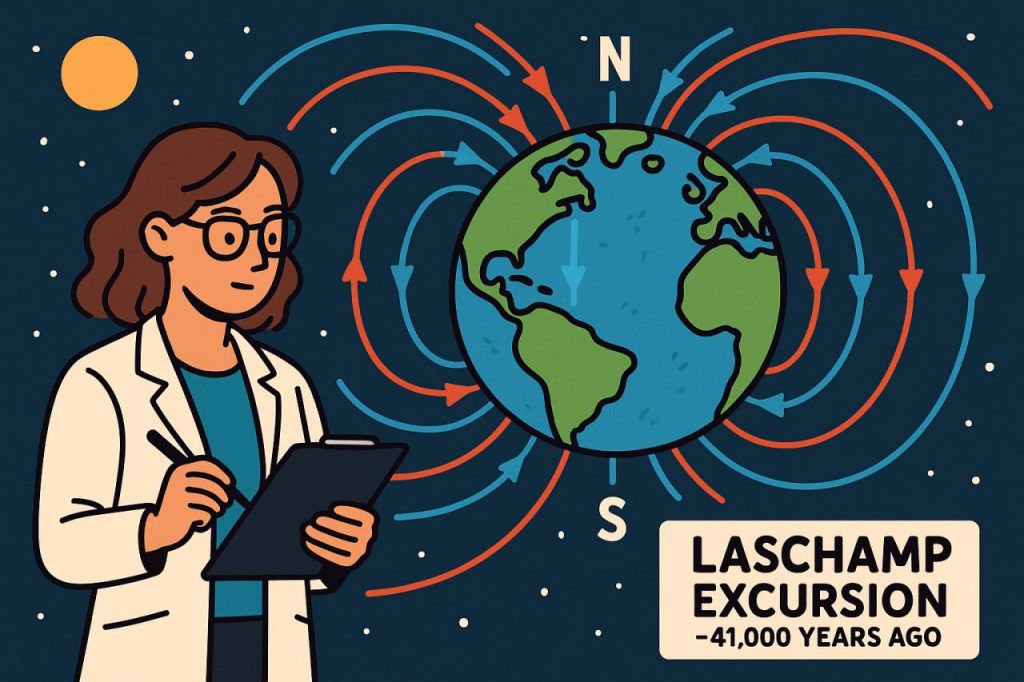
The Laschamp Excursion was a dramatic geomagnetic event that occurred approximately 42,000 years ago, during which Earth’s magnetic field weakened drastically and temporarily reversed its polarity. Named after the village of Laschamp in France, where evidence of the event was first discovered in volcanic rocks, this geomagnetic excursion lasted only a few centuries — a brief moment in geological time. During this period, the magnetic field strength dropped to less than 10% of its current level, leaving Earth far more exposed to cosmic radiation. Although it was not a full, long-term pole reversal, the Laschamp Excursion is considered one of the most significant geomagnetic anomalies of the late Quaternary period. Studying this event provides valuable insights into both Earth’s internal dynamics and the effects of magnetic-field fluctuations on climate, biology, and atmospheric chemistry.
What Caused the Laschamp Excursion
While the exact mechanism remains uncertain, scientists believe the Laschamp Excursion was triggered by complex interactions within Earth’s outer core, where molten iron generates the geomagnetic field. These interactions occasionally become unstable, causing the magnetic poles to drift, weaken, or temporarily reverse. During the Laschamp event, evidence from volcanic basalt and ocean sediments shows that the magnetic poles migrated rapidly, and the field intensity dropped to one of the lowest levels ever recorded. According to geophysicist Dr. Marcus Donovan:
“The Laschamp Excursion shows that Earth’s magnetic field is not constant —
it can change rapidly, dramatically, and with global consequences.”
This instability had wide impacts on atmospheric shielding and may have influenced ecosystems and climate patterns.
Environmental and Climatic Effects
The weakened magnetic field during the Laschamp event allowed increased levels of cosmic radiation and solar particles to reach Earth’s surface. This radiation influx likely altered atmospheric chemistry, particularly ozone levels, which help protect Earth from ultraviolet radiation. Some researchers propose that the Laschamp Excursion contributed to localized climate disruptions, such as cooling in certain regions or shifts in weather patterns. The event also coincided with changes in the behavior of Ice Age ecosystems, although the exact relationship remains debated. While it was not a global catastrophe, increased radiation may have placed stress on both humans and wildlife living during that time.
Impact on Early Humans and Extinct Species
The Laschamp Excursion occurred during a period of significant cultural and ecological change. Some studies suggest that the increased UV radiation could have driven early humans and animals to seek shelter in caves or shift migration patterns. The timing also overlaps with the disappearance of the Neanderthals, though scientists caution that magnetic-field changes alone are unlikely to have caused their extinction. Instead, the Laschamp event may have been one of several environmental pressures affecting human populations at the time. Ancient cave paintings, such as those found in Asia and Europe, may reflect increased cave habitation or symbolic responses to celestial phenomena during the weakened magnetic period.
How Scientists Study the Laschamp Event
Evidence for the Laschamp Excursion comes from several scientific sources. Volcanic rocks preserve snapshots of Earth’s magnetic field orientation at the time they cooled, while deep-sea sediments record magnetic mineral alignment over thousands of years. Tree rings, such as those from ancient kauri trees in New Zealand, provide detailed records of atmospheric radiocarbon fluctuations linked to magnetic-field strength. These combined datasets give researchers a multi-layered understanding of the event. Advances in paleomagnetism, radiometric dating, and climate modeling continue to refine knowledge of how and why the Laschamp Excursion occurred.
Why the Laschamp Excursion Matters Today
Although modern society is unlikely to face a sudden magnetic collapse identical to Laschamp, the event offers important lessons. Earth’s magnetic field is currently weakening, especially in the South Atlantic region, raising questions about future excursions. Understanding past magnetic instability helps scientists assess risks to satellites, power grids, and communication systems that depend on geomagnetic protection. The Laschamp Excursion also highlights the dynamic nature of Earth’s interior and its influence on planetary environments. By studying the past, scientists can better prepare for potential geomagnetic changes in the future.
Interesting Facts
- During the Laschamp Excursion, Earth’s magnetic field was only 6–10% as strong as it is today.
- The event lasted roughly 1,000 years, with the weakest period lasting just a few centuries.
- Evidence of the event was first found in lava flows near Laschamp, France.
- Increased cosmic radiation likely caused a spike in radiocarbon (¹⁴C) levels in the atmosphere.
- Some researchers call the Laschamp period the “Adams Event”, referencing its possible environmental impacts.
Glossary
- Geomagnetic Field — Earth’s magnetic shield generated by the movement of molten metal in the core.
- Excursion — a temporary deviation of the magnetic poles without a full reversal.
- Radiocarbon Spike — a sudden increase in atmospheric carbon-14 caused by higher cosmic radiation.
- Paleomagnetism — the study of ancient magnetic fields preserved in rocks and sediments.
- Cosmic Radiation — high-energy particles from space that Earth’s magnetic field normally deflects.