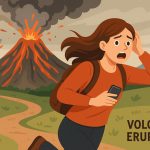
Supervolcanoes are among the most powerful natural forces on the planet, capable of releasing thousands of times more material than typical volcanic eruptions. Unlike ordinary volcanoes, which are often recognized by their tall cones and frequent activity, supervolcanoes form massive underground magma chambers that can remain dormant for hundreds of thousands of years. When they erupt, the consequences can be global: ash clouds block sunlight, climate patterns shift, and ecosystems may collapse. Although supervolcano eruptions are extremely rare, understanding them is vital for assessing long-term geological risks, climate impacts, and the evolution of Earth’s surface. These extraordinary volcanic systems remind us of the immense energy stored beneath our feet — and of the delicate balance that sustains life on our planet.
What Makes a Supervolcano Different?
A supervolcano is defined not by height or shape but by the volume of material it can release. Eruptions that exceed 1,000 cubic kilometers of ejected material are classified as VEI-8 events — the highest category on the Volcanic Explosivity Index. These eruptions can form giant calderas, depressions tens of kilometers wide created when large sections of the Earth’s crust collapse into emptied magma chambers. Famous examples of supervolcanoes include Yellowstone in the United States, Toba in Indonesia, and Taupo in New Zealand. According to geologist Dr. Caroline Meyers:
“Supervolcanoes do not erupt often, but when they do, they reshape the world.”
Their immense potential makes them objects of intense scientific study and monitoring.
Yellowstone — The Most Famous Supervolcano
Yellowstone is one of the best-known supervolcanoes, having produced three massive eruptions in the past 2.1 million years. The most recent, around 640,000 years ago, created a caldera approximately 70 kilometers wide. Evidence of Yellowstone’s power includes its widespread ash layers and active geothermal features such as geysers, hot springs, and fumaroles. While modern monitoring shows no signs of imminent eruption, even smaller volcanic events at Yellowstone could have significant regional effects. Scientists analyze ground deformation, gas emissions, and seismic activity to track this complex volcanic system.
Toba — A Supereruption With Global Consequences
The Toba supereruption around 74,000 years ago is one of the largest volcanic events in Earth’s history. It released over 2,500 cubic kilometers of ash and triggered a volcanic winter that may have lasted several years. Some evidence suggests Toba’s eruption caused severe global cooling, altered weather patterns, and possibly influenced early human evolution, though the extent of these effects remains debated. Regardless, Toba stands as a powerful reminder of how volcanic activity can impact the entire planet.
Taupo — Earth’s Most Violent Eruption of the Past 5,000 Years
New Zealand’s Taupo volcano produced the Hatepe eruption around 232 CE, one of the most explosive eruptions in the last five millennia. Though smaller than Yellowstone or Toba eruptions, Taupo’s blast was extraordinarily violent, ejecting massive amounts of pumice and ash that reshaped the landscape and destroyed vegetation across large areas of New Zealand’s North Island. Taupo remains an active volcanic system with ongoing geothermal and seismic activity.
Other Significant Supervolcanoes
Several other supervolcanic systems show evidence of massive prehistoric eruptions:
- Campi Flegrei (Italy) — A large caldera near Naples capable of producing highly explosive eruptions.
- Aira Caldera (Japan) — Known for powerful eruptions and ongoing volcanic activity.
- Long Valley Caldera (USA) — A supervolcanic system marked by geothermal fields and dense ash deposits.
While these systems have not erupted on a supervolcanic scale in recorded history, their geological structures indicate enormous potential.
Could a Supervolcano Erupt Again?
Supervolcanoes will erupt again — but likely not in the near future. These eruptions occur on timescales of tens to hundreds of thousands of years. Modern monitoring technology allows scientists to track magma movement, seismic activity, and ground inflation. While we cannot predict eruptions with absolute certainty, current data shows no immediate risk from Earth’s major supervolcanoes. However, even smaller eruptions from these systems could have significant regional effects, making preparedness and research essential.
Interesting Facts
- VEI-8 supereruptions eject over 1,000 cubic kilometers of volcanic material.
- Yellowstone’s last major eruption released ash across most of North America.
- The Toba eruption may have reduced global temperatures by 3–5°C for several years.
- The Taupo eruption produced pyroclastic flows that traveled over 70 kilometers.
- Some supervolcano calderas are so large they can only be seen clearly from space.
Glossary
- Caldera — a large depression formed after the collapse of a volcanic chamber.
- Volcanic Explosivity Index (VEI) — a scale used to measure the size of volcanic eruptions.
- Pyroclastic Flow — fast-moving hot gas and volcanic debris.
- Volcanic Winter — a period of global cooling caused by ash blocking sunlight.
- Geothermal Activity — heat-related processes near Earth’s surface, often found in volcanic regions.