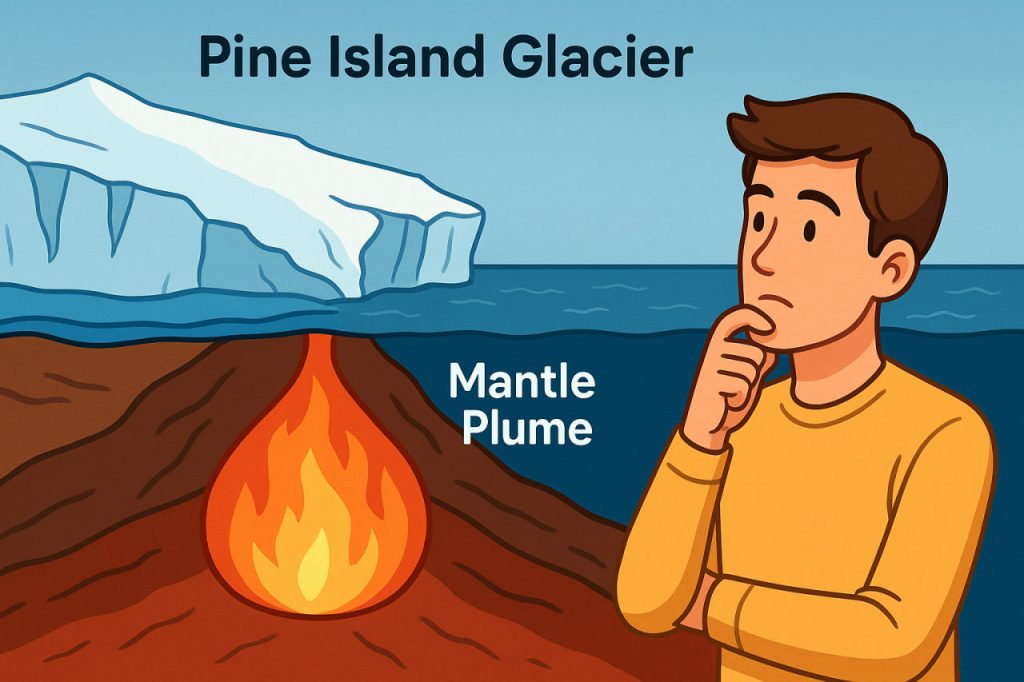
The Pine Island Glacier, located in the remote Amundsen Sea sector of West Antarctica, is one of the fastest-melting and most closely monitored glaciers on the planet. It plays a major role in global sea-level rise and has become a central focus of climate research. In recent years, scientists have uncovered strong evidence for a mantle plume — a column of unusually hot rock rising from deep within the Earth — beneath the West Antarctic Rift System. This discovery helps explain why glaciers such as Pine Island and Thwaites are melting faster than models predicted. The presence of a mantle plume does not diminish the impact of climate change; instead, it reveals an additional source of heat that interacts with warming ocean waters, accelerating ice loss from below. Understanding this combination of geological and climatic forces is essential for predicting future changes in Antarctica’s ice sheets.
The Pine Island Glacier drains a massive portion of the West Antarctic Ice Sheet. Because it is grounded below sea level, it is particularly vulnerable to both warm seawater and geothermal heat from below. The presence of a mantle plume beneath the region introduces a powerful natural heating mechanism that has shaped the landscape for millions of years and continues to influence ice dynamics today.
What Is a Mantle Plume and How Was It Detected?
A mantle plume is a vertical stream of hot, buoyant rock rising from deep within the Earth’s mantle. These plumes can generate volcanoes, thin the crust above them, and increase geothermal heat flow. For decades, scientists debated whether West Antarctica sat above such a plume. Advanced measurements — including seismic imaging, radar mapping, and geothermal modeling — have now provided compelling evidence that a mantle plume exists beneath the West Antarctic Rift System, directly under the region feeding Pine Island Glacier.
According to geophysicist Dr. James Harper:
“The mantle plume beneath West Antarctica does not directly melt glaciers,
but it delivers enough geothermal heat to weaken the ice sheet from below.”
This finding aligns with long-term observations of strong geothermal activity in the region.
How the Mantle Plume Influences Pine Island Glacier
The mantle plume heats the base of the ice sheet, increasing:
- basal melting,
- glacial flow speed,
- grounding line retreat,
- instability of the surrounding rift system.
The heat does not come from volcanic eruptions but from elevated geothermal flux penetrating the base of the glacier. When combined with warm ocean water melting the glacier from the front, Pine Island experiences a “double attack”: heat from below and warming seas from above.
Interaction Between Geological Heat and Climate Change
Although the mantle plume has existed for millions of years, Pine Island Glacier remained relatively stable until the last several decades. The recent rapid retreat is driven primarily by human-caused ocean warming. However, the plume accelerates melt rates by creating a lubricated, warm base that makes the glacier more sensitive to external heat. This combination explains why Pine Island and nearby Thwaites Glacier are losing ice faster than glaciers in East Antarctica.
Scientific Importance and Global Implications
Because Pine Island Glacier holds enough ice to raise global sea levels by more than half a meter, any acceleration of its retreat has worldwide consequences. The presence of a mantle plume suggests that West Antarctica is more geologically complex — and potentially more unstable — than previously assumed. The glacier’s future depends on both Earth’s internal heat and ongoing climate warming. Understanding this interaction will improve predictions of sea-level rise, coastal impacts, and long-term climate forecasting.
Ongoing Research and Technological Tools
Scientists are using satellite observations, ice-penetrating radar, seismic instruments, and autonomous underwater vehicles to map geothermal heat and ice movement. New field studies in the Amundsen Sea are providing clearer insight into how the plume’s heat flows through fractured crust and reaches the ice base. Researchers stress that while the plume is natural, accelerated ice loss remains strongly linked to rising ocean temperatures.
Interesting Facts
- The mantle plume beneath West Antarctica may generate up to 150–180 mW/m² of geothermal heat — several times higher than typical continental values.
- Pine Island Glacier is responsible for about 25% of Antarctica’s ice loss.
- The glacier’s grounding line has retreated over 30 km since the 1990s.
- The West Antarctic Rift System is one of the thinnest and most volcanically active regions beneath the continent.
- Heat from the plume creates subglacial rivers and lakes, influencing ice flow patterns.
Glossary
- Mantle Plume — a rising column of hot rock from Earth’s mantle that increases geothermal heat at the surface.
- Basal Melting — melting that occurs at the bottom of a glacier due to geothermal or frictional heat.
- Grounding Line — the point where a glacier lifts off the seabed and begins to float.
- West Antarctic Rift System — a large geological region characterized by tectonic thinning and volcanic activity.
- Geothermal Flux — the amount of heat rising from Earth’s interior to the surface.