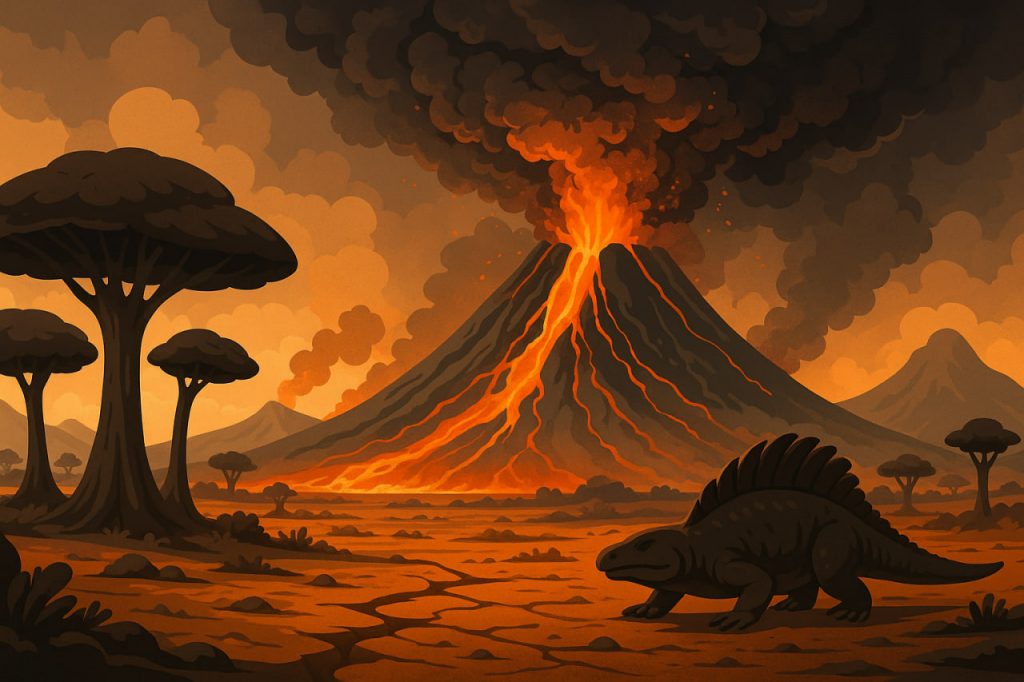
The Permian anomaly refers to a dramatic and still not fully understood period of geological and biological upheaval that occurred near the end of the Permian period, roughly 252 million years ago. This period is most famous for the Permian–Triassic extinction event, the largest mass extinction in Earth’s history, during which up to 90–95% of marine species and around 70% of terrestrial species disappeared. Scientists use the term “Permian anomaly” to describe the unusual environmental, chemical, and climatic signals preserved in rocks from this time. These anomalies include extreme volcanic activity, rapid climate instability, disruptions in ocean chemistry, and a collapse of global ecosystems. Studying this event helps researchers understand how Earth responds to rapid environmental stress — knowledge that is crucial for interpreting today’s climate changes and extinction risks.
Volcanic Triggers: The Siberian Traps
One of the leading explanations for the Permian anomaly is the massive volcanic eruptions known as the Siberian Traps. These eruptions released enormous quantities of lava over millions of square kilometers, but even more importantly, they emitted vast amounts of carbon dioxide, methane, and toxic gases. This triggered runaway greenhouse warming, acid rain, and ocean acidification. According to geologist Dr. Hannah Whitford:
“The Siberian Traps represent one of the most intense volcanic episodes in Earth’s history —
their environmental impact was global and devastating.”
The sustained volcanism heated the planet, destabilized ecosystems, and set off a chain reaction of climate changes that lasted hundreds of thousands of years.
Oceanic Collapse and Anoxia
Geochemical records from the late Permian show that oceans experienced severe anoxia, meaning a drastic loss of oxygen. Without oxygen, marine life struggled to survive, especially large organisms. Warming oceans reduced circulation, while volcanic gases fed microbial blooms that consumed remaining oxygen. This led to toxic conditions, including the spread of hydrogen sulfide produced by certain bacteria. The combination of heat, acidification, and anoxic conditions created a hostile environment for nearly all marine organisms.
Climate Instability and Extreme Warming
During the Permian anomaly, global temperatures rose sharply — possibly by 10–15°C. Such rapid warming destabilized ecosystems, causing droughts, wildfires, and drastic changes in vegetation. Forests collapsed, and large herbivores and predators disappeared due to the loss of food sources. The planet entered a prolonged period of environmental stress, with feedback loops amplifying warming and ecological collapse.
Biosphere Breakdown
With terrestrial and marine ecosystems failing simultaneously, food chains became unstable. Many ecological niches vanished, and biodiversity dropped to its lowest level in hundreds of millions of years. Soil erosion increased, deserts expanded, and previously stable biomes transformed rapidly. Even microbial life shifted dramatically, producing chemical signatures that scientists detect in Permian rocks today.
Alternative Hypotheses
While the Siberian Traps are considered the primary cause, researchers also explore additional factors that may have contributed to the Permian anomaly:
- methane release from destabilized seafloor hydrates
- asteroid impact (still debated)
- ozone-layer depletion
- shifts in ocean currents
- continental configuration of Pangaea causing climate extremes
These factors may have worked together, amplifying the severity of the mass extinction.
Why the Permian Anomaly Matters Today
The Permian anomaly provides a powerful example of how interconnected Earth’s systems are. Rapid increases in greenhouse gases, ocean chemistry disruptions, and loss of biodiversity had catastrophic consequences. Studying this period helps scientists understand thresholds and tipping points in the climate system. It also illustrates how life on Earth can be highly resilient — after the extinction, new species evolved, eventually paving the way for the age of dinosaurs.
Interesting Facts
- The Permian–Triassic extinction wiped out over 90% of marine species, the highest loss in Earth’s history.
- Lava from the Siberian Traps covered an area larger than modern-day Europe.
- Some scientists believe the extinction unfolded in multiple waves, not a single event.
- Ocean anoxia during the Permian anomaly lasted for hundreds of thousands of years.
- Chemical traces from this period show spikes in nickel, likely tied to volcanic emissions fueling microbial activity.
Glossary
- Anoxia — a severe lack of oxygen in oceans or lakes, harmful to most marine life.
- Siberian Traps — massive volcanic formations created by eruptions at the end of the Permian period.
- Hydrogen Sulfide — a toxic gas produced by certain anaerobic bacteria.
- Greenhouse Warming — temperature increases caused by trapped atmospheric gases.
- Mass Extinction — a period when many species go extinct in a relatively short geological timeframe.