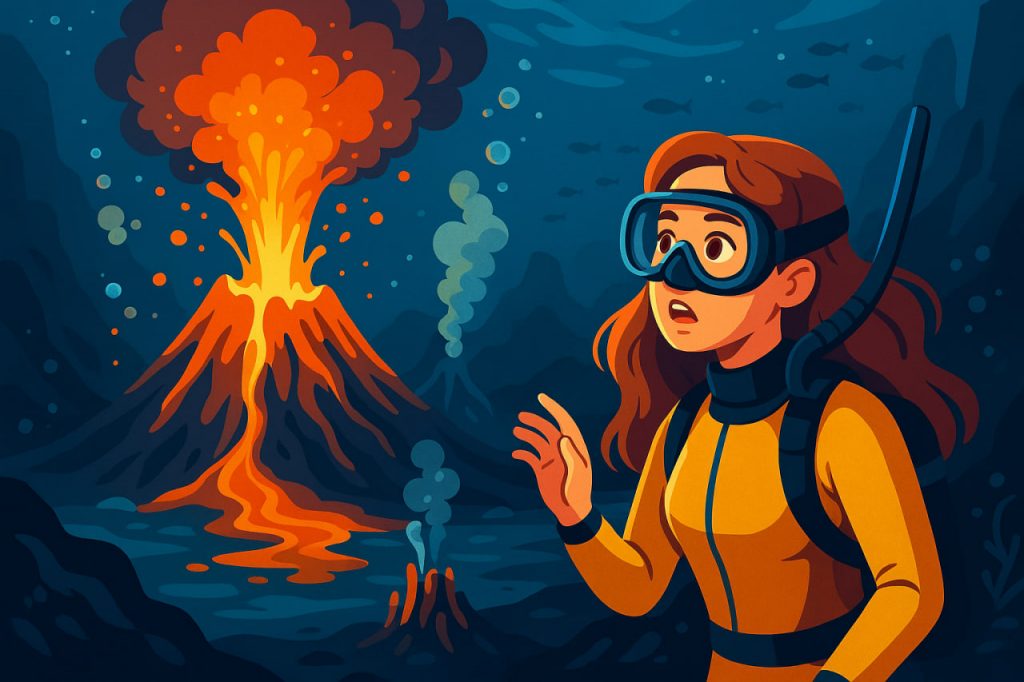
Underwater volcanoes, also known as submarine volcanoes, are hidden giants shaping the ocean floor and influencing Earth’s geology in powerful but often unseen ways. Unlike land volcanoes, which erupt into the open air, underwater volcanoes erupt beneath immense pressure, deep in the world’s oceans. These volcanoes create new seafloor, form islands, heat hydrothermal vents, and support unique ecosystems that depend on chemical energy rather than sunlight. Although most underwater eruptions go unnoticed, they are far more common than eruptions on land — in fact, more than 75% of Earth’s volcanic activity occurs beneath the ocean surface. Understanding submarine eruptions helps scientists better interpret tectonic movements, ocean chemistry, and the hidden forces that continuously transform the planet.
Underwater eruptions vary in intensity depending on depth. Near the surface, they can produce explosive plumes, steam clouds, and new islands. In the deep ocean, however, extreme pressure suppresses violent explosions, causing lava to ooze into bizarre shapes known as pillow lavas. Despite being out of sight, submarine eruptions can influence marine life, climate patterns, and even global circulation.
How Underwater Volcanoes Form
Submarine volcanoes typically occur along mid-ocean ridges, subduction zones, and volcanic hotspots. These geological settings allow magma to rise through cracks in the Earth’s crust. As tectonic plates pull apart or collide, molten rock emerges onto the seafloor, creating new crust. Some underwater volcanoes grow tall enough to break the ocean surface, forming volcanic islands like Iceland, Hawaii, and the Azores. According to marine geologist Dr. Adrian Cole:
“Underwater volcanoes are the silent architects of the ocean floor —
constantly building, reshaping, and renewing Earth’s crust.”
Many of these volcanoes remain active for millions of years, erupting periodically as tectonic forces continue to shift.
Types of Underwater Eruptions
The nature of a submarine eruption depends largely on depth:
- Deep-sea eruptions occur under high pressure, causing magma to cool rapidly into pillow-shaped formations.
- Shallow-water eruptions can be highly explosive, producing ash columns, steam plumes, and floating volcanic rocks known as pumice.
- Hydrothermal eruptions release superheated water, minerals, and gases, feeding ecosystems of rare bacteria and deep-sea organisms.
Scientists monitor these eruptions using underwater microphones, seafloor sensors, and satellite observations.
Hydrothermal Vents and Unique Ecosystems
One of the most fascinating aspects of submarine volcanism is the creation of hydrothermal vents, where mineral-rich, superheated water bursts from the seafloor. These vents host ecosystems unlike anything else on Earth. Organisms such as giant tube worms, clams, and bacteria thrive without sunlight, using chemical energy from sulfur and methane to survive. These extreme environments provide insights into how life might exist on icy moons such as Europa or Enceladus.
Hazards of Submarine Eruptions
Although most underwater eruptions are harmless to humans, some pose significant risks:
- Tsunamis can be triggered by volcanic explosions or underwater landslides.
- Steam-driven blasts occur when magma reaches shallow waters.
- Floating pumice rafts can disrupt shipping routes.
- Gas emissions may alter water chemistry and harm marine life.
The 2022 eruption of Hunga Tonga–Hunga Ha‘apai demonstrated the destructive potential of submarine volcanoes when a shallow eruption produced a massive atmospheric shockwave and global tsunamis.
How Scientists Study Underwater Volcanoes
Studying submarine volcanoes is challenging due to their location, but modern technology has made significant advances. Researchers use:
- autonomous underwater vehicles (AUVs)
- deep-sea robots
- sonar mapping
- satellite imagery
- seismic networks
These tools reveal eruptive activity, vent formation, and changes in seafloor structure. Such efforts help scientists understand volcanic cycles and identify potential hazards.
Interesting Facts
- Over 1 million submarine volcanoes exist on Earth, many of them unmapped.
- Pillow lavas form when magma cools instantly into rounded shapes under pressure.
- The tallest volcano on Earth, Mauna Kea, rises mostly from beneath the ocean.
- Hydrothermal vents can reach temperatures of over 400°C without boiling due to deep-sea pressure.
- Some underwater eruptions create floating rafts of pumice large enough to be seen from space.
Glossary
- Submarine Volcano — a volcano located beneath the ocean’s surface.
- Pillow Lava — rounded lava formations created when magma cools rapidly underwater.
- Hydrothermal Vent — a crack on the seafloor emitting superheated, mineral-rich water.
- Mid-Ocean Ridge — underwater mountain ranges formed by tectonic plates pulling apart.
- Pumice — a light volcanic rock that can float on water.