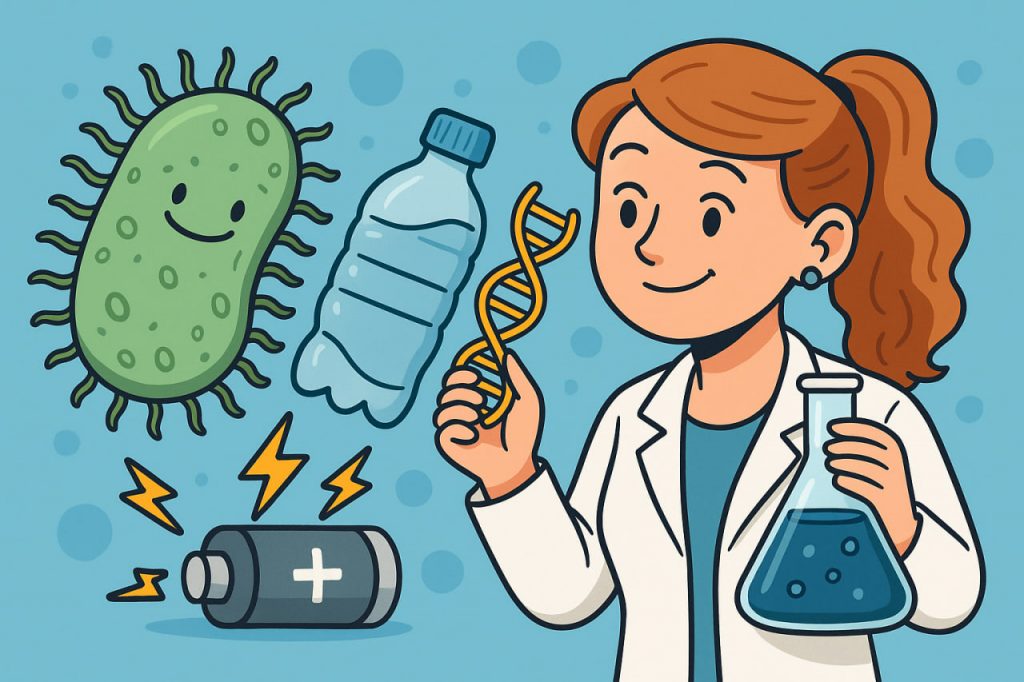
Plastic pollution is one of the biggest environmental challenges of the 21st century. Every year, millions of tons of plastic enter landfills, rivers, and oceans, threatening ecosystems and human health. At the same time, the world is searching for clean and sustainable energy sources. Remarkably, recent scientific discoveries reveal that certain bacteria can degrade plastic and even produce electricity during the process. These microorganisms offer a groundbreaking solution that addresses two global problems at once: waste management and renewable energy generation. Their unique biochemical abilities open new opportunities for biotechnology, environmental cleanup, and green power production.
Research on plastic-eating and electricity-producing bacteria demonstrates how powerful microbial systems can be when harnessed responsibly. Some species can break down PET (polyethylene terephthalate), the material used in bottles and packaging. Others generate electric current by transferring electrons outside their cells. When combined, these traits suggest a future where microbial systems convert plastic waste into usable energy — a process that could significantly reduce pollution.
How Bacteria Break Down Plastic
Several bacteria discovered in recent years can digest plastic by producing specialized enzymes. One of the most famous examples is Ideonella sakaiensis, which releases PETase and MHETase — enzymes capable of breaking down PET into simpler molecules. These molecules can then be used by the bacteria as fuel. Similar organisms have been found in soil, landfills, and even oceans. Scientists are now working on improving these enzymes to make plastic degradation faster and more efficient. According to microbiologist Dr. Elena Moritz:
“Microbial enzymes are evolving to handle modern pollutants —
and plastic-eating bacteria offer one of the most promising natural solutions.”
This discovery shows how adaptable microbial life can be in response to human-made materials.
Electricity-Producing Bacteria
Another group of microorganisms, known as electrogenic bacteria, can generate electricity as part of their metabolism. Species such as Geobacter sulfurreducens and Shewanella oneidensis release electrons outside their cell membranes during respiration. When placed in a bioelectrochemical system, these electrons travel through a circuit, creating an electric current. These bacteria form the foundation of microbial fuel cells (MFCs) — devices that turn organic waste into electricity.
Combining Both Abilities: A New Frontier
In recent studies, scientists explored how plastic-degrading bacteria could work together with electrogenic bacteria. The concept is simple but revolutionary:
- plastic-eating bacteria break down plastic into organic molecules;
- electrogenic bacteria consume these molecules;
- electrons released during this process generate electricity.
This synergy could allow the development of bioreactors that clean plastic waste while generating renewable power. Early experiments show promising results, although the technology is still in the research phase.
Environmental Benefits
These bacteria offer several important advantages:
- Reduced plastic pollution in oceans and landfills
- Cleaner waste-processing systems
- Production of renewable electricity
- Lower carbon emissions
- Sustainable recycling of difficult materials
Such microbial systems could become an essential tool for eco-friendly waste management.
Challenges and Limitations
Despite exciting progress, several obstacles must be overcome before large-scale use becomes possible:
- plastic degradation remains slow compared to mechanical recycling
- microbial fuel cells produce limited energy output
- scaling bioreactors requires stable, controlled environments
- potential ecological risks must be carefully evaluated
More research is needed to improve efficiency, safety, and commercial viability.
The Future of Microbial Technologies
The combination of plastic-eating and electricity-producing bacteria represents a bold step toward a cleaner and more sustainable future. Researchers envision smart waste facilities powered by microbes, self-sustaining recycling units, and even portable devices that generate electricity from environmental pollutants. As biotechnology continues to advance, these remarkable organisms may become powerful allies in the fight against pollution and climate change.
Interesting Facts
- PETase, the enzyme that digests plastic, was accidentally discovered at a Japanese recycling facility in 2016.
- Geobacter bacteria produce microscopic nanowires that conduct electricity.
- Some electrogenic bacteria can form biofilms that behave like living electrical circuits.
- Microbial fuel cells have been used to power small LEDs and sensors in laboratory experiments.
- Scientists are exploring ways to engineer bacteria to break down multiple types of plastics, not just PET.
Glossary
- Electrogenic Bacteria — microorganisms capable of generating electricity through electron transfer.
- PETase — an enzyme that breaks down PET plastic into smaller molecules.
- Microbial Fuel Cell (MFC) — a device that uses bacteria to convert organic matter into electrical energy.
- Biofilm — a structured community of microorganisms that adhere to surfaces.
- Biodegradation — the natural breakdown of materials by biological organisms.