The origin of life on Earth remains one of the most profound and fascinating scientific questions of all time. While no single explanation has been universally confirmed, modern research offers several compelling theories that explore how non-living molecules could have assembled into the first self-replicating, evolving organisms. These theories draw from chemistry, geology, astrophysics, and molecular biology to form a picture of how early Earth provided the conditions necessary for life to emerge. Understanding these theories helps us trace our biological roots and provides valuable insights into the possibility of life elsewhere in the universe. Although each theory has its strengths and limitations, together they form a rich scientific framework for studying life’s beginnings.
The early Earth, roughly 4 billion years ago, was dramatically different from the world we know today. It featured intense volcanic activity, meteorite impacts, ultraviolet radiation, and a chemically rich environment filled with simple organic molecules. These extreme conditions may have provided the foundation for life to develop. Modern theories focus on how environmental energy, minerals, and molecular interactions may have driven the transition from chemistry to biology.
Primordial Soup and Chemical Evolution
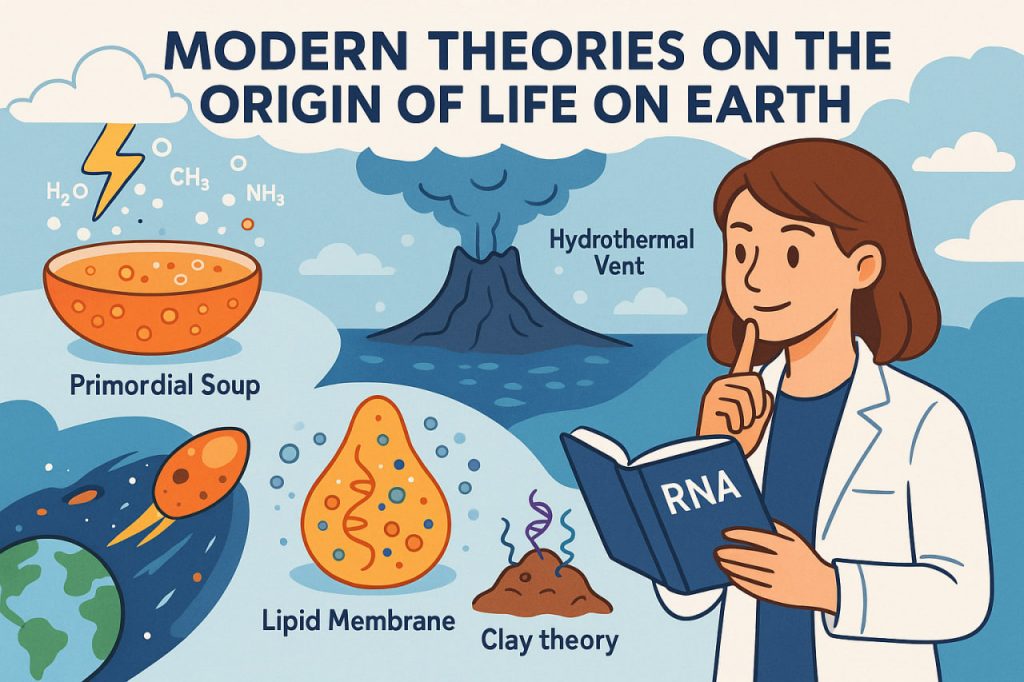
The “primordial soup” theory proposes that life began in Earth’s early oceans, where simple molecules accumulated and reacted under the influence of lightning, volcanic heat, and ultraviolet radiation. The famous Miller–Urey experiment demonstrated that amino acids — the building blocks of proteins — could form under simulated early-Earth conditions. According to molecular biologist Dr. Alan Huxley:
“Chemical evolution may have produced the first organic building blocks long before biology existed.”
This theory suggests that life began through gradual chemical complexity, eventually producing self-replicating molecules like RNA.
RNA World Hypothesis
One of the most widely accepted modern theories is the RNA world hypothesis, which proposes that RNA was the first self-replicating system. RNA can store genetic information like DNA and catalyze chemical reactions like proteins. This dual ability makes RNA a strong candidate for the molecule that bridged the gap between non-living chemistry and living cells. Over time, RNA-based systems may have evolved into more stable DNA–protein life.
Hydrothermal Vent Theory
Deep-sea hydrothermal vents — cracks in the ocean floor that release mineral-rich, superheated water — may have provided the ideal environment for life’s emergence. These vents contain:
- abundant chemical energy
- catalytic minerals like iron and nickel
- natural compartments formed by mineral structures
This theory suggests that early metabolic reactions developed in these energy-rich environments, eventually evolving into primitive life forms.
Panspermia Theory
The panspermia theory proposes that life, or the building blocks of life, may have originated elsewhere in the universe and arrived on Earth via comets, meteorites, or interstellar dust. Some meteorites contain organic molecules, and certain microbes can survive the vacuum of space. While panspermia does not explain the ultimate origin of life, it expands the possibility that life’s chemistry is universal.
Clay and Mineral Surface Theory
Some scientists suggest that minerals like clay acted as natural scaffolds for early molecules. Clay surfaces can bind organic compounds, allowing them to assemble, interact, and polymerize more efficiently. This theory argues that minerals may have supported the first biochemical networks, eventually leading to more complex systems.
Lipid World Hypothesis
The lipid world hypothesis proposes that early life began with self-assembling lipid molecules forming primitive membranes. These membranes created compartments, allowing chemical reactions to occur in isolated environments — a crucial step toward cellular life.
Why Multiple Theories Matter
No single theory can yet explain every step of life’s origin. Instead, modern scientists believe that several processes may have worked together on early Earth. Research continues through laboratory experiments, deep-sea exploration, and the study of ancient rocks. New discoveries, especially from Mars and icy moons like Europa and Enceladus, may eventually reshape our understanding of life’s beginnings.
Interesting Facts
- The Miller–Urey experiment created over 20 amino acids, many of which are found in living organisms today.
- Some hydrothermal vents host ecosystems that survive without sunlight, relying entirely on chemical energy.
- Meteorites have delivered complex organic molecules, including amino acids, to Earth.
- RNA can act both as genetic material and as a catalyst, supporting the RNA world theory.
- Modern cells still contain structures and chemical pathways that resemble ancient metabolic systems.
Glossary
- RNA World — a theory proposing RNA as the first self-replicating molecule.
- Hydrothermal Vent — a mineral-rich, heated opening on the ocean floor.
- Panspermia — the idea that life’s building blocks may have come from space.
- Polymerization — the joining of small molecules to form long chains essential for life.
- Lipid Membrane — a fatty barrier forming compartments similar to early cell structures.