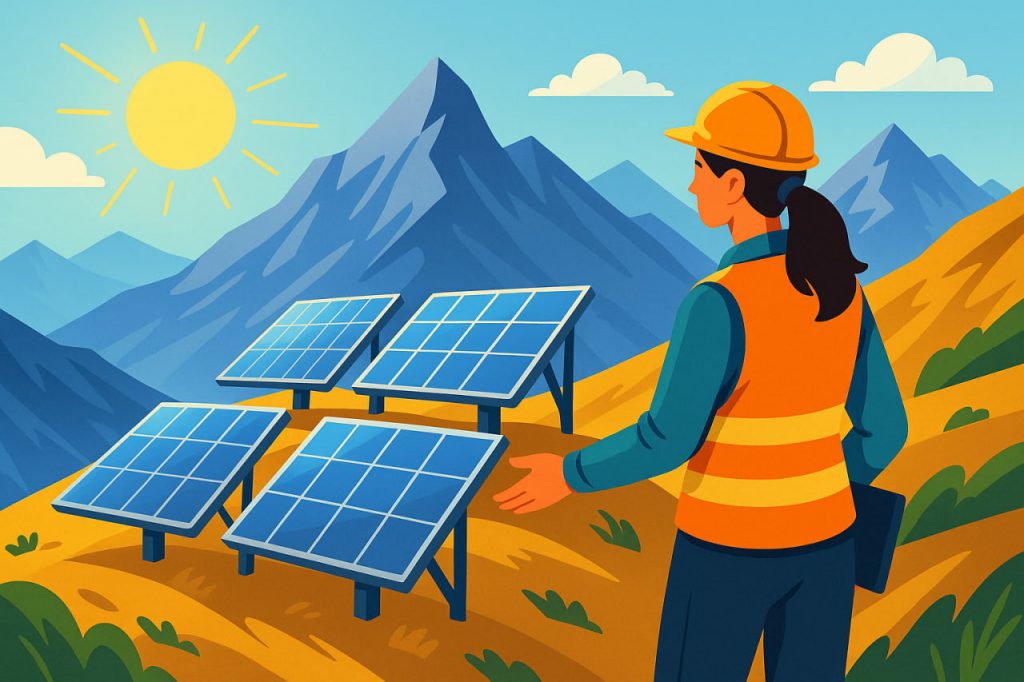
Harnessing solar energy from mountain ridges is becoming an increasingly attractive idea for engineers, climatologists, and renewable-energy specialists. High-altitude regions receive strong, stable sunlight, remain above cloud cover for much of the year, and offer vast unused land where large-scale solar installations can operate efficiently. As global demand for clean energy rises, mountain-based solar systems are being studied as a way to produce more electricity with fewer environmental conflicts and higher performance compared to traditional lowland solar farms. Understanding how altitude, geography, and atmospheric conditions influence solar generation reveals why mountain ridges may become important hubs for future renewable energy grids.
In recent decades, solar power has expanded rapidly across deserts and farmlands, but these areas face challenges such as land-use competition, dust accumulation, and high temperatures that reduce efficiency. Mountain ridges, by contrast, offer cooler temperatures, higher irradiation, and natural slopes ideal for solar panel alignment. These unique advantages make high-altitude solar projects an emerging frontier in clean energy development.
Why Mountain Ridges Are Ideal for Solar Power
Several natural factors make mountains excellent environments for solar energy:
- higher solar radiation due to thinner atmosphere
- frequent clear skies, especially above cloud layers
- cooler temperatures that improve photovoltaic efficiency
- reduced dust accumulation compared to desert regions
- abundant unused land that minimizes competition with agriculture or housing
Mountain environments also receive intense sunlight during winter, when lowland solar systems often underperform. According to renewable-energy researcher Dr. Sofia Renner:
“Altitude can boost solar efficiency by 10–25%,
making mountain ridges some of the most effective places for solar farms.”
This potential has led several countries to investigate high-mountain solar strategies.
Global Examples of High-Altitude Solar Projects
1. The Alps (Europe)
Countries like Switzerland and Austria are testing solar farms above the cloud line, where winter production exceeds that of lowland systems.
2. The Himalayas (India, Nepal, China)
High plateau regions receive intense sunlight year-round, making them ideal for large-scale installations.
3. The Andes (Chile, Peru, Bolivia)
The Atacama region, already home to advanced solar plants, benefits even more from ridge-top installations.
4. Rocky Mountains (USA & Canada)
Remote mountain slopes offer strong solar potential paired with wind-energy integration.
These projects demonstrate that mountain-based solar energy is both feasible and highly productive.
Engineering Advantages
Engineers designing mountain-ridge solar farms benefit from:
- natural slopes that reduce mounting costs
- excellent water runoff that prevents flooding
- temperature stability that reduces thermal stress
- ideal conditions for bifacial panels, which collect sunlight from above and reflected light from snow or rock
Bifacial solar panels in snowy mountains can produce significantly more energy due to natural reflectivity.
Environmental Considerations
While mountain solar farms offer many benefits, they require careful planning to minimize environmental impact. Key considerations include:
- preserving fragile alpine ecosystems
- avoiding disruption of wildlife migration routes
- designing minimal-footprint access routes
- selecting areas already affected by human activity (e.g., ski infrastructure)
Eco-engineered designs can significantly reduce long-term disturbance.
Hybrid Systems: Solar + Wind
Mountain ridges are excellent locations for hybrid renewable systems, where:
- strong winds
- intense sunlight
- natural elevation
combine to produce energy day and night. Hybrid plants stabilize power supply and improve grid reliability.
Challenges and Limitations
Despite their potential, mountain solar installations face obstacles:
- difficult construction logistics
- need for durable materials in extreme weather
- risk of snow accumulation on panels
- limited maintenance access
- higher initial investment costs
These challenges require specialized engineering solutions, but long-term efficiency gains often outweigh the difficulties.
The Future of High-Altitude Solar Energy
As global energy systems shift toward carbon neutrality, high-altitude solar power may become a major contributor to renewable-electricity supply. Advances in lightweight panels, autonomous maintenance robots, and high-efficiency materials are making it increasingly practical. Combined with smart-grid technology and long-distance transmission systems, mountain solar farms could help stabilize national and continental power networks.
Interesting Facts
- Solar panels lose efficiency in heat — mountain cold can boost performance by up to 15%.
- Snow reflects sunlight, increasing the output of bifacial panels installed on ridges.
- Some Alpine solar installations generate twice as much energy in winter as lowland systems.
- High-altitude regions receive stronger UV radiation due to thinner atmosphere.
- Mountain-based solar farms can operate above cloud layers for consistent year-round production.
Glossary
- Irradiation — the amount of solar energy received per unit area.
- Bifacial Panel — a solar panel that captures light on both sides.
- Hybrid Renewable System — combined use of solar and wind energy.
- Alpine Ecosystem — fragile high-mountain environment sensitive to disturbance.
- Smart Grid — an advanced electricity system that manages variable energy sources.