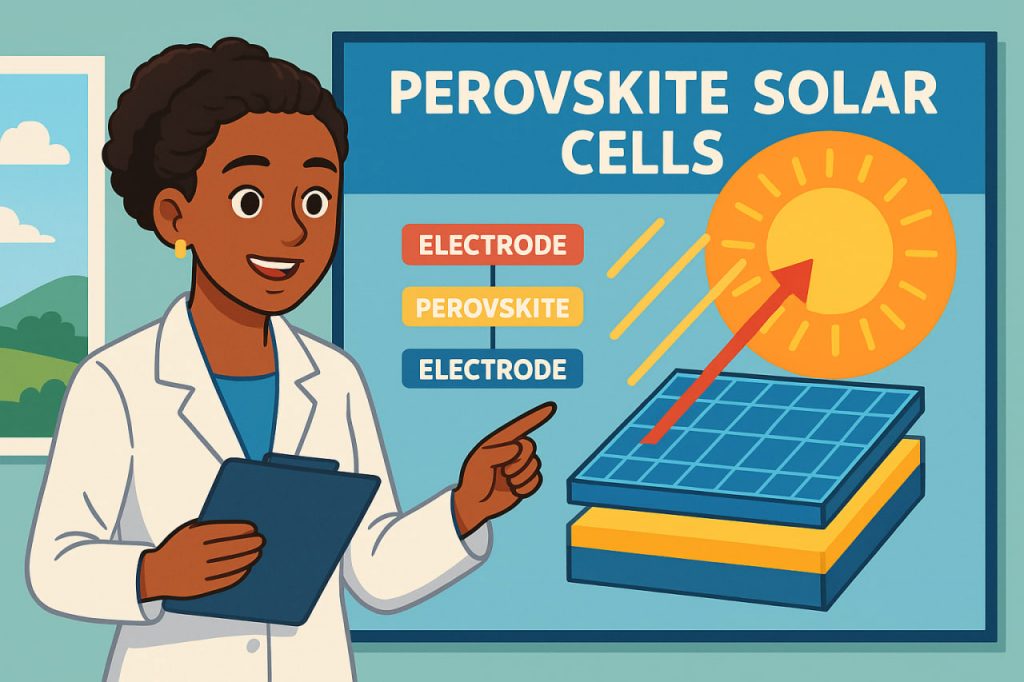
Perovskite solar cells are one of the most promising innovations in renewable energy. Over the last decade, they have rapidly advanced from a scientific curiosity to a leading candidate for next-generation photovoltaic technology. Named after their crystal structure — similar to the mineral perovskite (CaTiO₃) — these solar cells use hybrid organic–inorganic materials capable of absorbing sunlight with remarkable efficiency. Their structure allows for low-cost manufacturing, flexible designs, and tunable optical properties, making them a serious competitor to traditional silicon-based solar panels. Scientists are particularly excited because perovskite cells offer high performance while being lightweight, transparent, and suitable for a wide range of surfaces.
Unlike conventional solar cells, which require energy-intensive production processes, perovskites can be manufactured at low temperatures using solution-based methods such as printing or coating. This allows for cheaper large-scale production and opens the door to integrating solar technology into windows, fabrics, building materials, and portable devices. As research continues, perovskite solar cells may dramatically expand the use of solar energy worldwide.
How Perovskite Solar Cells Work
Perovskite solar cells absorb sunlight and convert it into electricity through three main steps:
- Light absorption — the perovskite layer captures photons efficiently.
- Charge generation — absorbed photons create electrons and holes.
- Charge transport — these charges are collected by electrodes to produce electrical current.
A critical advantage of perovskite materials is their strong absorption coefficient, meaning even thin layers capture large amounts of light. According to solar materials expert Dr. Alicia Romero:
“Perovskites combine high efficiency with low manufacturing cost —
a combination the solar industry has been seeking for decades.”
This explains why research interest is accelerating globally.
Why Perovskites Are So Efficient
Perovskite materials offer several key advantages:
- broad absorption spectrum, including visible and near-infrared light
- high charge mobility, reducing energy loss
- low defect densities, improving stability
- easy bandgap tuning, allowing customized absorption
- compatibility with flexible substrates
These properties helped perovskite solar cell efficiency rise from 3% in 2009 to over 30% today, making it one of the fastest improvements in the history of solar technology.
Perovskite–Silicon Tandem Cells
Another major innovation is tandem solar cells that combine:
- a perovskite top layer
- a silicon bottom layer
Each layer absorbs different parts of the solar spectrum, pushing efficiency beyond the limits of silicon alone. Tandem cells have already achieved world-record efficiencies above 33%, bringing commercial production closer.
Advantages of Perovskite Solar Cells
Perovskite solar cells offer numerous benefits:
- high efficiency at low cost
- lightweight and flexible design options
- semi-transparent variants for windows
- simple manufacturing methods
- high performance in low-light conditions
- potential for wide-scale integration in buildings and electronics
These features could make solar power more accessible and versatile than ever before.
Challenges and Limitations
Despite their promise, perovskite cells face several challenges:
- long-term stability, especially with heat and moisture
- degradation under prolonged light exposure
- scalability of manufacturing
- use of lead in some formulations, raising environmental concerns
Scientists are actively developing lead-free alternatives and protective coatings to improve durability and safety.
Applications of Perovskite Technology
Perovskite solar cells may soon appear in:
- building-integrated photovoltaics (solar windows, facades)
- portable electronics and wearables
- lightweight aerospace applications
- electric vehicles
- indoor IoT devices
- self-powered sensors
Their flexibility and low weight allow them to be used in places where silicon panels are impractical.
The Future of Perovskite Solar Cells
As stability improves and production methods mature, perovskite technology is expected to enter mainstream commercial markets. Many companies are preparing pilot lines, and experts anticipate widespread adoption within the next decade. Perovskites have the potential to reshape the global energy landscape by making solar power more affordable, efficient, and widely integrated into everyday life.
Interesting Facts
- Perovskite solar cell efficiency jumped from 3% to over 30% in just 14 years.
- They can be printed like newspaper ink, enabling ultra-low-cost production.
- Transparent perovskites can turn windows into electricity-generating surfaces.
- Some perovskite layers are only 300 nanometers thick — thinner than a human hair.
- Tandem perovskite–silicon cells are on track to become the most efficient solar modules ever made.
Glossary
- Perovskite — a crystal structure used in advanced solar materials.
- Bandgap — the energy difference determining which wavelengths of light a material absorbs.
- Charge Mobility — how easily electrons move through a material.
- Tandem Solar Cell — a multi-layer solar device combining different materials for higher efficiency.
- Degradation — loss of performance due to environmental exposure.