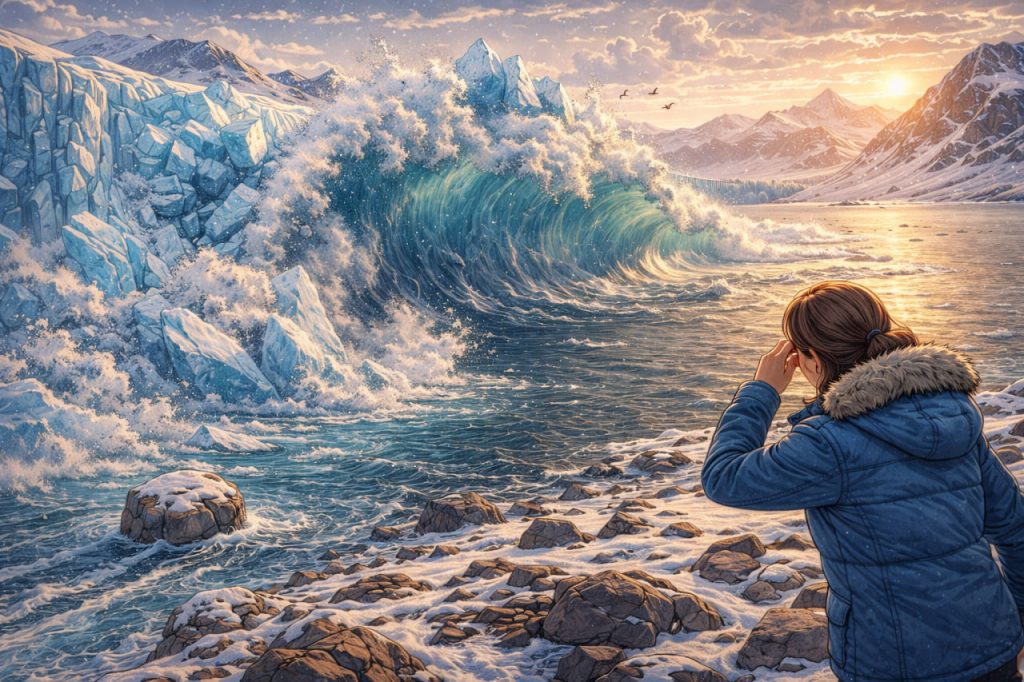
Ice tsunamis are rare but powerful natural events caused by the sudden displacement of large volumes of ice into water. Unlike classical tsunamis triggered by earthquakes, ice tsunamis originate from collapsing glaciers, ice shelves, or massive ice avalanches entering lakes, fjords, or coastal seas. These events generate fast-moving waves that can be extremely dangerous in confined water bodies. As global temperatures rise, ice tsunamis are receiving increased scientific attention due to their growing frequency in polar and mountainous regions. Understanding this phenomenon is essential for assessing risks near glaciers and ice-covered coastlines. Ice tsunamis demonstrate how cryospheric processes can directly affect surrounding environments.
What Is an Ice Tsunami
An ice tsunami is a wave generated when a large mass of ice rapidly enters a body of water, displacing it almost instantaneously. The impact can occur when glaciers calve into the sea, when ice cliffs collapse, or when ice avalanches fall into glacial lakes. The sudden transfer of momentum forces water outward, creating waves that can travel long distances. These waves are especially dangerous in narrow fjords and lakes, where water has little space to dissipate energy. According to glaciologist Dr. Mark Reynolds:
“Ice tsunamis are driven by gravity and mass,
not tectonic forces, but their destructive power can be comparable.”
This distinction makes them a unique category of wave hazard.
Glacier Calving and Ice Collapse
One of the most common causes of ice tsunamis is glacier calving, the process by which large ice blocks break off from the glacier front into water. While calving is a natural part of glacier dynamics, warming temperatures increase its intensity and unpredictability. When massive ice chunks fall into water, they can displace thousands or even millions of cubic meters of water in seconds. In extreme cases, calving events generate waves capable of flooding shorelines or damaging nearby infrastructure. The size of the wave depends on ice volume, impact angle, and water depth.
Ice Tsunamis in Glacial Lakes
Glacial lakes formed by melting ice are particularly vulnerable to ice tsunamis. These lakes are often dammed by unstable ice or loose sediment, making them highly sensitive to sudden disturbances. An ice avalanche or collapsing glacier tongue can generate waves that overtop natural dams, triggering secondary floods downstream. Scientists monitor such lakes closely in mountainous regions due to the combined risk of wave impact and dam failure. Ice tsunamis in lakes highlight the cascading nature of cryosphere-related hazards.
Historical Events and Observations
Ice tsunamis have been documented in Greenland, Alaska, Patagonia, and the Himalayas. In some cases, waves generated by glacier collapse have reached heights of tens of meters near the source. Modern instruments such as time-lapse cameras, drones, and satellite imagery now allow scientists to observe these events in detail. These observations have confirmed that even moderate ice collapses can produce surprisingly strong waves. Historical evidence suggests that similar events likely occurred in the past but went unrecorded due to their remote locations.
Why Ice Tsunamis Matter Today
As climate change accelerates glacier retreat, the likelihood of ice tsunamis increases. Coastal communities, research stations, and tourist vessels operating near glaciers face growing risks. Ice tsunamis also affect ecosystems by reshaping shorelines and disturbing sediment layers. Scientists emphasize that understanding these events is critical for hazard assessment and early warning strategies. Ice tsunamis remind us that melting ice does not only raise sea levels slowly, but can also trigger sudden and dramatic events.
Interesting Facts
- Ice tsunamis can occur without earthquakes or seismic activity.
- Waves may reach tens of meters near collapsing glaciers.
- Narrow fjords amplify wave height and energy.
- Ice tsunamis are becoming more frequent as glaciers destabilize.
- Some events are detected only through satellite observation.
Glossary
- Ice Tsunami — a wave generated by sudden ice collapse into water.
- Glacier Calving — the breaking off of ice blocks from a glacier front.
- Glacial Lake — a lake formed by melting glaciers.
- Cryosphere — all frozen components of Earth’s system.
- Displacement Wave — a wave created by rapid movement of mass into water.