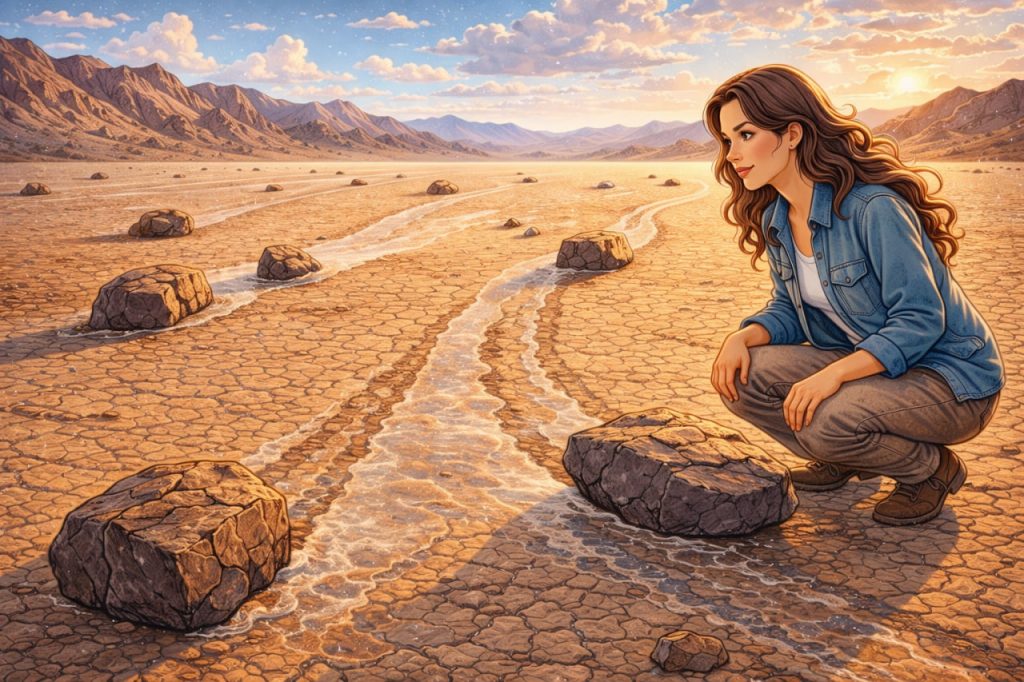
Moving stones, also known as sailing stones, are one of the most intriguing natural phenomena observed on Earth. In certain desert landscapes, large rocks appear to move across flat ground, leaving long trails behind them without any visible force acting upon them. For decades, this phenomenon puzzled scientists and inspired myths, speculation, and pseudoscientific explanations. The rocks move slowly and silently, often shifting only a few times per decade, making direct observation extremely rare. Despite their simplicity, these stones reveal how subtle environmental processes can produce seemingly impossible results. The mystery of moving stones shows how nature can surprise even modern science.
Where Moving Stones Are Found
The most famous moving stones are located in Racetrack Playa, a dry lakebed in Death Valley National Park, California. This landscape is exceptionally flat and covered with fine clay sediments that become slippery when wet. Similar phenomena have been reported in a few other arid regions around the world, but Racetrack Playa remains the best-studied site. The isolation and harsh climate of this region help preserve the long trails left behind by the stones. These visible tracks provide clear evidence that the rocks have moved, even when no one witnessed the motion itself.
Early Theories and Scientific Debate
Before modern measurements, explanations ranged from magnetic forces to strong winds and even supernatural causes. Some researchers proposed that algae growth or underground vibrations might be responsible. However, none of these theories could fully explain how heavy rocks, some weighing hundreds of kilograms, moved across dry ground. According to geologist Dr. James Norris:
“The challenge was not imagining a force strong enough,
but understanding how rare conditions could combine at exactly the right moment.”
The mystery persisted largely because the movement events were so infrequent and unpredictable.
The Role of Ice, Water, and Wind
The scientific breakthrough came when researchers discovered that thin sheets of ice play a critical role. During cold winter nights, shallow water on the playa can freeze into floating ice panels. As temperatures rise, these panels crack and begin to drift, pushed gently by light winds. The ice acts like a sail, transferring force to the stones and slowly sliding them across the slippery surface. This process does not require strong winds or large ice, only precise conditions. The movement is gradual but powerful enough to leave long, straight or curved trails.
Why the Stones Move So Rarely
All necessary conditions—rainfall, freezing temperatures, thawing ice, and wind—must align perfectly. Such combinations may occur only once every few years or even decades. When the playa dries completely, movement stops, and the trails remain as permanent records of past events. This rarity explains why the phenomenon remained unsolved for so long. Modern GPS tracking and time-lapse cameras finally confirmed the process, turning mystery into measurable science.
What Moving Stones Teach Us
Moving stones demonstrate how small forces over time can produce significant results. They remind scientists that rare environmental interactions can be just as important as dramatic events. This phenomenon also highlights the value of patience and long-term observation in scientific research. Nature often operates quietly, revealing its secrets only to those willing to observe carefully. The sailing stones stand as a symbol of how the natural world still holds mysteries waiting to be understood.
Interesting Facts
- Some moving stones weigh over 300 kilograms.
- The stones move at speeds of only a few centimeters per second.
- Ice sheets involved can be just a few millimeters thick.
- Trails may remain visible for years or decades.
- The mystery was scientifically confirmed only in the 21st century.
Glossary
- Sailing Stones — rocks that move across flat desert surfaces, leaving visible trails.
- Playa — a dry lakebed typically found in desert regions.
- Racetrack Playa — the most famous location of moving stones in Death Valley.
- Ice Panels — thin sheets of ice that help push stones across wet ground.
- Time-Lapse Photography — a technique used to record slow processes over long periods.