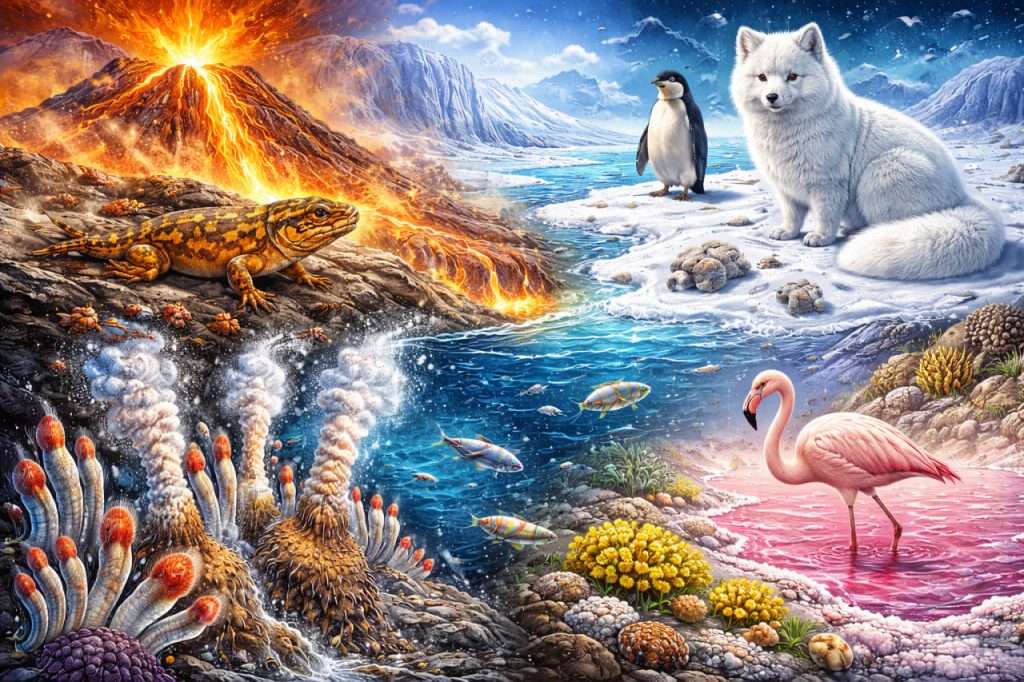
Life on Earth is far more resilient and adaptable than once believed. For a long time, scientists assumed that life could exist only within narrow ranges of temperature, pressure, and chemical balance. However, research over the past decades has revealed organisms thriving in conditions once thought completely uninhabitable. From boiling hydrothermal vents to frozen polar deserts, life has found ways to persist, adapt, and evolve. These discoveries have transformed biology and expanded our understanding of where life can exist. Studying life in extreme environments not only reshapes Earth science but also guides the search for life beyond our planet.
What Are Extreme Environments
Extreme environments are habitats characterized by conditions that are lethal to most known life forms. These include extreme temperatures, pressures, salinity, acidity, or radiation levels. Examples range from deep-sea trenches and volcanic vents to salt flats, acidic lakes, and polar ice. Organisms that inhabit such places are known as extremophiles. According to microbiologist Dr. Helen Vargas:
“Extreme environments redefine the limits of biology,
showing that life adapts rather than retreats.”
These habitats challenge traditional assumptions about the requirements for life.
Adaptations That Make Survival Possible
Life in extreme conditions depends on highly specialized biological adaptations. Proteins and enzymes in extremophiles are structured to remain stable under intense heat or pressure. Cell membranes are modified to prevent damage from acidity or salinity. Some organisms produce protective molecules that shield DNA from radiation. Others slow their metabolism to near dormancy, conserving energy until conditions improve. These adaptations demonstrate how evolution can fine-tune life to survive where it seems impossible.
Extreme Heat, Cold, and Pressure
Some organisms thrive at temperatures exceeding 100°C, living near hydrothermal vents where sunlight never reaches. These heat-loving microbes rely on chemical energy rather than photosynthesis. At the opposite extreme, cold-adapted organisms survive in Antarctic ice and permafrost, where metabolic processes occur at extremely slow rates. Deep beneath the ocean, life exists under crushing pressure that would destroy most cells. Each of these environments requires unique structural and biochemical solutions for survival.
Chemical Extremes and Radiation
Certain life forms flourish in environments with extreme chemical conditions. Acid-loving organisms inhabit lakes with pH levels similar to battery acid, while others survive in highly alkaline waters. Some microbes tolerate intense radiation by rapidly repairing DNA damage. These abilities have attracted scientific interest for applications in biotechnology and medicine. Studying chemical and radiation resistance provides insights into cellular repair mechanisms and long-term biological stability.
Why Extreme Life Matters
Life in extreme environments has profound implications for science. It expands the known boundaries of habitability and informs astrobiology, the study of life beyond Earth. Conditions similar to Earth’s extremes exist on Mars, Europa, and other celestial bodies. Extremophiles also inspire new technologies, including heat-resistant enzymes used in industry and research. Understanding extreme life helps answer fundamental questions about resilience, adaptation, and the universality of biological principles.
Interesting Facts
- Some extremophiles survive temperatures above boiling water.
- Microorganisms have been found living kilometers beneath Earth’s surface.
- Certain bacteria can endure radiation levels hundreds of times higher than humans.
- Life exists in environments with no sunlight, relying on chemical energy.
- Extremophiles help scientists study the possible origins of life.
Glossary
- Extremophile — an organism adapted to survive in extreme environmental conditions.
- Hydrothermal Vent — a deep-sea opening that releases heated, mineral-rich water.
- Astrobiology — the study of life in the Universe beyond Earth.
- Metabolic Dormancy — a state of extremely reduced biological activity.
- Chemical Energy — energy derived from chemical reactions rather than sunlight.