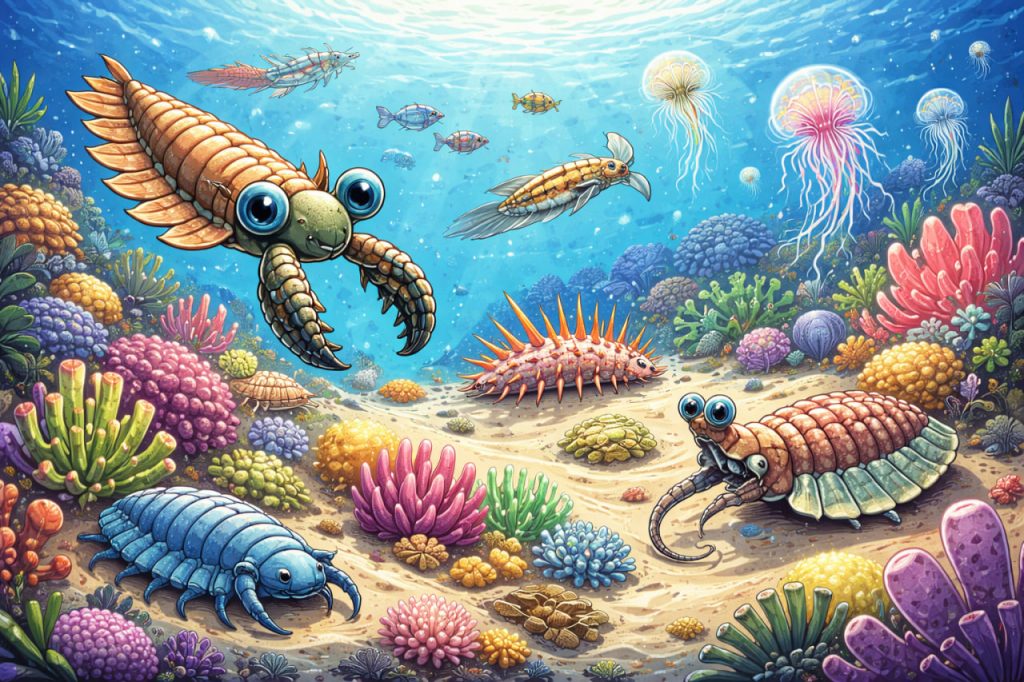
The Cambrian Explosion is one of the most significant and mysterious events in the history of life on Earth. Around 541 million years ago, the planet experienced a relatively short geological period during which an extraordinary diversity of complex, multicellular organisms appeared in the fossil record. Before this event, life was mostly simple, microscopic, and soft-bodied. During the Cambrian Explosion, however, animals with hard shells, segmented bodies, eyes, and specialized organs emerged with remarkable speed. This sudden increase in biological complexity reshaped ecosystems and laid the foundations for nearly all modern animal groups. Understanding the Cambrian Explosion helps scientists explain how complex life evolved and why Earth’s biosphere looks the way it does today.
What Happened During the Cambrian Explosion
The Cambrian Explosion refers to a burst of evolutionary innovation that occurred over roughly 20–25 million years, a short time by geological standards. During this period, most major animal phyla appeared for the first time, including ancestors of arthropods, mollusks, chordates, and echinoderms. Fossils from sites such as the Burgess Shale reveal animals with diverse body plans and novel adaptations. According to evolutionary biologist Dr. Samuel Greene:
“The Cambrian Explosion represents a turning point
where life experimented with form, function, and complexity on an unprecedented scale.”
This event marked the transition from simple life to structured ecosystems with predators and prey.
Environmental Triggers and Oxygen Levels
One of the leading explanations for the Cambrian Explosion involves changes in environmental conditions, particularly rising oxygen levels in Earth’s oceans and atmosphere. Increased oxygen made it possible for organisms to develop larger bodies, more active metabolisms, and complex tissues. At the same time, changes in ocean chemistry may have supported the formation of hard shells and skeletons. These environmental shifts provided the raw conditions necessary for evolutionary experimentation. While oxygen alone does not explain the explosion, it likely removed key biological constraints that previously limited complexity.
Genetic Innovation and Development
Another crucial factor behind the Cambrian Explosion was genetic innovation, especially the expansion of genes controlling body development. Regulatory genes that guide how organisms grow and differentiate allowed for greater variation in body plans. Small genetic changes could produce large structural differences, accelerating evolutionary diversification. This genetic flexibility enabled rapid adaptation and specialization. Scientists emphasize that evolution did not invent complexity from nothing, but built upon existing biological foundations.
The Rise of Predation and Ecosystem Dynamics
The emergence of predators during the Cambrian period dramatically altered evolutionary pressures. Once predation became common, organisms faced strong incentives to develop defenses such as armor, spines, mobility, and sensory organs. This evolutionary arms race drove rapid innovation on both sides. Eyes, jaws, and complex nervous systems appeared as survival advantages. The interaction between predators and prey helped stabilize food webs and increase ecological diversity.
Why the Cambrian Explosion Still Matters
The Cambrian Explosion continues to shape scientific debates about the speed and mechanisms of evolution. It demonstrates that under the right conditions, evolution can proceed rapidly and produce profound biological change. This event also informs the search for life on other planets by highlighting the importance of environmental thresholds. Understanding the Cambrian Explosion provides insight into how complexity arises and why it may be rare or episodic in the history of life.
Interesting Facts
- Most modern animal groups trace their origins to the Cambrian period.
- Some Cambrian animals had no modern equivalents and later went extinct.
- The Burgess Shale preserves soft-bodied organisms, rare in fossils.
- The Cambrian Explosion followed a long period of microscopic life dominance.
- Evolutionary change during this period occurred much faster than earlier eras.
Glossary
- Cambrian Explosion — a rapid diversification of complex life forms around 541 million years ago.
- Phylum — a major classification group in biological taxonomy.
- Burgess Shale — a famous fossil site preserving Cambrian organisms.
- Predation — a biological interaction where one organism hunts another.
- Regulatory Genes — genes that control the development and structure of organisms.