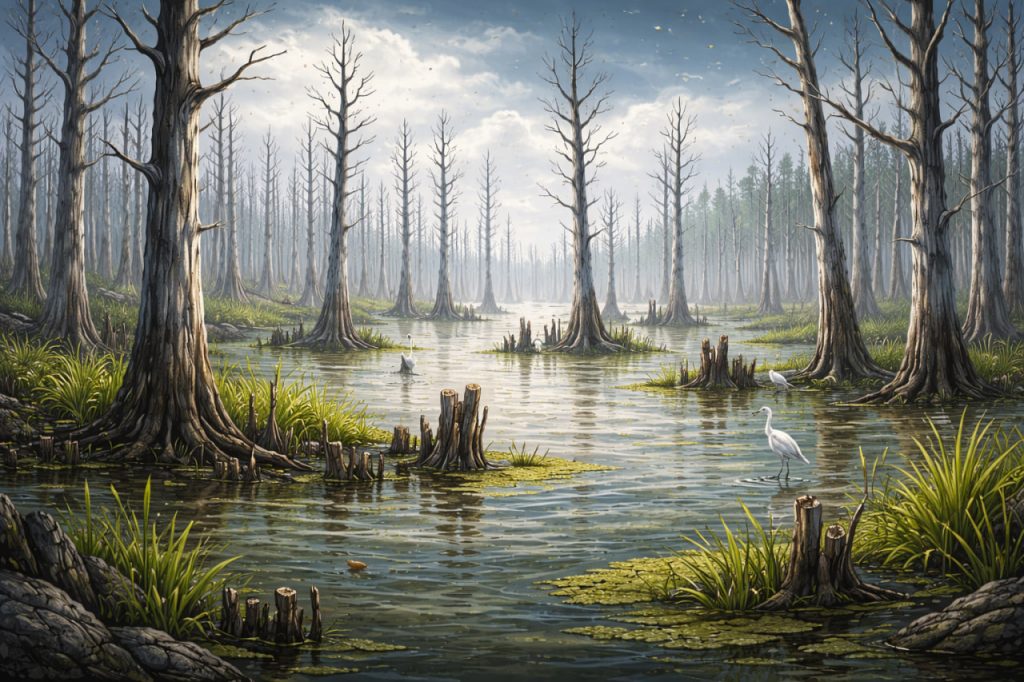
Ghost forests are haunting landscapes where once-living forests stand dead, their bare trunks rising silently from the ground. These forests are not the result of fires or logging, but of slow and persistent environmental change. Most ghost forests form in coastal regions where rising sea levels and increasing saltwater intrusion gradually poison freshwater ecosystems. As saltwater seeps into the soil, trees lose access to the conditions they need to survive, leading to widespread die-off. What remains is a stark reminder of how climate-driven processes reshape ecosystems over time. Understanding ghost forests provides insight into the long-term impacts of environmental change on natural landscapes.
How Ghost Forests Are Formed
The formation of ghost forests is closely linked to sea-level rise and changing coastal hydrology. As oceans rise, saltwater penetrates inland through groundwater and tidal flooding, altering soil chemistry. Trees that evolved to thrive in freshwater environments cannot tolerate high salt concentrations, which disrupt water uptake and damage root systems. Over time, entire forests weaken and die, often without dramatic events. According to coastal ecologist Dr. Matthew Collins:
“Ghost forests do not appear overnight.
They are the result of gradual, invisible changes beneath the surface.”
This slow transformation makes ghost forests powerful indicators of environmental stress.
The Role of Climate Change
Climate change accelerates ghost forest formation through multiple pathways. Rising global temperatures contribute to thermal expansion of seawater and melting ice, driving sea-level rise. At the same time, stronger storms and higher storm surges push saltwater farther inland. Changes in rainfall patterns can reduce freshwater flow, allowing saltwater to dominate coastal soils. These combined effects increase the vulnerability of coastal forests, particularly in low-lying regions. Ghost forests therefore reflect not a single cause, but a network of interconnected climate processes.
Ecological Consequences
The loss of living forests has profound ecological consequences. Trees provide habitat, stabilize soil, and regulate local climate. When they die, ecosystems shift toward marshes or wetlands dominated by salt-tolerant plants. While these new ecosystems can be productive, the transition often involves a temporary loss of biodiversity. Carbon storage also changes, as dead trees release stored carbon over time. Scientists study ghost forests to understand how ecosystems reorganize under stress and how these changes affect regional carbon cycles.
Where Ghost Forests Are Found
Ghost forests are increasingly observed along the Atlantic coast of North America, as well as in parts of Europe, Australia, and Asia. They are most common in flat coastal plains where small changes in sea level have large impacts inland. Satellite imagery and aerial surveys reveal expanding ghost forest zones over recent decades. These landscapes serve as visible markers of environmental thresholds being crossed. Their global distribution highlights the widespread nature of coastal change.
Why Ghost Forests Matter
Ghost forests act as natural warning signs, showing how ecosystems respond to long-term environmental pressure. They help scientists track the pace of sea-level rise and saltwater intrusion more effectively than abstract measurements alone. For communities living near coasts, ghost forests signal future risks to agriculture, infrastructure, and freshwater resources. Studying these forests supports better planning and adaptation strategies. Ghost forests remind us that environmental change often unfolds quietly, but with lasting consequences.
Interesting Facts
- Ghost forests can remain standing for decades after the trees die.
- Saltwater intrusion affects roots long before visible damage appears.
- Some ghost forests eventually transform into coastal marshlands.
- Satellite data shows ghost forest expansion over recent decades.
- Dead trees can temporarily store carbon before slowly releasing it.
Glossary
- Ghost Forest — a landscape of dead trees caused by environmental stress, often saltwater intrusion.
- Saltwater Intrusion — the movement of seawater into freshwater soils or aquifers.
- Sea-Level Rise — an increase in average ocean height due to climate-related processes.
- Coastal Plain — a flat, low-lying land area near the sea.
- Carbon Cycle — the movement of carbon through Earth’s ecosystems and atmosphere.