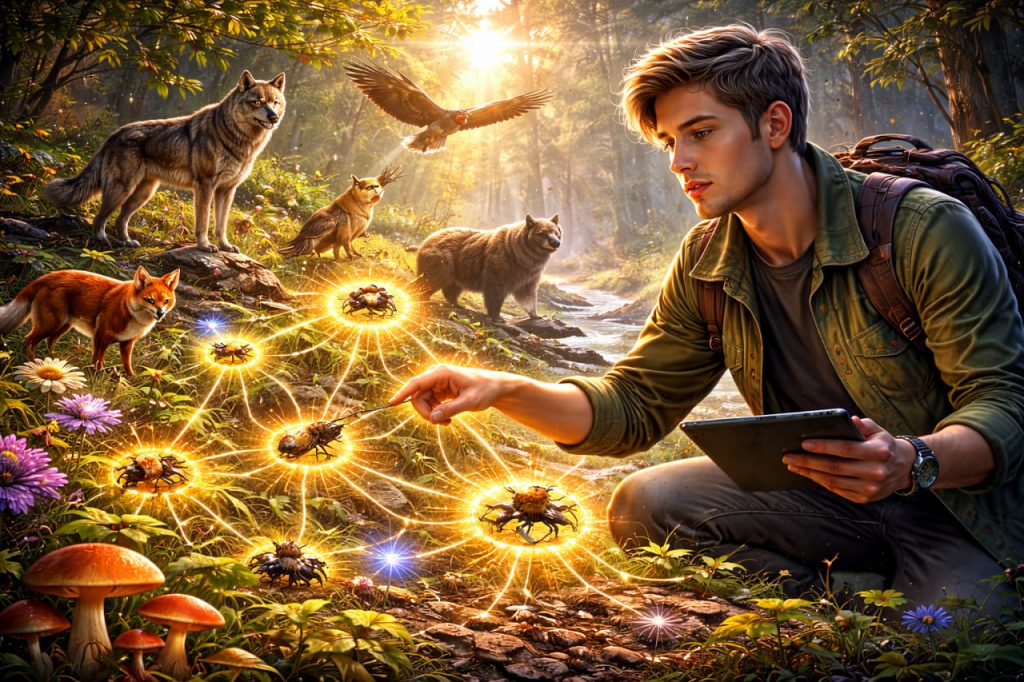
A food web is one of the most fundamental concepts in ecology, describing how energy and nutrients move through living systems. Unlike simple food chains, which show a single linear path of who eats whom, food webs reveal a complex network of interactions among organisms. Every ecosystem—from oceans and forests to grasslands and deserts—relies on food webs to maintain balance and stability. These networks determine population sizes, species survival, and the flow of energy from the sun through plants to animals and decomposers. When a food web is stable, ecosystems can absorb shocks and recover from disturbances. When it is disrupted, the consequences can cascade across entire environments.
What Is a Food Web?
A food web represents the interconnected feeding relationships within an ecosystem. At its base are primary producers, such as plants and algae, which convert sunlight into chemical energy through photosynthesis. Above them are consumers, including herbivores, carnivores, and omnivores, which obtain energy by eating other organisms. At every level, decomposers recycle dead material back into the system. Unlike a food chain, where each organism has a single role, food webs show that most species occupy multiple positions and interact with many others. This complexity makes ecosystems more flexible, but also more vulnerable when key connections are lost.
Energy Flow and Trophic Levels
Energy moves through a food web in one direction, from producers to consumers, but it is lost at each step as heat and metabolic activity. This is why food webs are structured into trophic levels, with fewer organisms at higher levels. Top predators require large, stable food bases below them to survive. If energy flow is disrupted at lower levels—such as plants or insects—higher levels quickly feel the effects. Ecologist Dr. Samuel Hartman explains:
“Food webs are not just about eating;
they are about energy economics within ecosystems.”
This principle explains why changes at the bottom of the web often have the most dramatic impacts.
The Role of Keystone Species
Some organisms play a disproportionately large role in maintaining food web stability. These are known as keystone species. Predators like wolves, sharks, or large birds of prey can regulate prey populations, preventing overgrazing or resource depletion. When keystone species are removed, food webs can collapse or reorganize in destructive ways. Such changes often lead to reduced biodiversity and altered ecosystem function. Identifying keystone species is therefore essential for conservation and ecosystem management.
Food Webs and Ecosystem Resilience
Complex food webs tend to be more resilient than simple ones. When multiple pathways exist for energy flow, ecosystems can adapt if one species declines or disappears. However, resilience has limits. Habitat destruction, pollution, invasive species, and climate change can overwhelm even complex food webs. Once critical thresholds are crossed, ecosystems may shift into new, less productive states. Understanding food web dynamics helps scientists predict which ecosystems are most at risk and which conservation actions are most effective.
Human Influence on Food Webs
Human activities have become one of the most powerful forces reshaping food webs. Overfishing, pesticide use, deforestation, and climate change alter species interactions on a global scale. By removing top predators or reducing insect populations, humans unintentionally destabilize food webs that evolved over millions of years. These disruptions often rebound back to human societies through reduced food security, ecosystem degradation, and economic losses. Recognizing humanity’s role within food webs is crucial for building sustainable relationships with nature.
Why Food Webs Matter for the Future
Food webs provide a unifying framework for understanding how life on Earth is connected. They reveal that no species exists in isolation and that stability depends on cooperation, balance, and diversity. As environmental pressures increase, preserving food web integrity becomes essential for maintaining ecosystem services that support human life. Studying food webs helps guide conservation strategies, sustainable agriculture, and climate adaptation efforts. In many ways, protecting food webs means protecting the foundations of life itself.
Interesting Facts
- A single species can participate in dozens of food web interactions.
- Marine food webs often begin with microscopic phytoplankton.
- Removing top predators can cause trophic cascades that reshape entire ecosystems.
- Insects connect plant-based and animal-based food webs.
- Healthy food webs increase ecosystem resilience to climate change.
Glossary
- Food Web — a network of interconnected feeding relationships in an ecosystem.
- Trophic Level — a position in a food web based on how an organism obtains energy.
- Primary Producer — an organism that produces energy through photosynthesis.
- Keystone Species — a species with a disproportionately large impact on ecosystem stability.
- Trophic Cascade — a chain reaction caused by changes at one level of a food web.