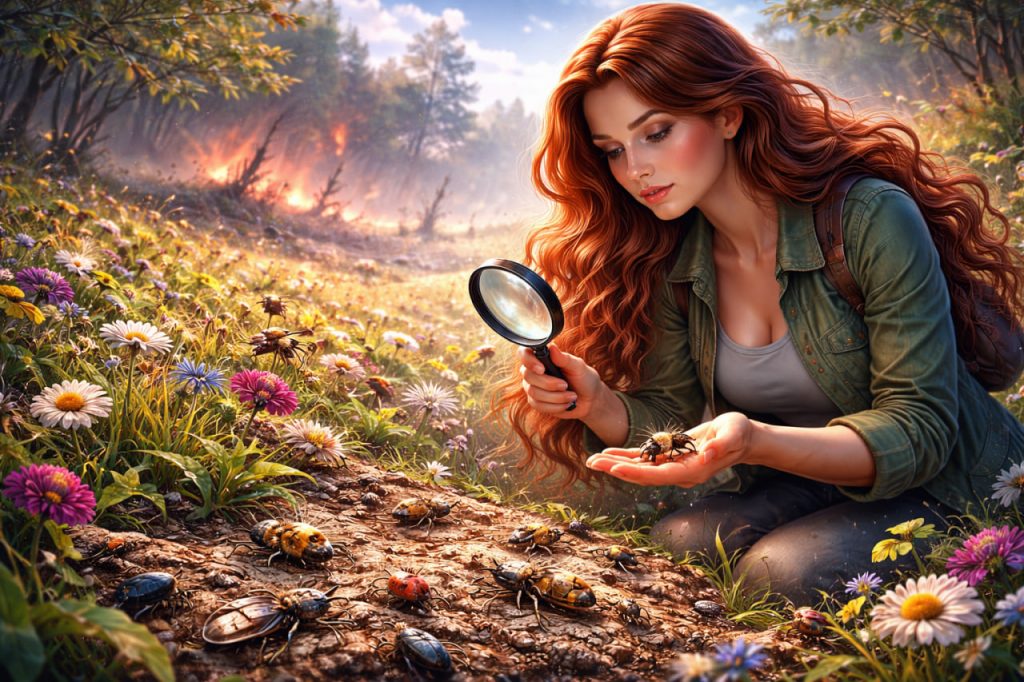
At first glance, the extinction of dinosaurs may seem like the ultimate ecological catastrophe, wiping out some of the most iconic creatures in Earth’s history. However, from a modern scientific perspective, the ongoing decline and potential extinction of insects represents a far more dangerous threat to life on Earth. Insects form the invisible foundation of terrestrial ecosystems, supporting food chains, plant reproduction, and soil health. Unlike dinosaurs, whose disappearance reshaped ecosystems over millions of years, insect decline is happening rapidly and within human timescales. This acceleration leaves little room for adaptation, recovery, or replacement. Understanding why insects matter so deeply reveals why their loss could destabilize the biosphere in ways far more severe than ancient mass extinctions.
Insects as the Foundation of Food Webs
Insects occupy a central position in nearly all terrestrial food webs. They serve as primary food sources for birds, amphibians, reptiles, fish, and countless mammals. When insect populations decline, the effects ripple upward through entire ecosystems. Predators lose reliable nutrition, reproduction rates fall, and populations collapse. Ecologist Dr. Martin Keller explains:
“Remove insects, and the entire structure above them begins to crumble.
They are the biological glue holding ecosystems together.”
During the dinosaur extinction, many food webs reorganized over long periods of time. In contrast, the rapid loss of insects today risks triggering cascading collapses faster than ecosystems can reorganize.
Pollination and the Survival of Plants
One of the most critical roles insects play is pollination. A vast majority of flowering plants rely on insects to reproduce, including many crops that humans depend on for food. Bees, butterflies, beetles, and flies transfer pollen, enabling fruit and seed formation. Without these pollinators, plant populations decline, leading to reduced biodiversity and food shortages. Unlike dinosaur-era plants, modern ecosystems are heavily interconnected with insect pollinators. Agricultural systems, in particular, are extremely vulnerable to pollinator loss, making insect decline a direct threat to global food security.
Soil Health and Nutrient Cycling
Insects are essential engineers of the soil. Decomposers such as beetles, ants, and termites break down organic matter, returning nutrients to the soil and maintaining its structure. This process supports plant growth and regulates carbon storage. Without insects, dead material accumulates, soil fertility declines, and ecosystems lose resilience. Paleontologist Dr. Elena Fischer notes:
“Dinosaurs did not manage the planet’s recycling system.
Insects do — and without them, ecosystems suffocate.”
This hidden labor is rarely noticed, yet it underpins the productivity of forests, grasslands, and agricultural land.
Speed of Decline and Lack of Recovery Time
One of the most alarming aspects of insect decline is its speed. Studies indicate that insect biomass has dropped dramatically in just a few decades in many regions. Habitat loss, pesticides, climate change, and pollution act simultaneously, overwhelming insect populations. In contrast, dinosaur extinction occurred due to a sudden catastrophic event followed by long recovery periods spanning millions of years. Today’s insect decline is ongoing, multifactorial, and continuous, offering no natural pause for recovery. This makes it uniquely dangerous in Earth’s history.
Why Humans Are Especially Vulnerable
Modern human civilization is tightly coupled to insect-driven systems. Food production, ecosystem services, and even cultural landscapes depend on insect activity. Unlike the age of dinosaurs, humans cannot simply wait for ecosystems to slowly rebuild over geological time. The loss of insects would directly affect food availability, economic stability, and public health. The consequences would be immediate, global, and deeply disruptive. In this sense, insect extinction is not just an ecological crisis, but a civilizational one.
A Warning from the Biosphere
Scientists increasingly describe insect decline as a warning signal from the biosphere itself. Insects are highly sensitive to environmental changes, making them early indicators of ecological imbalance. Their disappearance reflects deeper systemic stress affecting climate, land use, and chemical pollution. Addressing insect decline requires rethinking how humans interact with nature, from agriculture to urban planning. The extinction of dinosaurs reshaped the planet, but the extinction of insects could dismantle the systems that sustain life today.
Interesting Facts
- Insects make up over 70% of all known animal species on Earth.
- Some bird populations have declined in direct correlation with insect biomass loss.
- Pollinating insects contribute to the reproduction of more than 75% of food crops.
- Insects have existed for over 400 million years, surviving multiple mass extinctions.
- Many ecosystems collapse silently when insects disappear, without dramatic visible signs at first.
Glossary
- Food Web — a network of interconnected feeding relationships within an ecosystem.
- Pollination — the transfer of pollen that enables plant reproduction.
- Biomass — the total mass of living organisms in a given area.
- Decomposer — an organism that breaks down dead material and recycles nutrients.
- Ecosystem Services — natural processes that support life and human well-being.