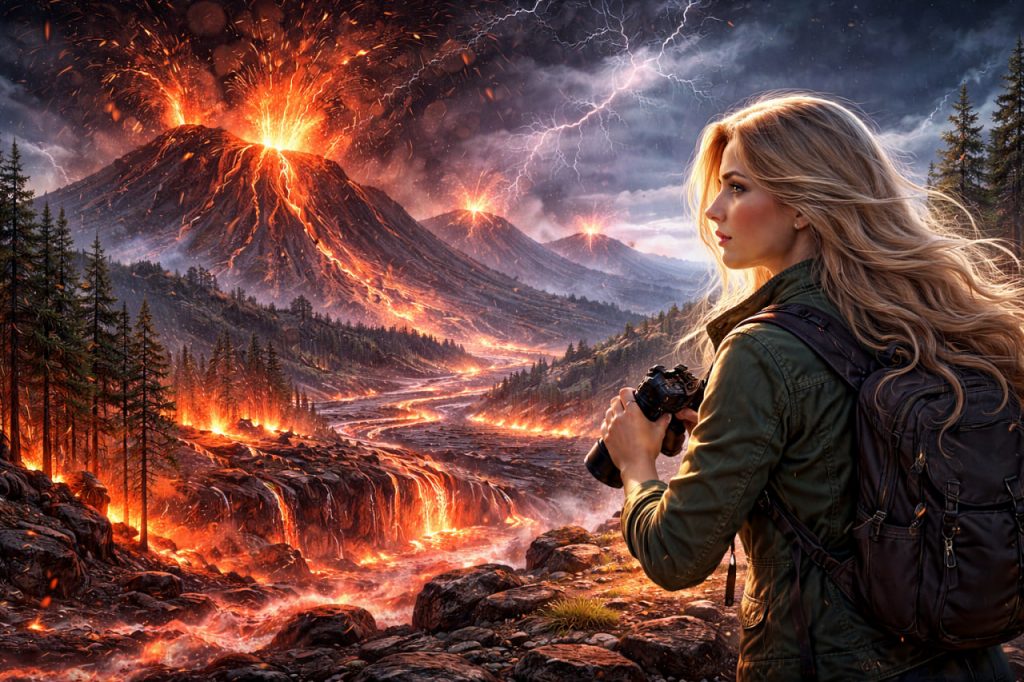
The Siberian Traps are one of the most powerful volcanic systems in Earth’s history, associated with catastrophic environmental change. Around 252 million years ago, massive eruptions in this region coincided with the Permian–Triassic mass extinction, the most severe extinction event ever recorded. Today, the idea of the Siberian Traps erupting again raises profound scientific and societal questions. Although such an event is extremely unlikely on human timescales, exploring this scenario helps scientists understand volcanic risks and Earth system responses. If a large-scale eruption were to occur within the next decade, its consequences would extend far beyond regional boundaries. The impacts would reshape climate, ecosystems, and human civilization on a global scale.
What Are the Siberian Traps?
The Siberian Traps are a vast large igneous province located in northern Siberia, formed by immense outpourings of basaltic lava. Unlike typical volcanoes, these eruptions do not build steep cones but instead release lava through long fissures, covering enormous areas. During their ancient formation, lava flows spread over millions of square kilometers, creating thick basalt layers that remain visible today. These eruptions released not only lava but also massive amounts of gases into the atmosphere. Geologist Dr. Nathan Cole explains:
“The Siberian Traps were not a single eruption,
but a prolonged volcanic crisis that fundamentally altered Earth’s systems.”
This scale is what makes them uniquely dangerous in hypothetical modern scenarios.
Immediate Atmospheric and Climatic Effects
If the Siberian Traps were to erupt again on a large scale, the immediate release of sulfur dioxide, carbon dioxide, and methane would drastically alter the atmosphere. Sulfur aerosols would reflect sunlight, causing short-term global cooling, sometimes referred to as a volcanic winter. At the same time, greenhouse gases would accumulate, leading to long-term global warming once aerosols settled. This combination of rapid cooling followed by intense warming would destabilize weather patterns worldwide. Crop failures, disrupted precipitation, and extreme temperature swings would become likely outcomes. Modern climate systems, already under stress, would struggle to adapt to such abrupt changes.
Impact on Ecosystems and Biodiversity
Ecosystems would face unprecedented pressure from both climate instability and chemical changes in the environment. Acid rain, caused by volcanic gases, would damage forests, soils, and freshwater systems. Oceans would absorb large amounts of carbon dioxide, leading to ocean acidification and threatening marine life. Many species would be unable to migrate or adapt quickly enough, increasing extinction risks. Paleontologist Dr. Elena Morozova notes:
“Past evidence shows that large igneous eruptions push ecosystems beyond recovery thresholds.”
The disruption would cascade through food webs, affecting both natural ecosystems and human-managed environments.
Consequences for Human Civilization
Modern civilization depends on stable climate conditions, global trade, and reliable food systems. A Siberian Traps–scale eruption would disrupt aviation due to ash clouds, damage infrastructure through lava flows and seismic activity, and contaminate air and water supplies. Agricultural systems would be especially vulnerable to temperature shifts and reduced sunlight. Health risks from air pollution would increase, particularly respiratory and cardiovascular stress. Economic systems could experience prolonged instability as regions struggle to maintain productivity and supply chains. While humanity possesses advanced technology, the sheer scale of such an eruption would challenge even the most resilient societies.
Long-Term Earth System Changes
Over decades to centuries, Earth would enter a new climatic regime shaped by elevated greenhouse gas levels. Ice sheets could melt more rapidly, accelerating sea-level rise. Altered ocean circulation might change regional climates permanently. Geological records suggest that recovery from past large igneous province eruptions took hundreds of thousands of years. Although life eventually rebounded, the biosphere that emerged was fundamentally different from what existed before. A modern eruption would likely leave a lasting imprint on Earth’s climate and biological systems.
Scientific Reality and Risk Perspective
It is important to emphasize that there is no clear evidence suggesting the Siberian Traps are close to reactivating on a large scale, but some scientists talk about it. Large igneous province eruptions occur over millions of years and are not comparable to typical volcanic hazards. Scientists study such scenarios not to predict imminent danger, but to understand Earth’s capacity for extreme change. This research helps refine climate models, assess resilience, and contextualize modern environmental challenges. Understanding past catastrophes allows humanity to better appreciate the stability required for civilization to thrive.
Interesting Facts
- The original Siberian Traps eruptions coincided with the extinction of over 90% of marine species.
- Lava flows from large igneous provinces can last hundreds of thousands of years.
- Volcanic gases can alter climate more dramatically than lava itself.
- The Permian extinction reshaped evolution, paving the way for dinosaurs millions of years later.
- Large igneous provinces are extremely rare on human timescales.
Glossary
- Large Igneous Province — a region formed by massive, long-lasting volcanic eruptions covering vast areas.
- Basaltic Lava — low-viscosity lava that can spread over great distances.
- Volcanic Winter — a period of global cooling caused by sunlight-blocking volcanic aerosols.
- Ocean Acidification — the decrease in ocean pH due to increased carbon dioxide absorption.
- Mass Extinction — a widespread and rapid loss of biodiversity across Earth.