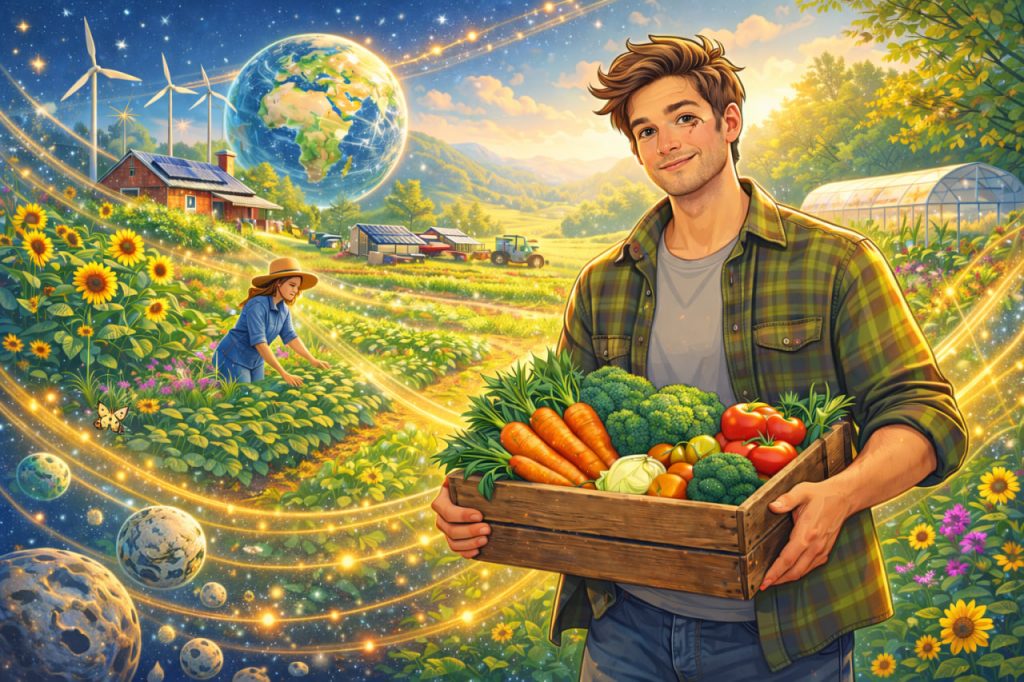
Feeding a growing global population is one of the greatest challenges of the 21st century. Modern agriculture has dramatically increased food production, but often at the cost of soil degradation, biodiversity loss, water pollution, and climate change. As the world moves toward nearly ten billion people, the question is no longer only how to produce more food, but how to do so without exhausting the planet’s natural systems. Sustainable agriculture seeks to balance productivity with ecological responsibility, ensuring long-term food security. This approach recognizes that human survival is inseparable from healthy ecosystems. Understanding sustainable agriculture helps clarify how food systems can support both people and the planet.
What Is Sustainable Agriculture?
Sustainable agriculture is a farming approach that aims to meet current food needs while preserving environmental health, economic viability, and social equity for future generations. It emphasizes soil conservation, efficient resource use, and ecological balance rather than short-term yield maximization. Instead of relying heavily on synthetic inputs, sustainable systems work with natural processes such as nutrient cycling and biological pest control. Agricultural scientist Dr. Maria Thompson explains:
“Sustainable agriculture is not about abandoning productivity,
but about redesigning food systems to last.”
This perspective shifts farming from extraction to regeneration.
Soil Health as the Foundation of Food Security
Healthy soil is the cornerstone of sustainable agriculture. Conventional intensive farming often depletes soil organic matter, reducing fertility and increasing erosion. Sustainable practices such as crop rotation, cover cropping, and reduced tillage help rebuild soil structure and microbial diversity. Rich soils retain water more effectively, reduce the need for chemical fertilizers, and increase resilience to droughts and floods. When soil health improves, productivity becomes more stable rather than dependent on constant external inputs. Protecting soil is therefore essential for long-term agricultural sustainability.
Biodiversity and Resilient Farming Systems
Biodiversity plays a critical role in sustainable agriculture by supporting pollination, pest control, and ecosystem stability. Monocultures, while efficient in the short term, are vulnerable to pests, diseases, and climate extremes. Diverse farming systems—such as agroforestry and polycultures—reduce these risks by mimicking natural ecosystems. Ecologist Dr. Samuel Reed notes:
“Diversity is nature’s insurance policy,
and agriculture is no exception.”
By fostering biodiversity, farms become more resilient and less dependent on chemical interventions.
Water Use and Climate Adaptation
Agriculture is the largest global consumer of freshwater, making water management a key sustainability challenge. Efficient irrigation, rainwater harvesting, and soil moisture conservation help reduce water waste. Sustainable agriculture also focuses on adapting to climate change by selecting crop varieties suited to changing conditions. These strategies protect both food production and freshwater ecosystems. As climate variability increases, water-smart agriculture becomes essential for feeding the planet.
Reducing Environmental Impact
Sustainable agriculture aims to minimize pollution and greenhouse gas emissions associated with food production. Practices such as precision farming reduce excess fertilizer runoff, while improved livestock management lowers methane emissions. Integrating crops and livestock can recycle nutrients more efficiently. These methods reduce agriculture’s contribution to climate change while maintaining productivity. Importantly, sustainability does not mean lower output, but smarter output.
Social and Economic Dimensions
Food systems are not only ecological systems, but also social ones. Sustainable agriculture supports farmer livelihoods, local communities, and food accessibility. Fair labor practices, knowledge sharing, and local food networks strengthen resilience across the food system. When farmers are economically secure, they are more likely to invest in long-term sustainability rather than short-term survival. Feeding the planet sustainably therefore requires addressing social and economic realities alongside environmental concerns.
Can Sustainable Agriculture Feed the World?
Research increasingly shows that sustainable agriculture can produce sufficient food when combined with reduced waste, improved distribution, and dietary shifts. The challenge lies not in biological limits, but in transforming policies, markets, and consumer behavior. Sustainable agriculture offers a pathway to feed humanity while restoring ecosystems rather than depleting them. It represents a shift from domination of nature to cooperation with it—a shift that may define the future of food.
Interesting Facts
- Healthy soils can store more carbon than the atmosphere.
- Crop rotation has been used sustainably for thousands of years.
- Nearly one-third of all food produced is lost or wasted globally.
- Biodiverse farms are often more resilient to climate extremes.
- Sustainable practices can reduce long-term farming costs.
Glossary
- Sustainable Agriculture — farming that meets present needs without compromising future resources.
- Agroforestry — integrating trees into agricultural landscapes.
- Cover Crops — plants grown to protect and enrich soil between harvests.
- Soil Organic Matter — decomposed plant and animal material that improves soil fertility.
- Food Security — reliable access to sufficient, nutritious food.