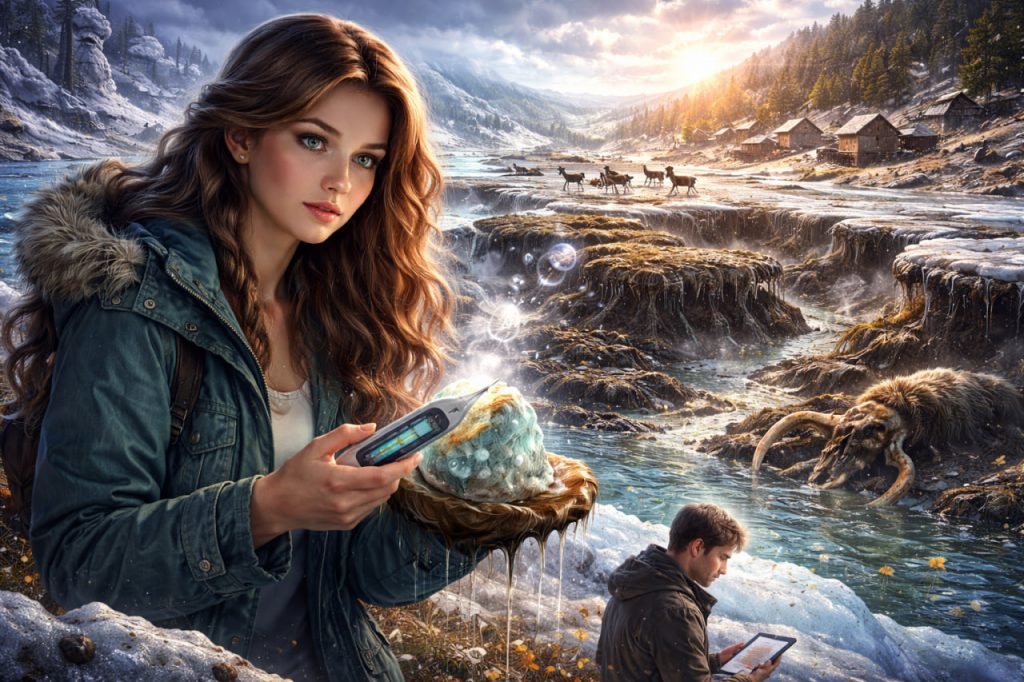
The cryosphere is one of the least visible yet most influential components of Earth’s climate system. It includes all regions where water exists in frozen form—glaciers, ice sheets, sea ice, snow cover, and permafrost. Among these elements, permafrost plays a particularly critical role because it locks away vast amounts of carbon, ancient microorganisms, and geological structures beneath the surface. As global temperatures rise, permafrost is thawing at an accelerating rate, triggering a chain of consequences that extend far beyond polar regions. This process is not a distant or localized problem; it affects climate stability, ecosystems, infrastructure, and global health. Understanding why permafrost thaw is dangerous helps explain why the cryosphere matters to everyone on the planet.
What Is Permafrost and Where Is It Found?
Permafrost refers to ground—soil, sediment, or rock—that remains frozen for at least two consecutive years. It underlies large parts of the Arctic, subarctic regions, and high mountain areas, covering nearly a quarter of the Northern Hemisphere’s land surface. Permafrost can be shallow or extend hundreds of meters deep, often containing ice, organic matter, and trapped gases. For thousands of years, it has acted as a natural freezer, preserving carbon-rich material and stabilizing landscapes. Climate scientist Dr. Anna Kovalev explains:
“Permafrost is not just frozen ground;
it is a massive storage system built over millennia.”
Once thawed, this storage system begins to release its contents into the environment.
Carbon Release and Climate Feedback Loops
One of the most serious dangers of permafrost thaw is the release of greenhouse gases, particularly carbon dioxide and methane. Frozen soils contain enormous quantities of organic carbon from ancient plants and animals. When permafrost thaws, microbes begin decomposing this material, releasing gases into the atmosphere. Methane, in particular, is a highly potent greenhouse gas over short timescales. This creates a positive feedback loop: warming causes thawing, thawing releases gases, and released gases cause further warming. Scientists warn that this feedback could significantly amplify global climate change beyond current projections.
Impact on Landscapes and Infrastructure
As ice within permafrost melts, the ground loses structural stability. This leads to land subsidence, landslides, and the formation of thermokarst landscapes marked by collapsing terrain and irregular depressions. In regions where communities, roads, pipelines, and buildings are built on permafrost, thawing poses severe risks. Infrastructure designed for frozen ground can crack, tilt, or fail entirely. According to geotechnical engineer Dr. Michael Andersson:
“Permafrost thaw transforms solid ground into unstable terrain,
turning engineering challenges into safety crises.”
These effects are already visible in Arctic settlements and are expanding southward.
Threats to Ecosystems and Water Systems
Permafrost thaw reshapes ecosystems by altering soil composition, drainage patterns, and vegetation. Wetlands may expand in some areas, while others dry out due to disrupted water flow. Changes in nutrient release can affect plant growth and microbial communities, influencing entire food webs. Rivers and lakes may become unstable as banks erode and sediment loads increase. These changes affect fish populations, wildlife habitats, and freshwater quality, with consequences that extend far beyond the Arctic.
Ancient Pathogens and Biological Risks
Another emerging concern is the release of ancient microorganisms preserved in frozen soils for thousands of years. While most pose no threat, some bacteria and viruses may remain viable after thawing. Scientists study these risks carefully, emphasizing that large-scale outbreaks are unlikely but not impossible. The thawing cryosphere introduces biological uncertainty into regions already facing rapid environmental change. This aspect highlights how permafrost thaw is not only a climate issue, but also a matter of global biosecurity awareness.
Global Consequences Beyond the Arctic
Although permafrost regions are geographically limited, their impact is global. Greenhouse gas emissions from thawing permafrost affect atmospheric composition worldwide. Disruptions to Arctic ecosystems influence ocean circulation, weather patterns, and climate systems far from polar regions. What happens in the cryosphere does not stay in the cryosphere; it feeds into interconnected Earth systems that regulate temperature, precipitation, and sea level across the planet.
Why Permafrost Thaw Matters Now
Permafrost thaw is not a future possibility—it is already underway. The speed of change is outpacing many climate models, raising concerns about underestimating its long-term impact. Protecting the cryosphere requires reducing global warming and understanding the cascading effects of thawing frozen ground. The stability of permafrost is closely tied to the stability of Earth’s climate as a whole. Its loss represents one of the most profound risks associated with climate change.
Interesting Facts
- Permafrost stores more carbon than all the world’s forests combined.
- Some permafrost layers have remained frozen for over 500,000 years.
- Thawing ground can create new lakes in a matter of weeks.
- Methane released from permafrost is far more potent than carbon dioxide in the short term.
- Infrastructure damage from permafrost thaw costs billions of dollars annually.
Glossary
- Cryosphere — all parts of Earth where water exists in frozen form.
- Permafrost — ground that remains frozen for at least two consecutive years.
- Methane — a powerful greenhouse gas released during organic decomposition.
- Thermokarst — landforms created by thawing permafrost and ground collapse.
- Climate Feedback Loop — a process that amplifies initial climate changes.