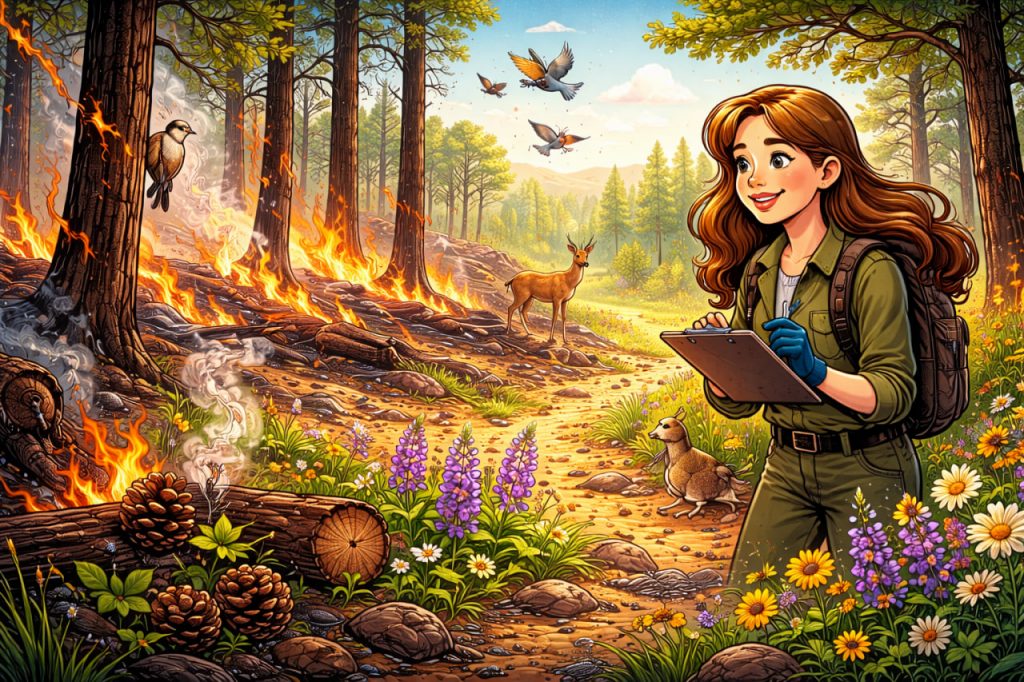
Forest fires are often perceived only as destructive events that threaten wildlife, forests, and human settlements. However, from an ecological perspective, fire has long been a natural force shaping many ecosystems across the planet. Long before human activity influenced landscapes, lightning-caused fires periodically burned forests, grasslands, and savannas. Over time, plants and animals adapted to these cycles, making fire an integral part of ecological renewal. In such systems, fire does not signal collapse but transition and regeneration. Understanding this natural role is essential for distinguishing healthy fire processes from destructive, human-driven wildfires.
Fire as a Natural Ecological Regulator
In many ecosystems, fire functions as a regulating mechanism that maintains balance between species. Low-intensity fires remove accumulated dead vegetation, fallen branches, and dry undergrowth that would otherwise suppress new growth. By clearing this material, fire reduces competition for sunlight, water, and nutrients. This process prevents a small number of aggressive plant species from dominating the landscape. Ecologists describe fire as a natural “reset button” that restores ecological diversity. According to fire ecologist Dr. Alan Morrison:
“In fire-adapted ecosystems, burning is not destruction.
It is one of the processes that allows life to restart, diversify, and persist.”
Without periodic fire, these ecosystems can become unstable and more vulnerable to extreme disturbances.
Fire-Adapted Plants and Evolutionary Strategies
Many plant species have evolved remarkable adaptations that allow them to survive fire or even rely on it for reproduction. Some trees develop thick, fire-resistant bark that protects vital tissues from heat. Other species store seeds in cones or fruits that open only after exposure to high temperatures. In certain ecosystems, smoke itself triggers seed germination by breaking chemical dormancy. These strategies ensure rapid regrowth after a fire, often resulting in dense, healthy vegetation within a short time. Rather than eliminating plant life, natural fires frequently stimulate renewal and succession.
Fire and Biodiversity Enhancement
Natural fires can increase biodiversity by creating a patchwork of habitats at different stages of recovery. Burned areas allow sunlight to reach the soil, encouraging grasses, flowers, and pioneer species to grow. These plants attract insects, which in turn support birds, reptiles, and mammals. Unburned patches act as refuges for animals during fires, enabling populations to recover quickly. This mosaic structure supports a wider range of species than a uniform, unburned forest. In fire-dependent ecosystems, long periods without fire can actually reduce biodiversity by allowing dense, shaded conditions to dominate.
Soil Health and Nutrient Cycling
Fire plays a significant role in nutrient recycling within ecosystems. When plant material burns, nutrients such as phosphorus, potassium, and calcium are released into the soil in forms that plants can readily absorb. Ash can temporarily improve soil fertility and support early plant growth. Fire also reduces pests and pathogens that accumulate in leaf litter. While extremely intense fires can damage soil structure, naturally occurring fires usually enhance long-term soil productivity. The ecological outcome depends on fire intensity, frequency, and ecosystem type.
Natural Fires vs. Human-Driven Wildfires
It is crucial to distinguish natural fire cycles from modern, destructive wildfires intensified by human activity. Climate change, land-use change, and decades of fire suppression have disrupted natural fire regimes in many regions. When fire is excluded for too long, fuel builds up, leading to larger and more dangerous fires. As a result, many scientists now support controlled burns and adaptive fire management to restore natural processes. Allowing ecosystems to experience appropriate fire cycles can reduce the risk of catastrophic events while maintaining ecological health.
Interesting Facts
- Some plant species release seeds only after exposure to fire.
- Many ecosystems evolved with natural fire cycles of 5–50 years.
- Fire can increase plant diversity by preventing one species from dominating.
- Ash from natural fires can temporarily enrich soil nutrients.
- Suppressing all fires often leads to more severe wildfires later.
Glossary
- Wildfire — an uncontrolled fire occurring in natural vegetation.
- Fire Regime — the natural pattern of fire frequency and intensity in an ecosystem.
- Fire-Adapted Species — plants or animals with traits that allow survival after fires.
- Nutrient Cycling — the movement and reuse of nutrients within ecosystems.
- Controlled Burn — a planned fire used to maintain ecosystem balance and reduce fuel.