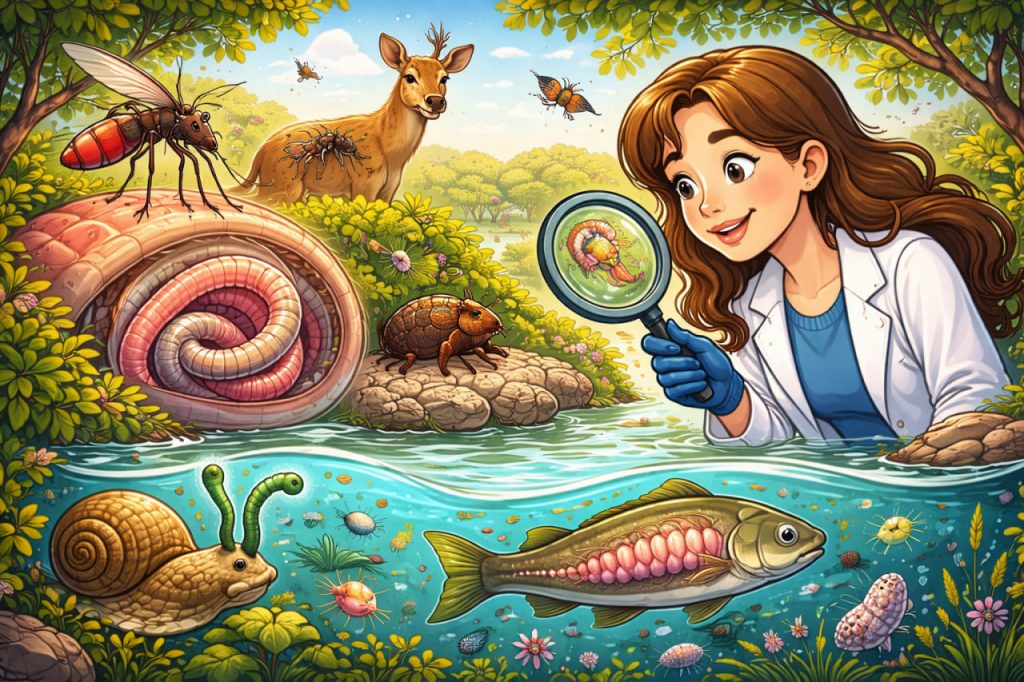
Parasites are among the most misunderstood forms of life on Earth, often associated only with disease and discomfort. In reality, parasites are a natural and ancient part of ecosystems, evolving alongside their hosts for millions of years. They exist in almost every environment, from oceans and forests to the human body, and influence the survival, behavior, and evolution of countless species. Although parasites depend on other organisms for resources, their role extends far beyond simple harm. By regulating populations and driving natural selection, parasites actively shape biodiversity and ecological balance. Understanding parasites allows us to see them not only as threats, but as powerful biological forces.
What Is a Parasite and How It Lives
A parasite is an organism that lives on or inside another organism, known as the host, and derives nutrients or shelter at the host’s expense. Parasites range in size from microscopic protozoa to large worms visible to the naked eye. Some parasites spend their entire life cycle within a single host, while others require multiple hosts to complete their development. This complex life strategy allows parasites to survive in changing environments and spread efficiently. According to evolutionary biologist Dr. Marcus Levin:
“Parasites are masters of adaptation.
Their survival depends on precise timing, biological stealth, and evolutionary innovation.”
Their success lies in their ability to exploit biological systems without immediately killing the host, ensuring long-term survival.
Types of Parasites in Nature
Parasites can be broadly classified into several groups based on their biology and lifestyle. Endoparasites live inside the host’s body, often in organs such as the intestines, blood, or tissues. Ectoparasites, such as ticks and lice, live on the surface of the host and feed externally. Some parasites are highly specialized, infecting only one species, while others can switch between hosts. There are also temporary parasites, which interact with the host only during feeding, and obligate parasites, which cannot survive without a host. This diversity makes parasites one of the most widespread life strategies on the planet.
Parasites and Host Behavior
One of the most fascinating aspects of parasitism is the ability of some parasites to alter host behavior. Certain parasites manipulate the nervous system or hormonal balance of their hosts to increase their own chances of reproduction. For example, some parasites cause insects to become less fearful of predators, making them easier targets. Others influence feeding habits or movement patterns. These behavioral changes demonstrate that parasites do not merely consume resources but can actively reshape the biology of their hosts. Scientists study these interactions to better understand brain function, immunity, and evolutionary pressure.
The Ecological Role of Parasites
Despite their negative reputation, parasites play a crucial role in maintaining ecosystem stability. By weakening dominant species, parasites prevent overpopulation and allow weaker species to survive. They contribute to food web complexity and influence species diversity. In aquatic ecosystems, parasites regulate fish populations, while in terrestrial environments they affect mammals, birds, and insects. Ecologists increasingly recognize parasites as essential components of healthy ecosystems rather than simple agents of disease. Removing parasites entirely could disrupt natural balance in unpredictable ways.
Parasites and Human Health
Parasites also have significant implications for human health. Some cause serious diseases, while others coexist with humans with minimal symptoms. Advances in medicine, sanitation, and public health have reduced the impact of many parasitic infections, but they remain a global challenge in many regions. At the same time, research into parasites has led to unexpected medical insights. Some parasitic molecules are being studied for their ability to regulate immune responses, potentially helping treat autoimmune disorders. This highlights the complex relationship between humans and parasites—one that involves both risk and discovery.
Interesting Facts
- Parasites make up nearly half of all known species when parasites of parasites are included.
- Some parasites can control host behavior with remarkable precision.
- Certain parasites have life cycles involving three or more different species.
- Fossil evidence suggests parasites existed over 500 million years ago.
- Not all parasites cause disease; many exist in a delicate balance with their hosts.
Glossary
- Parasite — an organism that lives on or inside a host and benefits at the host’s expense.
- Host — an organism that provides resources or shelter to a parasite.
- Endoparasite — a parasite that lives inside the host’s body.
- Ectoparasite — a parasite that lives on the surface of the host.
- Life Cycle — the series of developmental stages a parasite passes through.