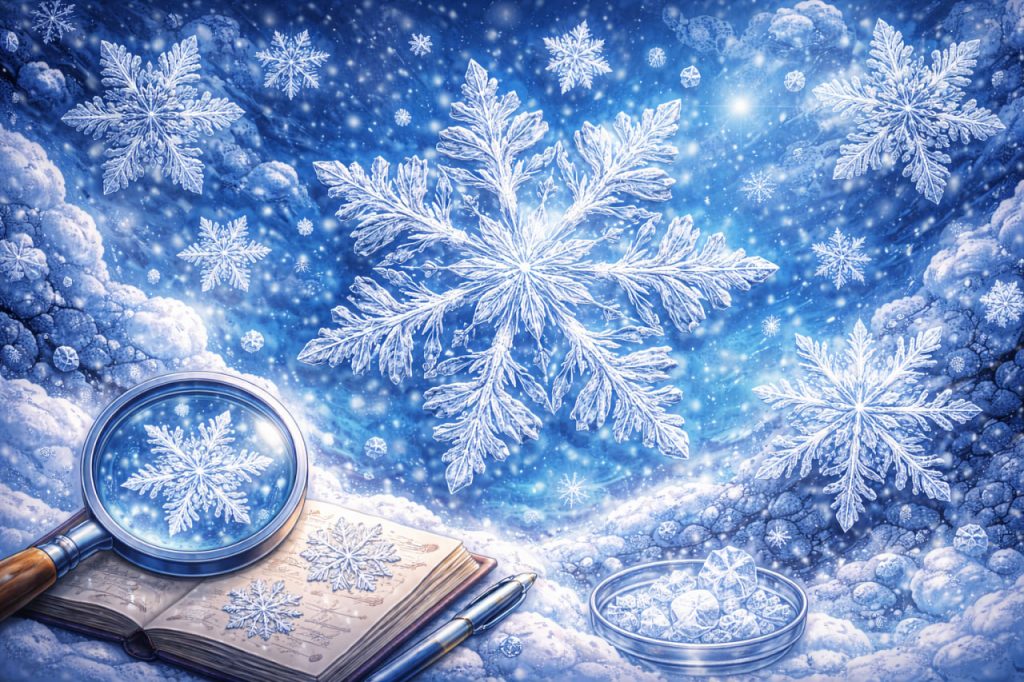
At first glance, a snowflake appears delicate and fleeting, but behind its beauty lies a remarkable example of natural geometry. Every snowflake is built according to strict physical and mathematical rules, forming intricate patterns that repeat with stunning precision. While no two snowflakes are exactly the same, they all share a common structural logic rooted in molecular physics. Snowflakes demonstrate how order can emerge from chaos, guided by temperature, humidity, and the geometry of water molecules. Studying snowflake geometry allows scientists to connect crystallography, thermodynamics, and mathematics into a single natural phenomenon.
Why Snowflakes Have Sixfold Symmetry
The defining feature of a snowflake is its sixfold symmetry, meaning it has six identical arms radiating from a central point. This symmetry originates from the molecular structure of water. When water freezes, its molecules arrange themselves into a hexagonal crystal lattice, minimizing energy while maintaining stable hydrogen bonds. As the crystal grows, this hexagonal structure repeats outward, forcing the snowflake to expand evenly in six directions. According to physicist Dr. Alan Brewer:
“Snowflake symmetry is not random decoration.
It is a direct consequence of how water molecules lock together.”
This molecular rule applies universally, whether a snowflake forms in a quiet cloud or a turbulent storm.
Branching Patterns and Fractals
As a snowflake falls through the atmosphere, it passes through layers of air with different temperatures and humidity levels. These changing conditions influence how fast ice grows along each arm, creating branching patterns that often resemble fractals. Small changes early in growth are amplified over time, producing complex, tree-like structures. Despite their apparent randomness, these branches obey strict geometric constraints imposed by crystal physics. The result is a balance between symmetry and variation, where each arm mirrors the others while developing fine, unique details.
The Role of Temperature and Humidity
Different atmospheric conditions produce different snowflake shapes. At certain temperatures, thin plates form; at others, long needles or hollow columns appear. Higher humidity encourages elaborate branching, while lower humidity leads to simpler forms. Scientists classify snowflakes into categories based on these growth conditions, revealing a predictable relationship between environment and geometry. A slight change of just one or two degrees can completely alter a snowflake’s final structure. This sensitivity makes snowflakes valuable indicators of atmospheric processes inside clouds.
Mathematical Beauty in Natural Crystals
Snowflakes are often cited as natural examples of geometric optimization, where physical laws produce efficient and repeating patterns. Their symmetry reflects principles found in group theory, lattice geometry, and crystallography. Although humans may perceive snowflakes as artistic, their structure is purely functional at the atomic level. Mathematics does not decorate snowflakes—it defines them. This realization bridges the gap between abstract mathematical theory and tangible natural beauty.
Why No Two Snowflakes Are Identical
While snowflakes share the same geometric rules, no two follow the exact same growth path. Each snowflake experiences a unique journey through the atmosphere, encountering slightly different conditions at every moment. These tiny variations accumulate, ensuring individuality within a universal framework. The idea that snowflakes are “all different” does not contradict their symmetry; instead, it highlights how complexity emerges from simple rules. Snowflakes thus become a powerful symbol of diversity built upon fundamental order.
Interesting Facts
- All natural snowflakes exhibit sixfold symmetry, never five or eight.
- Snowflake arms grow simultaneously and influence each other’s shape.
- The largest recorded snowflake was reportedly over 38 cm wide.
- Snowflake geometry changes continuously during descent through a cloud.
- Artificial snow crystals follow the same geometric rules as natural ones.
Glossary
- Hexagonal Symmetry — sixfold rotational symmetry based on a hexagon.
- Crystal Lattice — a repeating atomic structure forming a solid.
- Fractal — a pattern that repeats similar shapes at different scales.
- Crystallography — the scientific study of crystal structures.
- Hydrogen Bond — a weak bond that plays a key role in water’s structure.