Lake Baikal is far more than a natural landmark of Siberia; it is one of the most important freshwater ecosystems on Earth. Often called the “Galápagos of freshwater,” Baikal plays a critical role in global biodiversity, climate regulation, and the planet’s freshwater balance. It contains a unique combination of extreme depth, age, and biological richness that has no equivalent anywhere else in the world. Scientists consider Baikal a living archive of Earth’s environmental history, preserving information about climate and life over millions of years. Protecting this lake is not only a regional responsibility but a global priority, as changes within Baikal can reflect and influence planetary-scale processes. Understanding why Baikal matters helps explain why freshwater ecosystems are essential to Earth’s long-term stability.
The World’s Deepest and Oldest Freshwater Lake
Lake Baikal is the deepest freshwater lake on the planet, reaching depths of more than 1,600 meters, and it is also the oldest, estimated to be over 25 million years old. This extraordinary age has allowed life within the lake to evolve in isolation, leading to a remarkable level of endemism. About two-thirds of Baikal’s species are found nowhere else on Earth. The lake contains roughly 20% of the world’s unfrozen freshwater reserves, making it a critical component of the global water system. According to limnologist Dr. Alexei Petrov:
“Baikal is not just a lake —
it is a planetary-scale reservoir that stabilizes freshwater systems far beyond its shores.”
Its sheer volume and depth also allow Baikal to buffer environmental changes more effectively than smaller lakes.
A Unique and Fragile Ecosystem
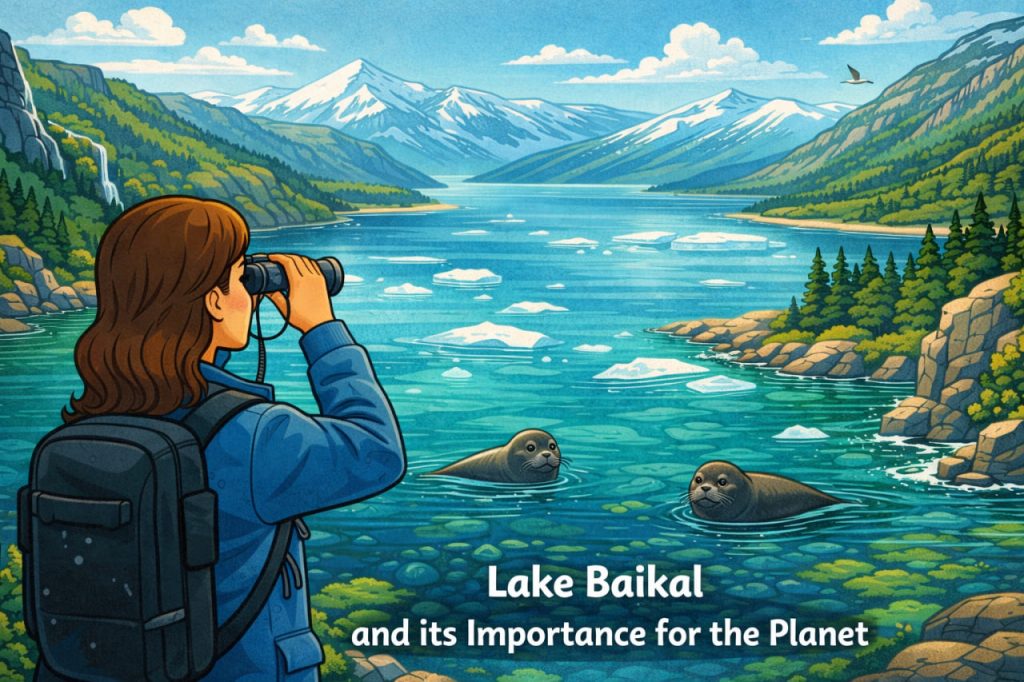
Baikal’s ecosystem is unlike any other freshwater environment, hosting thousands of species adapted to its cold, oxygen-rich waters. One of its most famous inhabitants is the Baikal seal (nerpa), the only freshwater seal species in the world. Microscopic organisms, such as endemic plankton, play a crucial role in filtering the water, giving Baikal its legendary clarity. These organisms form the foundation of a complex food web that supports fish, invertebrates, and mammals. However, this balance is extremely delicate. Pollution, invasive species, and warming temperatures threaten organisms that evolved under very stable conditions. Even small disruptions can cascade through the ecosystem, altering water quality and biodiversity.
Baikal’s Role in Climate Regulation
Lake Baikal influences regional and global climate processes through its vast thermal capacity. Because of its depth and volume, the lake absorbs heat in summer and releases it slowly in winter, moderating temperature extremes in surrounding regions. This stabilizing effect impacts atmospheric circulation and local weather patterns across Siberia. In addition, Baikal’s sediments preserve long-term climate records, allowing scientists to reconstruct past temperature shifts, precipitation patterns, and ecosystem responses. These records help improve climate models and refine predictions about future environmental change. Baikal thus functions as both a climate regulator and a climate archive for the planet.
Human Impact and Environmental Pressures
Despite its remote location, Lake Baikal is increasingly affected by human activity. Industrial pollution, untreated wastewater, tourism pressure, and shoreline development introduce harmful substances into the lake. Climate change compounds these problems by warming surface waters and altering ice cover duration. Algal blooms, once rare, have become more frequent in some coastal areas, signaling nutrient imbalance. Environmental scientist Dr. Marina Volkova warns:
“Baikal’s resilience has limits.
Once crossed, recovery could take centuries.”
Balancing economic development with conservation remains one of the greatest challenges facing the region.
Why Baikal Matters to the Entire Planet
Lake Baikal’s importance extends far beyond Russia’s borders. Its freshwater reserves represent a critical buffer against future global water scarcity. The lake’s biodiversity offers insights into evolution, adaptation, and ecosystem resilience. Scientific research conducted at Baikal contributes to global understanding of freshwater conservation, climate feedbacks, and long-term environmental stability. Protecting Baikal is therefore not only about preserving a natural wonder, but about safeguarding a system that supports planetary health. The fate of Baikal reflects how humanity treats Earth’s most irreplaceable natural resources.
Interesting Facts
- Lake Baikal holds around one-fifth of the world’s liquid freshwater.
- Its water is so clear that objects can be seen at depths of up to 40 meters.
- Baikal contains more than 3,600 known species, most of them endemic.
- The lake’s ice can reach over one meter thick while remaining transparent.
- Baikal continues to widen slowly because it lies on an active continental rift.
Glossary
- Endemic Species — organisms found only in a specific geographic location.
- Limnology — the scientific study of inland water bodies such as lakes and rivers.
- Rift Zone — a region where Earth’s crust is slowly pulling apart.
- Freshwater Reservoir — a natural storage system for liquid freshwater.
- Climate Archive — natural records that preserve information about past climate conditions.